How to Train Your Mouth for Fluent English
TL;DR
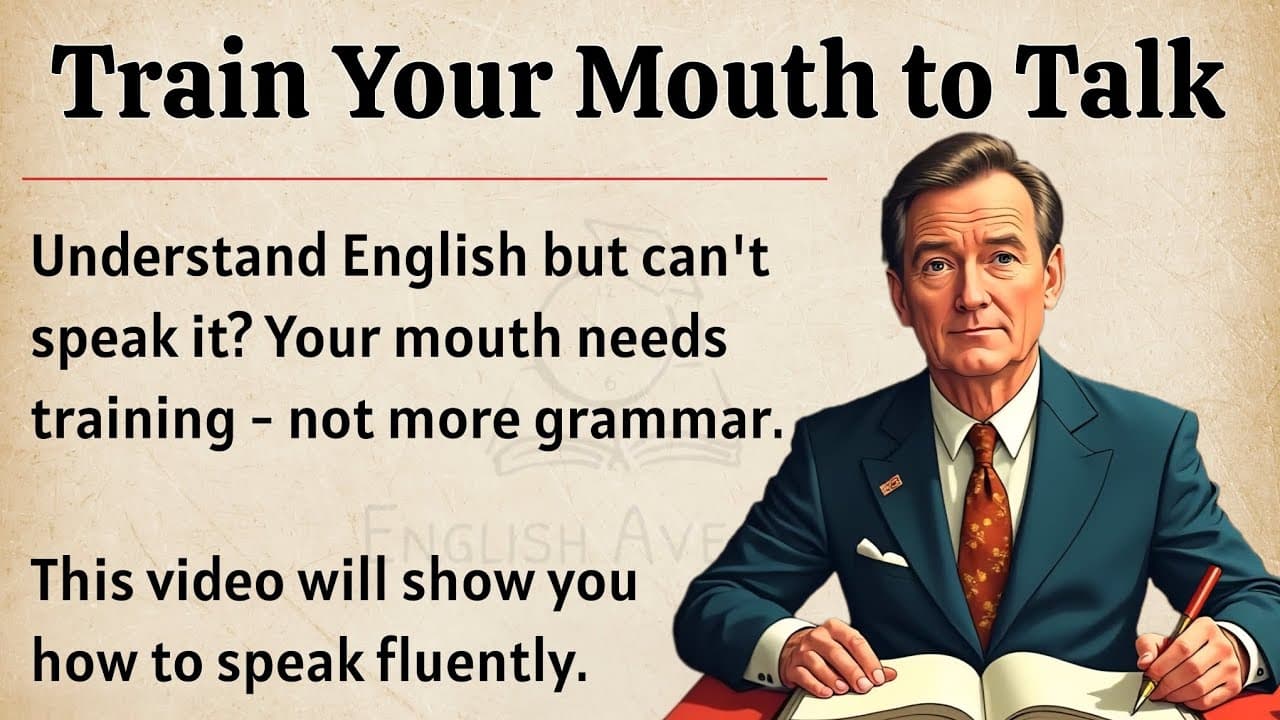
To speak English fluently, focus on training your mouth muscles, not just learning grammar. Daily 5-minute exercises can transform your speaking ability by building muscle memory and confidence. Practice includes mouth warm-ups, mirror techniques, shadow speaking, and fluency loops, fostering natural speech flow and emotional expression.
Transcript
Welcome everyone. In today's video, we're not just going to talk about English. We're going to transform the way you speak it. We're going to fix something no one ever told you about. And by the end of this video, I promise you'll look in the mirror and say, "Yes, now I can speak. I finally understand how to train my mouth to talk." So, listen till... Read More
Key Insights
- Fluency in English is not just mental; it's also physical, involving lips, tongue, and jaw movements.
- Training your mouth muscles is crucial for overcoming the freeze many experience when speaking English.
- A daily 5-minute practice routine can significantly improve your spoken English.
- The routine includes mouth warm-ups, mirror techniques, shadow speaking, and fluency loops.
- Sound clusters and flow are essential for natural and confident speech, not just perfect grammar.
- Combining emotion, voice, and movement enhances the brain-mouth connection, boosting confidence.
- Repetition should focus on quality, incorporating clarity, flow, emotion, and real-world usage.
- Consistent practice and overcoming fear of mistakes are key to achieving fluency.
Install to Summarize YouTube Videos and Get Transcripts
Explore YouTube Video Summarizer or Get YouTube Transcript Extractor
Questions & Answers
Q: How to train your mouth for English fluency?
Train your mouth by focusing on daily exercises that target the physical aspects of speaking. This includes warming up your mouth muscles, practicing in front of a mirror, shadow speaking, and using fluency loops. These exercises help build muscle memory, improve pronunciation, and boost confidence, essential for fluent speech.
Q: Why is mouth training important for English speaking?
Mouth training is crucial because English requires different muscle movements than your native language. Without training, you may struggle with pronunciation and fluency, leading to a lack of confidence. Proper mouth training helps you speak more naturally, smoothly, and confidently by building the necessary muscle memory.
Q: What is the 5-minute daily practice routine?
The 5-minute daily practice routine involves four steps: mouth warm-ups, mirror technique, shadow speaking, and fluency loops. Each step is designed to target specific aspects of speech, such as muscle activation, self-awareness, fluency rhythm, and speed. Consistent practice can significantly improve your spoken English.
Q: How do sound clusters improve fluency?
Sound clusters improve fluency by encouraging the natural flow of speech. Instead of speaking word by word, sound clusters help you link words together, mimicking the rhythm and flow of native speakers. This technique makes your speech sound more natural and confident, even if your grammar isn't perfect.
Q: What role does emotion play in speaking English?
Emotion plays a significant role in speaking English as it enhances communication and engagement. Speaking with emotion helps convey meaning beyond words, making your speech more relatable and memorable. Practicing with varying emotions can also boost confidence and reduce fear of judgment, essential for fluency.
Q: How can repetition be used effectively in language learning?
Effective repetition involves focusing on quality rather than quantity. This means practicing sentences with clarity, flow, emotion, and real-world context. By repeating sentences in different ways, such as slow clarity, emotional expression, and fast-paced drills, you build fluency, sound memory, and confidence.
Q: Why do many learners struggle to speak despite understanding English?
Many learners struggle to speak because they focus on passive learning, such as watching videos and reading, without actively practicing speaking. Without training the mouth and building muscle memory, learners may freeze when speaking. Active practice and overcoming fear of mistakes are crucial for fluency.
Q: What is the importance of combining brain and mouth training?
Combining brain and mouth training is important because it ensures that your thoughts and speech are aligned. This approach reduces overthinking and self-doubt, which can hinder fluency. By training both the brain and mouth, you develop a natural, confident speaking style that feels authentic and expressive.
Summary & Key Takeaways
-
Fluency in English requires training your mouth muscles, not just learning grammar rules. Daily exercises can help build the necessary muscle memory for smooth and confident speech. This involves practicing sound clusters, emotional expression, and using techniques like shadow speaking and mirror drills.
-
The video emphasizes the importance of a 5-minute daily routine to improve spoken English. This routine includes mouth warm-ups, mirror techniques, shadow speaking, and fluency loops to help learners speak more naturally and confidently.
-
Repetition with quality and emotion is crucial for fluency. Practicing with sound clusters and using real-world contexts can help transform speaking ability. Overcoming fear of mistakes and consistent practice are vital for becoming a fluent English speaker.
Read in Other Languages (beta)
Share This Summary 📚
Summarize YouTube Videos and Get Video Transcripts with 1-Click
Try YouTube Summary with ChatGPT & Claude or YouTube Transcript Generator
Explore More Summaries from English Avenue 📚






Summarize YouTube Videos and Get Video Transcripts with 1-Click
Try YouTube Summary with ChatGPT & Claude or YouTube Transcript Generator