How Can You Stop Wasting Your Life and Take Action? | Learn English Through Motivation, Graded Reader & Listening Practice
TL;DR
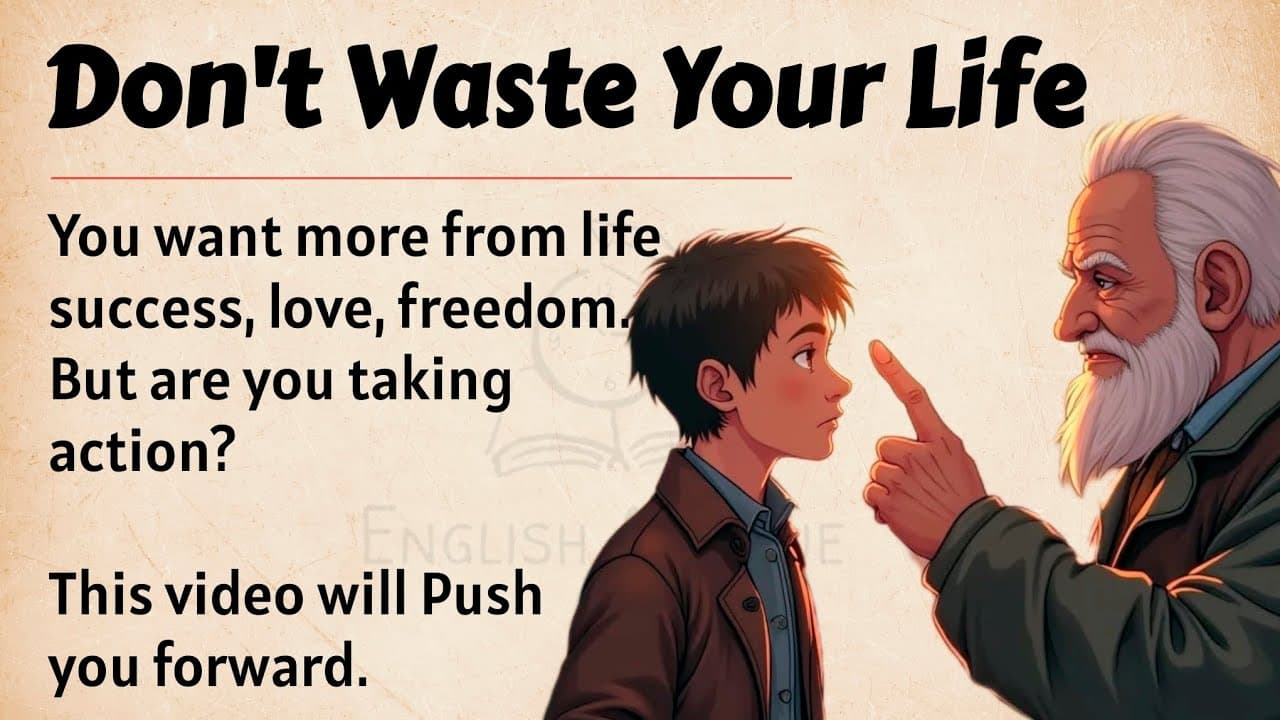
You can stop wasting your life by valuing each hour, making a daily plan, and taking one useful action now instead of waiting to feel ready. Cut one hour of social media, assign it to reading or English practice, and do something uncomfortable every day. The graded-reader-style motivational lesson also turns listening, speaking, and repetition into active English practice. Read on for concrete ways to replace excuses with progress.
Transcript
welcome everyone today I want you to stop whatever you're doing sit down close your eyes for a moment take a deep breath and ask yourself this simple question am I really living or am I just existing everyone wants to travel the world they want their dream car they want freedom money a peaceful mind love respect happiness a business they can call t... Read More
Key Insights
- Time is part of a person’s limited life, not an empty resource that can be casually killed. Each delayed task, unnecessary hour of scrolling, or repeated alarm snooze removes time that could have supported learning, relationships, health, work, or personal growth.
- A daily plan is a practical way to respect time. Writing down priorities, choosing one activity that moves life forward, and cutting one hour of social media creates a simple structure for replacing passive consumption with reading, learning, practice, or productive work.
- Personal responsibility is the foundation for changing difficult circumstances. Family, education, money, support, talent, and other limitations may shape a person’s story, but progress begins by identifying problems, writing one possible solution for each, and taking whatever small action is available.
- The comfort zone is a barrier to growth because meaningful improvement requires discomfort. English learners must speak despite mistakes, aspiring business owners must risk failure, and job seekers must apply despite uncertainty. Repeated exposure to discomfort turns fear into experience and forward movement.
- Procrastination works by disguising avoidance as a future intention. Saying a task will happen later often allows laziness or fear to postpone it indefinitely. Setting a 10-minute timer and beginning immediately makes one imperfect action more valuable than many polished plans that remain unexecuted.
- Overthinking becomes a cage when preparation replaces practice. Watching lessons, taking notes, buying equipment, or planning routines cannot produce the skill that direct participation develops. English improves through speaking, writing, listening, recording the voice, and making mistakes, not through observation alone.
- Discipline is demonstrated through behavior that continues without outside approval. Waking early, studying while others relax, speaking despite fear, and continuing when others quit allow results to replace announcements. The disciplined person supports personal goals even when friends or family express doubt.
- The central struggle is between competing versions of the same person. Daily choices feed either lazy, fearful habits or ambitious, confident habits. Tracking moments of growth and celebrating victories over weaker patterns can gradually change identity and make disciplined action more consistent.
Install to Summarize YouTube Videos and Get Transcripts
Explore YouTube Video Summarizer or Get YouTube Transcript Extractor
Questions & Answers
Q: How can I stop wasting time and start taking action?
Write a daily plan and focus on one task that will move your life forward. Cut one hour of social media each day and use it to read, learn, practice English, or grow. Begin immediately, even when you do not feel ready.
Q: Why does the lesson say that time is your life?
The lesson argues that every hour spent scrolling, watching random videos, or repeatedly hitting snooze consumes part of a limited life. Time continues moving while people get older and their dreams remain unfinished. Respecting your hours means using them for deliberate progress.
Q: How can I take responsibility for changing my life?
Accept your circumstances without remaining a victim of them. Write your problems on paper, add one possible solution for each, and take action no matter how small. The lesson recommends repeating, “I’m responsible for my life,” to focus attention on what you can build.
Q: How do I escape my comfort zone?
Do one constructive but uncomfortable thing every day. Speak English despite mistakes, join a class, apply for a job, post a video, or start a business even when failure is possible. The lesson presents discomfort as necessary for growth.
Q: Why is saying “I’ll do it later” dangerous?
The lesson describes “I’ll do it later” as the voice of laziness, fear, and the weaker self. Repeating it turns a future intention into ongoing avoidance. People who make progress act now, even before they feel prepared.
Q: How can this motivational lesson help me practice English?
Listen actively and use the lesson’s language instead of only watching passively. The existing guidance recommends using subtitles, repeating phrases aloud, speaking in front of a mirror, recording your voice, and writing regularly. Mistakes are treated as part of the practice rather than a reason to remain silent.
Q: What should I do if fear or overthinking keeps me from starting?
Move from preparation into a small practical action before confidence arrives. Speak, write, listen, record your voice, exercise, apply for the job, or begin the project. Direct participation builds experience and momentum that planning alone cannot provide.
Q: What does “you versus you” mean in this lesson?
It describes a daily contest between passive habits and ambitious ones. Scrolling, doubt, and quitting strengthen the weaker pattern, while reading, practicing, building, and persisting strengthen the confident one. Tracking your choices helps reveal which version your behavior is supporting.
Summary & Key Takeaways
-
Time is presented as life itself, so wasting hours means losing opportunities that cannot be recovered. The practical response is to write a daily plan, identify one task that moves life forward, and replace one hour of social media with reading, learning, English practice, or another useful activity.
-
Personal responsibility begins when people accept their circumstances without treating themselves as permanent victims. Writing down each problem, adding one possible solution, and taking a small action shifts attention from blame to building. The message argues that results come from using available power rather than repeatedly explaining limitations.
-
Growth requires leaving the comfort zone, starting before feeling ready, and acting more than thinking. Speaking English despite mistakes, applying for a job, exercising, or beginning a project builds momentum. Tracking daily choices reinforces a disciplined identity by showing whether the ambitious self or the passive self is winning.
Read in Other Languages (beta)
Share This Summary 📚
Summarize YouTube Videos and Get Video Transcripts with 1-Click
Try YouTube Summary with ChatGPT & Claude or YouTube Transcript Generator
Explore More Summaries from English Avenue 📚




Summarize YouTube Videos and Get Video Transcripts with 1-Click
Try YouTube Summary with ChatGPT & Claude or YouTube Transcript Generator