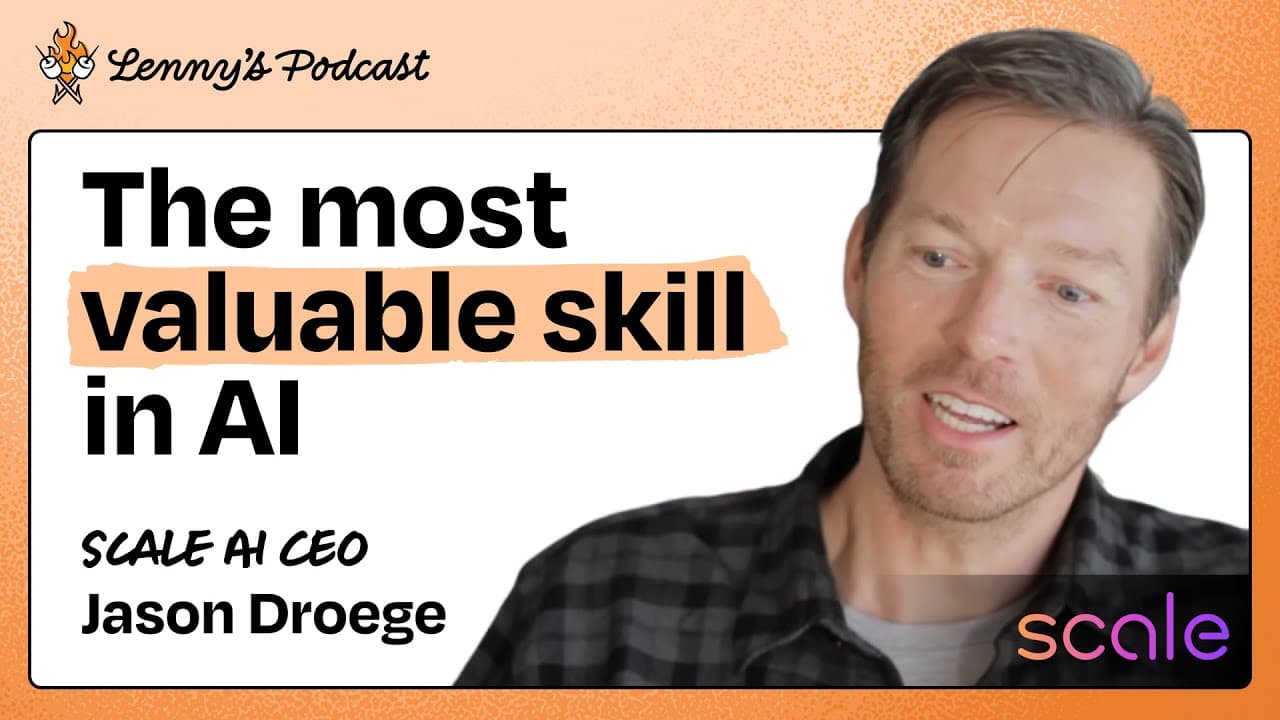
Jason Droege on Scaling AI and New Businesses
TL;DR
AI models are shifting from knowing information to performing tasks, but reliable enterprise automation can require six to 12 months of practical implementation. Scale AI supports that transition with increasingly complex training and evaluation work performed by professionals, while Jason Droege’s experiences at Scour and Uber Eats illustrate the value of negotiation, independent insight, urgent customer problems, and close operational investigation.
Transcript
There's been a lot of talk these days about AI not delivering on the promise that we hear especially at enterprises. These things take six to 12 months to get them truly robust enough where an important process can be automated. Like with any of these major tech revolutions, headlines tell one story and then on the ground laying broadband means you... Read More
Key Insights
- Enterprise AI automation is an infrastructure project that commonly takes six to 12 months to become robust enough for an important process. Headlines can obscure the detailed implementation work, much like broadband deployment requires roads to be excavated and undersea cables to be installed.
- AI models are moving from knowing things to doing things. As factual capabilities improve, the central product question becomes what a model can accomplish for a user and how an agent can make appropriate decisions on that user’s behalf.
- Scale AI’s training work is becoming longer and more specialized. Tasks that once involved choosing between two short stories can now require hours from PhDs or professionals who build complete websites, debug code, or explain nuanced cancer topics.
- Human experts are still important to model improvement because they demonstrate strong performance, identify knowledge gaps, and correct flawed understanding. Their contribution gives frontier models examples of what good work looks like across domains used by consumers.
- Enterprise data is often not immediately useful for improving AI models. The discussion frames reliable AI systems as requiring careful preparation, expert feedback, evaluations, and sustained operational work rather than expecting raw organizational information to produce dependable automation automatically.
- A strong entrepreneurial opportunity begins with a distinctive insight and a credible explanation for possessing it. Founders should ask why they are unusually positioned to notice something that many other intelligent and motivated entrepreneurs have not already recognized.
- Business arrangements are negotiable when participants can imagine a workable outcome, establish leverage, and align incentives. Droege learned this while Scour’s financing terms changed repeatedly, challenging his assumption that fundraising and company-building followed a single accepted procedure.
- Urgent daily problems can provide stronger foundations for products than highly valuable but occasional problems. Droege’s experience building transformative technology businesses also emphasizes direct operational investigation, including examining restaurant economics at the level of individual sandwich ingredients.
Install to Summarize YouTube Videos and Get Transcripts
Explore YouTube Video Summarizer or Get YouTube Transcript Extractor
Questions & Answers
Q: How long can enterprise AI automation take to implement?
An important enterprise process can take six to 12 months to automate robustly with AI. The delay reflects practical implementation work rather than a simple failure of the underlying models. Organizations must prepare their systems, improve reliability, conduct evaluations, and address operational details before automation is dependable enough to support a consequential business process.
Q: How are AI models expected to change over the next two years?
The stated direction is a transition from models that know things to models that do things. Users will increasingly judge a system by what it can accomplish for them, not only by the information it can provide. This shift also raises a central design question: how an agent should make decisions appropriately on a user’s behalf.
Q: Why do AI models still need human experts?
Human experts help models by filling gaps in their knowledge, correcting misunderstandings, and demonstrating what excellent work looks like in specialized domains. Scale AI’s assignments can involve PhDs, doctors, software engineers, web developers, and other professionals. Their work supports both training and evaluation as frontier systems attempt increasingly complex, practical tasks.
Q: How has AI data labeling changed since Scale AI entered the market?
AI data work has progressed far beyond short comparisons in which a contributor selects the better of two stories. A current assignment may require hours of expert effort, such as constructing an entire website at a high professional standard, debugging code, or giving a model a nuanced explanation about cancer. Training work has therefore become substantially more complex and specialized.
Q: What did Jason Droege learn from co-founding Scour?
Droege learned that everything in business is negotiable. During Scour’s financing process, proposed terms changed repeatedly, including how much ownership investors wanted. The experience showed him that there is no single fixed procedure for building companies. Outcomes can become possible when people imagine an arrangement, negotiate effectively, and align their incentives.
Q: What happened when the entertainment industry sued Scour?
Associations representing the entertainment industry sued Scour for a quarter of a trillion dollars over a product used to find free multimedia content. The case ultimately settled for one million dollars. Droege interpreted the enormous original demand as an effort to force the young company into bankruptcy and remove it from the market.
Q: What makes an entrepreneurial insight worth pursuing?
A promising entrepreneurial starting point is an insight that others are unlikely to possess, combined with a convincing reason the founder is particularly positioned to recognize it. Droege recommends asking why, among a million intelligent entrepreneurs testing ideas, you are unusually likely to understand the opportunity. That question challenges founders to think independently rather than follow general enthusiasm.
Q: What product lessons came from building Uber Eats?
Droege’s Uber Eats experience supports investigating economics and operations at a very detailed level, including weighing sandwich ingredients to understand restaurant economics. The broader lesson is to study how a business actually functions, identify urgent recurring problems, and develop an independent insight. Uber Eats grew from an internal idea into a multibillion-dollar business and helped Uber during the pandemic.
Summary & Key Takeaways
-
AI development is progressing from models that answer questions toward agents that perform work and make decisions. Scale AI contributes training data and evaluations, with assignments evolving from simple comparisons between short stories to hours-long projects such as building websites, debugging code, and explaining nuanced cancer topics with professional expertise.
-
Jason Droege’s early experience co-founding Scour with Travis Kalanick taught him that business conventions are negotiable. Financing terms repeatedly changed, and the company was later sued for a quarter of a trillion dollars before settling for one million dollars, demonstrating how incentives, leverage, and institutional power shape commercial outcomes.
-
Droege later launched and led Uber Eats from an internal idea into a multibillion-dollar business that helped Uber during the pandemic. His broader product philosophy emphasizes finding a distinctive insight, understanding why the founder is positioned to see it, investigating operational details directly, and favoring urgent daily problems over valuable but occasional ones.
Read in Other Languages (beta)
Share This Summary 📚
Summarize YouTube Videos and Get Video Transcripts with 1-Click
Try YouTube Summary with ChatGPT & Claude or YouTube Transcript Generator
Explore More Summaries from Lenny's Podcast 📚





Summarize YouTube Videos and Get Video Transcripts with 1-Click
Try YouTube Summary with ChatGPT & Claude or YouTube Transcript Generator