How to start deep learning with Python for beginners
TL;DR
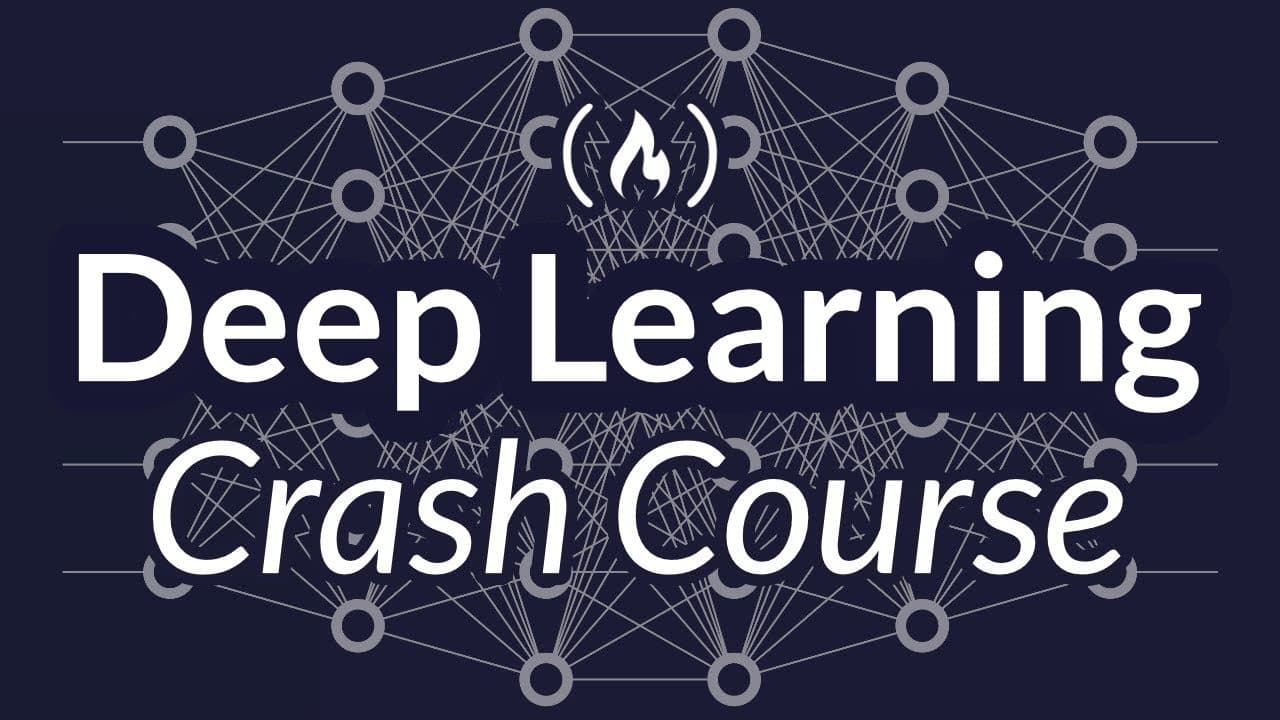
Deep learning is a subset of machine learning that learns representations from data through neural networks. The course covers what deep learning is, how neural networks learn through forward and back propagation, and the core terms, architectures, and learning types. It also introduces activation and loss functions, optimizers, and the learning process.
Transcript
you've probably read in the news that deep learning is the secret recipe behind many exciting developments and has made many of our world's dreams and perhaps also nightmares come true who would have thought that deep minds alphago could be at least a doll in a boat game which boasts in more possible moves than there are atoms in the entire univers... Read More
Key Insights
- Deep learning learns features directly from data using neural networks that have hidden layers and non linear activation functions.
- The training process relies on forward propagation to generate outputs and back propagation to adjust weights using a loss function.
- Back propagation uses the loss to guide adjustments of weights and biases to improve accuracy over iterations.
- Neural networks are built from input, hidden, and output layers with weights and biases that shape the final prediction.
- Activation functions determine whether a neuron contributes to the next layer by introducing non linearly.
- Loss functions quantify the deviation of predictions from targets and drive learning through optimization.
- Optimizers and the gradient descent family are used to minimize loss and update parameters.
- Common learning types include supervised, unsupervised, and reinforcement learning, each with distinct goals and data use cases.
- Key architectures discussed include fully connected feedforward nets, recurrent nets, and convolutional nets.
- More videos from this channel:
- More from this channel: freeCodeCamp.org
Install to Summarize YouTube Videos and Get Transcripts
Explore YouTube Video Summarizer or Get YouTube Transcript Extractor
Questions & Answers
Q: What is deep learning and how does it relate to AI and machine learning
Deep learning is a subset of machine learning that learns representations directly from data using neural networks with hidden layers. It sits inside artificial intelligence as a specialized approach, enabling machines to learn complex patterns without manual feature engineering. By processing data through layered structures, deep learning models can capture hierarchical representations that improve tasks like recognition and prediction, aligning with the course goal of teaching fundamental concepts to beginners.
Q: How do neural networks learn during training
Neural networks learn through forward propagation, where inputs pass through weighted connections to produce outputs, and back propagation, where errors are measured by a loss function and propagated backward to adjust weights and biases. This cycle repeats across data examples and epochs, gradually reducing prediction error and enhancing the model’s ability to generalize to new data, which is the core learning process described in the transcript.
Q: What are activation functions and why are they important
Activation functions introduce non linearity into neural networks, enabling them to learn complex patterns beyond linear relationships. They operate on the weighted sums of inputs and biases within neurons, shaping how strongly a neuron contributes to subsequent layers. The course covers activation functions as a central concept because they determine the network’s capacity to model non linear decision boundaries.
Q: What is the role of a loss function in training
A loss function quantifies the difference between the network’s predicted outputs and the true targets, providing a numeric measure of error. During back propagation this loss guides the adjustment of weights and biases, steering the model toward improved accuracy over iterations. Without a loss function, the network would have no objective to optimize.
Q: What are common neural network architectures mentioned in the course
The course introduces several architectures including fully connected feedforward nets, recurrent nets, and convolutional nets. Fully connected nets link every neuron to the next layer, recurrent nets handle sequential data through feedback connections, and convolutional nets specialize in processing spatial patterns such as images, each enabling different kinds of learning tasks.
Q: What is the difference between supervised, unsupervised, and reinforcement learning
Supervised learning uses labeled data to train models to map inputs to correct outputs. Unsupervised learning models find structure in unlabeled data, such as clustering or dimensionality reduction. Reinforcement learning trains agents to make sequences of decisions by maximizing cumulative rewards in an environment. Each type serves different problem setups and data availability scenarios as described in the transcript.
Q: Why is deep learning becoming popular now
The transcript attributes growing popularity to big data availability, hardware advances, and the rise of open source tools like TensorFlow and PyTorch. These factors enable training large neural networks more efficiently and deploying models more easily, allowing more applications to benefit from deep learning across industries.
Q: What will I learn about during this beginner course
The course covers what deep learning is, how neural networks learn through forward and back propagation, core terminologies, activation and loss functions, optimizers, learning types, and different neural network architectures. It aims to give a foundational understanding suitable for beginners who want to start applying deep learning concepts in Python without coding.
Summary & Key Takeaways
-
This summary describes the course focus on deep learning basics, neural networks, and learning processes. It highlights the path from data input to weight updates and the role of loss and activation functions in training models.
-
The content explains supervised, unsupervised, and reinforcement learning, along with neural network architectures such as fully connected nets, recurrent nets, and convolutional nets. It emphasizes practical understanding without coding.
-
The overview notes the importance of data, hardware, and open tools like TensorFlow and PyTorch in enabling modern deep learning applications and experimentation.
Read in Other Languages (beta)
Share This Summary 📚
Summarize YouTube Videos and Get Video Transcripts with 1-Click
Try YouTube Summary with ChatGPT & Claude or YouTube Transcript Generator
Explore More Summaries from freeCodeCamp.org 📚




Summarize YouTube Videos and Get Video Transcripts with 1-Click
Try YouTube Summary with ChatGPT & Claude or YouTube Transcript Generator