How to Master Dynamic Programming with Visuals
TL;DR
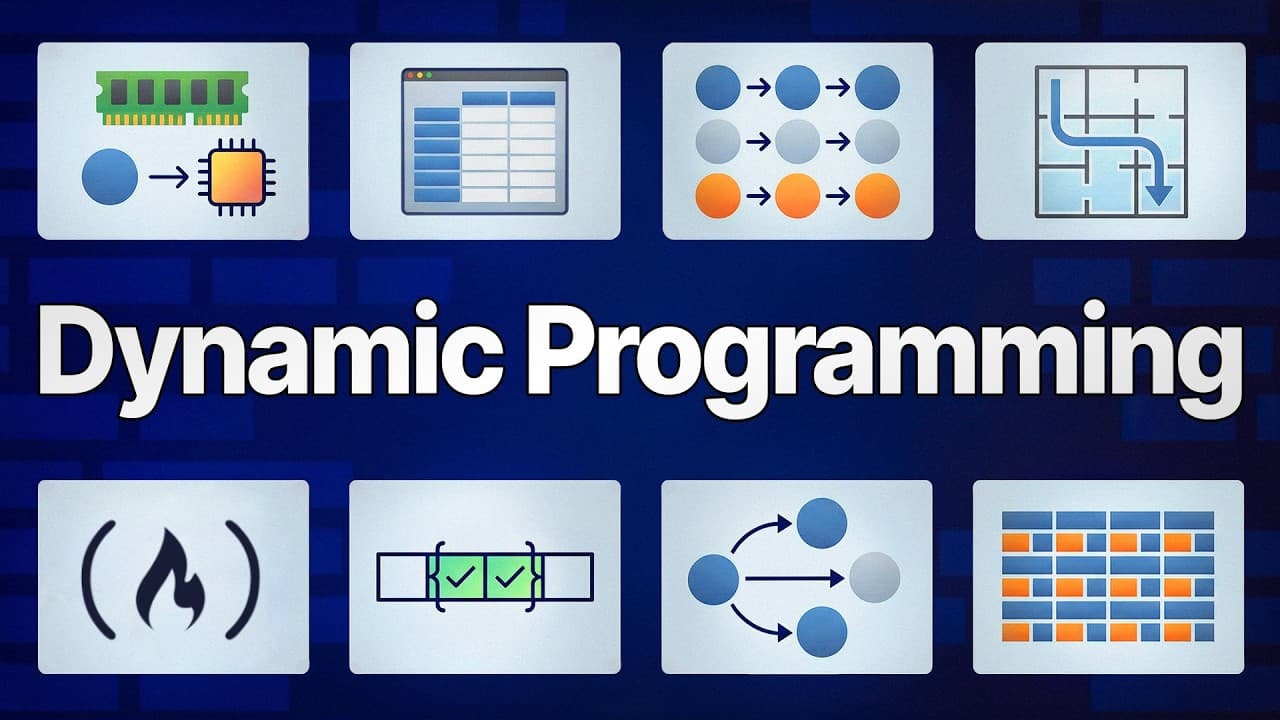
Dynamic programming can be mastered by breaking complex problems into simple, reusable sub-problems. This course uses animations to demonstrate how data flows through tables and recursion trees, helping to build a strong visual intuition for optimization. By understanding key patterns like memoization and tabulation, one can solve challenging algorithmic puzzles efficiently.
Transcript
Master the art of dynamic programming by learning to break complex challenges into simple reusable subpros. This course features step-by-step animations that bring abstract logic to life, showing you exactly how data flows through tables and recursion trees in real time. Develop a powerful visual intu intuition for optimization so you can solve eve... Read More
Key Insights
- Dynamic programming involves breaking down complex problems into simpler sub-problems.
- Visualization through animations helps in understanding the flow of data and recursion.
- Memoization is a top-down approach that stores results of expensive function calls.
- Tabulation is a bottom-up approach that fills a table iteratively to solve problems.
- Recognizing patterns in dynamic programming can simplify problem-solving.
- Grid-based problems often involve two-dimensional dynamic programming.
- Interval DP is used for problems involving optimization within a single sequence.
- Non-constant transition patterns require checking multiple previous states.
Install to Summarize YouTube Videos and Get Transcripts
Explore YouTube Video Summarizer or Get YouTube Transcript Extractor
Questions & Answers
Q: How to optimize dynamic programming solutions?
Optimizing dynamic programming solutions often involves using memoization to store previously computed results and tabulation to iteratively fill tables. These techniques help reduce redundant calculations, leading to more efficient algorithms. Additionally, recognizing patterns and using appropriate data structures can further enhance optimization.
Q: What is memoization in dynamic programming?
Memoization is a dynamic programming technique where results of expensive function calls are stored, so that when the same inputs occur again, the stored results can be used directly, avoiding repeated calculations. This top-down approach reduces time complexity by preventing redundant computations.
Q: How does tabulation differ from memoization?
Tabulation is a bottom-up approach that involves filling a table iteratively to solve a problem, whereas memoization is a top-down approach that stores results of expensive function calls. Tabulation usually avoids recursion and is often more space-efficient, while memoization can be easier to implement for certain problems.
Q: What is the significance of recognizing patterns in dynamic programming?
Recognizing patterns in dynamic programming is crucial as it allows for the application of proven techniques to new problems. By identifying patterns such as grid problems, interval DP, or knapsack-like problems, one can apply appropriate strategies to efficiently solve complex algorithmic challenges.
Q: How do grid-based problems utilize dynamic programming?
Grid-based problems often use two-dimensional dynamic programming to compute solutions by filling a grid or matrix. Each cell in the grid represents a sub-problem, and the solution is built by combining results from neighboring cells, following specific movement rules, such as moving only right or downward.
Q: What is interval DP and when is it used?
Interval DP is used in problems where the solution for a larger interval depends on solutions for smaller intervals within it. It's commonly applied in optimization problems involving a single sequence, such as finding palindromic subsequences, where results are computed based on progressively larger intervals.
Q: When should non-constant transition patterns be applied?
Non-constant transition patterns should be applied when the solution for the current state depends on multiple previous states, not just a fixed number. These patterns involve iterating over several previous candidates and selecting the best option, often leading to O(N^2) time complexity due to nested loops.
Q: What are knapsack-like problems in dynamic programming?
Knapsack-like problems involve determining whether a specific sum can be achieved using elements from a given set, akin to filling a backpack with items of different sizes to match a capacity. These problems are solved using dynamic programming by exploring combinations of elements to reach the target sum.
Summary & Key Takeaways
-
Dynamic programming simplifies complex problems by dividing them into smaller, manageable sub-problems, often using techniques like memoization and tabulation. (50 words)
-
Visual animations can enhance understanding by showing real-time data flow through tables and recursion trees, fostering a deeper intuition for solving algorithmic challenges. (50 words)
-
Mastering dynamic programming involves recognizing and applying key patterns, such as grid problems, interval DP, and non-constant transitions, to efficiently tackle diverse computational problems. (50 words)
Read in Other Languages (beta)
Share This Summary 📚
Summarize YouTube Videos and Get Video Transcripts with 1-Click
Try YouTube Summary with ChatGPT & Claude or YouTube Transcript Generator
Explore More Summaries from freeCodeCamp.org 📚






Summarize YouTube Videos and Get Video Transcripts with 1-Click
Try YouTube Summary with ChatGPT & Claude or YouTube Transcript Generator