How to Learn Algebra with Python Coding Step by Step
TL;DR
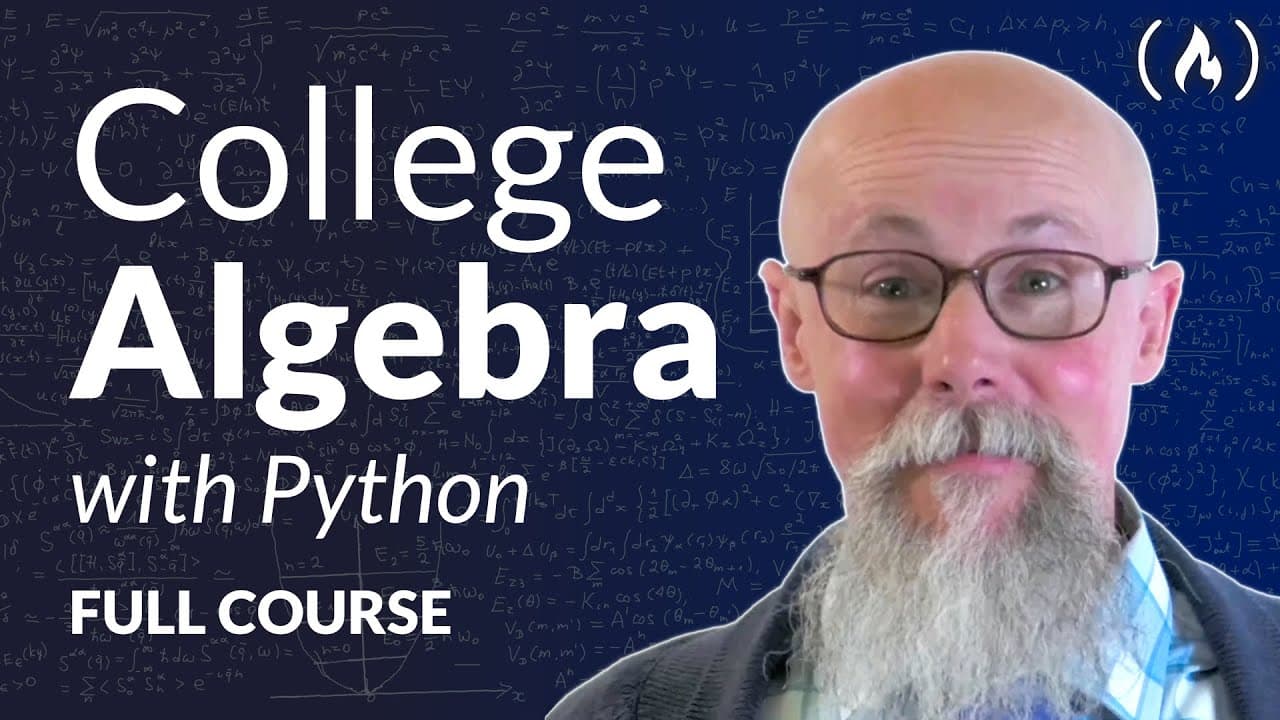
The course blends college algebra concepts with Python programming to show how formulas can be executed in code. It uses Google Colab notebooks to demonstrate math on the board and then translate it into runnable code, helping learners build practical skills for data science and problem solving.
Transcript
This college algebra course is different than other college algebra courses. Like many other ones, you will be learning all the concepts from an experienced university professor. But in this course, the instructor Ed Protowski will also show you how to implement all the concepts in Python. This course is for everybody, but especially those interest... Read More
Key Insights
- Ed Protowski presents algebra concepts and Python implementation in parallel, reinforcing understanding through code.
- The course uses Google Colab as the primary environment for writing and running algebra code.
- Each unit combines mathematical lessons with coding demonstrations on how to translate formulas into programs.
- Code cells and text blocks in Colab notebooks are organized with sections for easy navigation.
- The curriculum includes problem sets and extra videos to practice applying learned skills.
- The course emphasizes building personal resources and notebooks that can be downloaded and reused.
- The goal is to prepare students for data science careers by integrating math and programming skills.
- The description highlights accessibility for beginners and those interested in computer science.
- More videos from this channel:
- More from this channel: freeCodeCamp.org
Install to Summarize YouTube Videos and Get Transcripts
Explore YouTube Video Summarizer or Get YouTube Transcript Extractor
Questions & Answers
Q: How does the course integrate algebra with Python, and what is the expected outcome for a student?
The course integrates algebra with Python by first teaching the mathematical concepts on the board and then showing how to implement those concepts as Python code in Google Colab notebooks. Students learn to translate formulas into executable functions, build problem-solving workflows, and maintain notebooks as reusable resources. The expected outcome is a practical grasp of algebra and the ability to apply coding to solve real-world math problems, accelerating progression toward data science tasks.
Q: What role does Google Colab play in this algebra with Python course?
Google Colab serves as the primary coding environment where students write, run, and test Python code that implements algebra concepts. It supports code blocks and text blocks for explanations, allows creating sections for organization, and enables saving and sharing notebooks. This setup helps learners see immediate results from mathematical operations and maintain a portfolio of working resources.
Q: Who is the instructor and what is their teaching approach?
The instructor is Ed Protowski, a university professor who guides students through algebra concepts and their Python implementations. His approach combines traditional math instruction with hands-on coding, demonstrating on a board and then translating those steps into code. This dual method aims to deepen understanding and show practical applications in computing and data science.
Q: What topics are covered in the course, and how are they sequenced?
The course covers a wide range of algebra topics including ratios, proportions, basic algebra, percentages, decimals, fractions, functions of two variables, slope and intercept, factoring, systems of equations, quadratic equations, polynomials, cost and revenue models, interest formulas, exponents, and logarithms. The sequence moves from foundational concepts to more complex topics, with each unit pairing math with corresponding code demonstrations.
Q: How are notebooks organized to aid learning and review?
Notebooks are organized into sections and subsections within Google Colab, which creates a table of contents for easy navigation. Each section can contain code cells and text cells, allowing explanations, formulas, and results to be kept together. The structure enables learners to collapse or expand sections as needed and to download or reuse resources for future study.
Q: What practical skills does the course aim to build beyond theory?
Beyond theory, the course aims to build practical skills in solving algebraic problems with code, creating reusable Colab notebooks, and using these notebooks as dynamic study resources. Learners gain the ability to implement formulas in Python, run computations, visualize basic relationships, and prepare for data science workflows that require a strong mathematical foundation.
Q: How does the course support beginners or those new to coding?
The course is designed to be accessible to beginners by starting with fundamental algebra concepts and gradually introducing Python coding in a familiar environment. By showing side-by-side board work and code implementation, it lowers barriers to entry and builds confidence as learners test simple calculations and gradually tackle more complex problems.
Q: Are there additional resources or future content mentioned for continued learning?
Yes, the description mentions extra videos and problem-solving sessions to reinforce learning, as well as resources and a GitHub repository with course outlines. This suggests ongoing content and downloadable materials that learners can use to continue practicing algebra with Python and to extend their knowledge into related topics like data science.
Summary & Key Takeaways
-
This course teaches algebra concepts alongside Python coding, using a university professor’s guidance to bridge math and programming. It emphasizes using Google Colab to write and run code that implements algebraic formulas, incrementally building notebooks and resources for self-paced learning.
-
Learners gain hands-on experience solving equations, graphing, and applying algebra to real problems by writing code, which reinforces understanding and prepares for data science workflows.
-
The structure includes math lessons, board demonstrations, coding exercises, and extra practice problems, culminating in a resource-rich approach that scales to more advanced topics and future courses.
Read in Other Languages (beta)
Share This Summary 📚
Summarize YouTube Videos and Get Video Transcripts with 1-Click
Try YouTube Summary with ChatGPT & Claude or YouTube Transcript Generator
Explore More Summaries from freeCodeCamp.org 📚


Summarize YouTube Videos and Get Video Transcripts with 1-Click
Try YouTube Summary with ChatGPT & Claude or YouTube Transcript Generator