What Drives US Weapons Sales to 103 Countries?
TL;DR
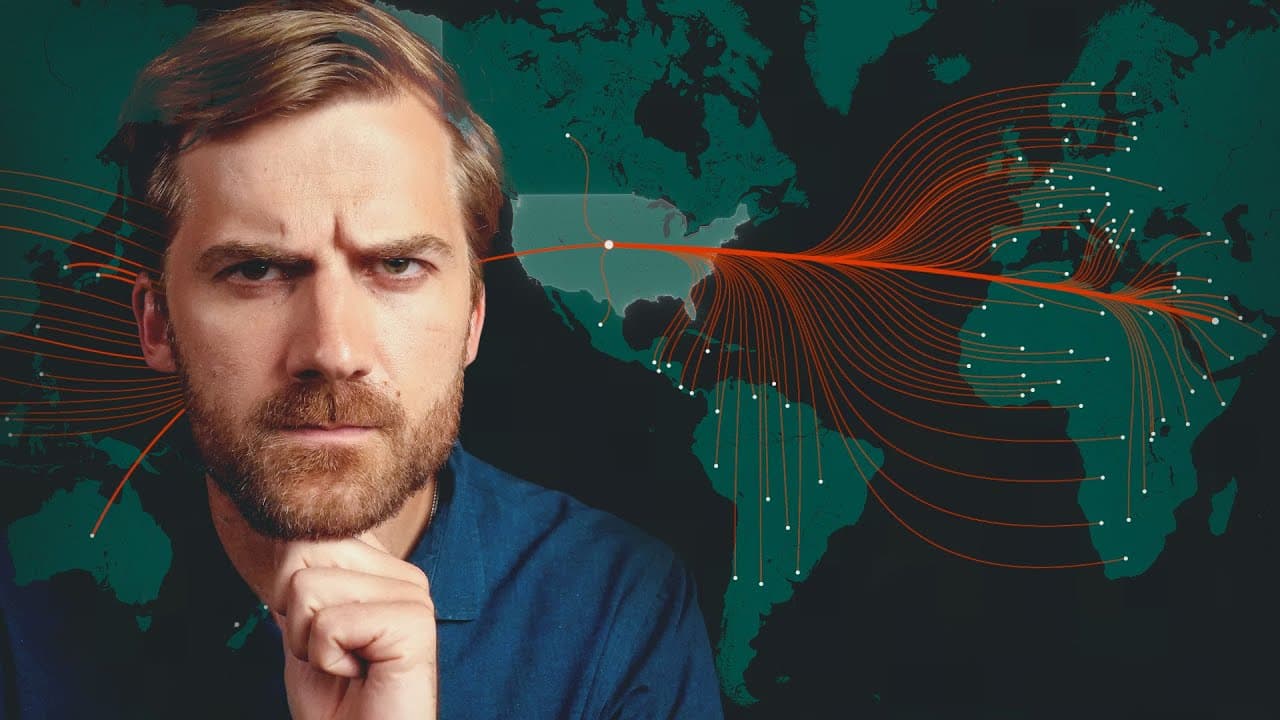
The United States sells weapons to many countries to secure influence and align policy with its interests. The video argues weapons act as a currency for loyalty, allies, and access to resources, while also highlighting the balance of power as a driver that can create instability. It questions whether selling weapons truly promotes peace.
Transcript
(ominous synth music) - We've been busy mapping where weapons flow in this world, especially those that originate in the United States. And this is part two of a series on the arms trade. If you watch part one, you'll already know that there's a long history of businessmen getting rich off of war. (synth music) But I wanted to see what the weapons ... Read More
Key Insights
- The United States sells weapons to 103 countries, creating a global network of influence.
- Weapons act as a currency for securing loyalty and shaping foreign policy.
- Balance of power explains why countries build up or restrain their weaponry to deter rivals.
- The map visualizes US influence as lines and regions, illustrating reach and responsibility.
- Five main motives for sales emerge: stability, alliances, friendship, countering enemies, and securing resources.
- Different regions reveal different priorities, such as NATO alignment in Europe and resource protection in the Middle East.
- Ukraine, while not a NATO member, is treated as a target for countering a specific adversary, illustrating policy aims.
- The analysis highlights that more weapons sales often equate to greater leverage over a country.”
- More videos from this channel:
- More from this channel: Johnny Harris
Install to Summarize YouTube Videos and Get Transcripts
Explore YouTube Video Summarizer or Get YouTube Transcript Extractor
Questions & Answers
Q: What is the basic purpose of selling weapons according to the video?
The video presents that the core purpose of selling weapons is to promote peace and security by using weapons as a currency to secure loyalty and influence. It discusses that sales can be used to stabilize regions, gain allies, and ensure access to strategic advantages, though it notes the irony that arming others can both support and undermine security.
Q: How many countries receive US weapons as described in the transcript?
The transcript states that the United States sells weapons to 103 countries. This broad distribution is used in the video to illustrate the scale of American influence and the way arms sales function as a global currency in international relations, connecting defense policy with geopolitical leverage.
Q: What does the video mean by describing weapons as a currency?
Describing weapons as a currency means that armaments are used to secure political objectives, such as stability, allied commitments, loyalty, access to resources, and military cooperation. The idea is that weapons exchanges can trade for influence, support in international forums, and reciprocal policy concessions from purchasing governments.
Q: What are the five main things the video suggests the US seeks in exchange for weapons?
The video outlines five main things: stability in the region, alliances with other governments, friendship and cooperation, help against a mutual enemy or rival, and access to vital resources. These motives explain why the US embeds arms sales within broader strategic and economic objectives.
Q: How does the video describe the concept of balance of power?
The video explains balance of power as countries arming themselves to be just powerful enough to deter adversaries but not so powerful as to provoke escalation. It argues that weapons are the ingredients in this calculation, and that external arms transfers can influence regional dynamics by shifting perceived power and risk of conflict.
Q: Which region is highlighted as using weapons to counter Iran, and what is the implication?
In the Middle East, the video highlights weapons sales to countries like Israel to counter Iran. The implication is that arms transfers are used to deter or counter regional adversaries, reinforcing security arrangements and shaping the balance of power in a volatile area.
Q: Why does the video say the US avoids being the world policeman by selling weapons?
The video argues that by selling weapons, the US can influence other governments and secure outcomes without having to directly deploy its own forces everywhere. This outsourcing of certain security functions is presented as a practical rationale for arming allies while maintaining broader strategic reach.
Q: What is the role of Sam Ellis in the video, and what does the collaboration illustrate?
Sam Ellis, creator of Search Party, collaborates to decode the map and translate complex data into understandable insights. The collaboration illustrates how design and data storytelling can reveal the motives behind arms transfers, showing that quantifiable flows can be interpreted to infer policy goals like stability, loyalty, and resource access.
Summary & Key Takeaways
-
The video maps US weapon flows and shows a global footprint that signals influence through hardware sales. It uses a design-focused approach to interpret why states accept arms transfers and how those deals shape regional power dynamics.
-
The analysis introduces a framework where weapons purchases are linked to stability, alliances, resources, and strategic positioning, suggesting that money and policy goals drive these transfers.
-
The presenter acknowledges subjectivity in categorizing motives but demonstrates how data can reveal patterns of influence, loyalty, and conflict risk tied to the arms trade.
Read in Other Languages (beta)
Share This Summary 📚
Summarize YouTube Videos and Get Video Transcripts with 1-Click
Try YouTube Summary with ChatGPT & Claude or YouTube Transcript Generator
Explore More Summaries from Johnny Harris 📚




Summarize YouTube Videos and Get Video Transcripts with 1-Click
Try YouTube Summary with ChatGPT & Claude or YouTube Transcript Generator