What Are Essential AI Terms to Know?
TL;DR
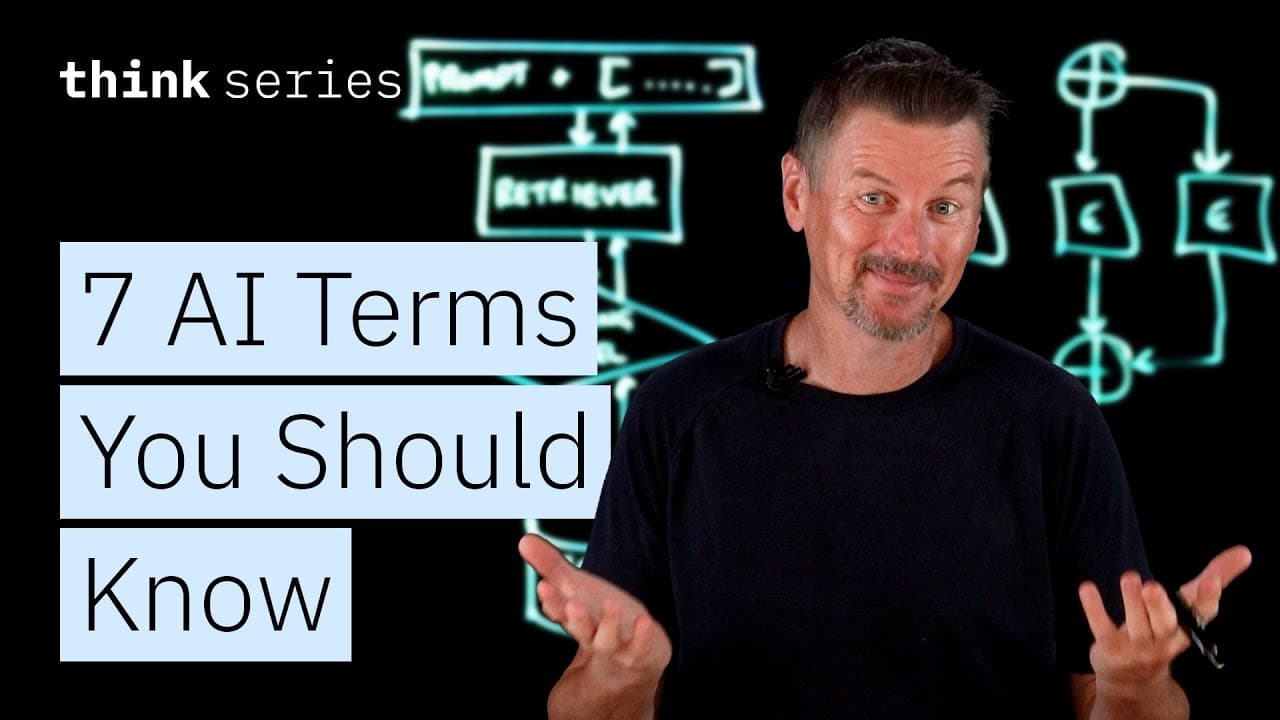
Understanding key AI terms is crucial as the field evolves rapidly. AI agents operate autonomously, utilizing reasoning models to solve complex tasks. Vector databases store data as vectors to enhance search capabilities, while RAG enriches prompts using these databases. MCP standardizes LLM interactions, and MoE scales models efficiently. ASI remains theoretical, promising unprecedented intelligence.
Transcript
There are two things that hold true when it comes to artificial intelligence. One. It's everywhere. My toothbrush just got an AI update this week. And two. The field is changing rapidly, making it hard to keep up even for those of us who work in tech. So, I've put together my top seven AI terms that I think are important to be familiar with as AI c... Read More
Key Insights
- AI agents can reason and act autonomously to achieve goals, unlike traditional chatbots.
- Large reasoning models are specialized LLMs fine-tuned for step-by-step problem-solving.
- Vector databases use embeddings to store data as vectors, allowing semantic similarity searches.
- RAG, or retrieval augmented generation, enriches LLM prompts using vector databases.
- MCP standardizes how LLMs interact with external data sources and services.
- Mixture of experts (MoE) divides LLMs into specialized subnetworks, enhancing efficiency.
- Artificial superintelligence (ASI) is a theoretical concept beyond human-level intelligence.
- ASI systems could potentially self-improve recursively, posing both opportunities and risks.
Install to Summarize YouTube Videos and Get Transcripts
Explore YouTube Video Summarizer or Get YouTube Transcript Extractor
Questions & Answers
Q: What are AI agents and how do they function?
AI agents are autonomous systems designed to perceive their environment, reason about actions, and execute tasks to achieve specific goals. Unlike traditional chatbots, which respond to prompts one at a time, AI agents operate continuously, cycling through perception, reasoning, and action stages. They can be used in various roles, such as travel booking or data analysis, and are often built on large reasoning models that enable them to solve complex, multistep problems.
Q: How do large reasoning models differ from regular LLMs?
Large reasoning models are a specialized type of large language model (LLM) that undergo fine-tuning focused on reasoning. Unlike regular LLMs that generate immediate responses, reasoning models are trained to approach problems step by step, generating internal chains of thought before responding. This approach is particularly useful for AI agents that need to plan and execute complex tasks with multiple steps, ensuring more accurate and reliable outcomes.
Q: What is a vector database and its advantage?
A vector database stores data in the form of vectors, which are long lists of numbers representing the semantic meaning of content. This is achieved through embedding models that convert raw data, like text or images, into vectors. The primary advantage of vector databases is their ability to perform searches as mathematical operations, allowing for the retrieval of semantically similar content. This capability enhances applications such as RAG, where vector databases enrich language model prompts with contextually relevant information.
Q: What is retrieval augmented generation (RAG)?
Retrieval augmented generation (RAG) is a technique that enhances language model prompts by incorporating relevant information retrieved from vector databases. It begins with a user input prompt, which is converted into a vector using an embedding model. A similarity search is then performed in the vector database, and the retrieved information is embedded back into the original prompt. This process allows for more contextually enriched responses, drawing on external data to improve the accuracy and relevance of language model outputs.
Q: How does the Model Context Protocol (MCP) work?
The Model Context Protocol (MCP) standardizes the way large language models (LLMs) interact with external data sources, services, and tools. By providing a consistent framework for these interactions, MCP eliminates the need for developers to create custom connections for each new tool. Instead, an MCP server acts as a bridge, allowing LLMs to access and utilize external systems efficiently. This standardization enhances the utility and scalability of LLMs, enabling them to perform a wider range of tasks with greater ease.
Q: What is the Mixture of Experts (MoE) model?
The Mixture of Experts (MoE) model divides a large language model into specialized neural subnetworks, known as experts. A routing mechanism then activates only the necessary experts for a given task, optimizing computational efficiency. This approach allows for the scaling of model size without proportional increases in compute costs. By activating a subset of experts, MoE models can handle complex tasks with reduced computational demands, making them a cost-effective solution for large-scale AI applications.
Q: What is artificial superintelligence (ASI)?
Artificial superintelligence (ASI) is a theoretical concept referring to AI systems that possess intelligence beyond human capabilities. Unlike artificial general intelligence (AGI), which aims to match human cognitive abilities, ASI would surpass them, potentially achieving recursive self-improvement. This means ASI systems could redesign and upgrade themselves, becoming increasingly intelligent over time. While ASI remains purely theoretical, its potential implications include solving complex global challenges or, conversely, creating unforeseen risks.
Q: What role does ASI play in AI development?
Artificial superintelligence (ASI) represents a long-term goal for frontier AI research, aiming to create systems with intelligence beyond human levels. While ASI does not yet exist and remains speculative, it drives innovation and exploration within the AI community. Researchers are interested in ASI's potential to address complex global issues or revolutionize industries through unprecedented problem-solving capabilities. However, the pursuit of ASI also raises ethical and safety concerns, prompting discussions on responsible AI development and governance.
Summary & Key Takeaways
-
AI agents are autonomous systems that perceive, reason, and act to achieve goals. They utilize large reasoning models, which are fine-tuned for step-by-step problem-solving, making them ideal for complex tasks. These agents can function in various roles, such as travel agents or data analysts, providing versatile applications across industries.
-
Vector databases store data as vectors using embedding models, enabling semantic similarity searches. This capability is crucial for technologies like retrieval augmented generation (RAG), which enriches language model prompts with relevant information from vector databases. MCP further enhances LLM utility by standardizing interactions with external systems.
-
Mixture of experts (MoE) divides large language models into specialized subnetworks, activating only necessary experts for specific tasks, thus optimizing computational efficiency. While artificial superintelligence (ASI) remains theoretical, it represents a potential future where AI surpasses human intelligence, capable of recursive self-improvement.
Read in Other Languages (beta)
Share This Summary 📚
Summarize YouTube Videos and Get Video Transcripts with 1-Click
Try YouTube Summary with ChatGPT & Claude or YouTube Transcript Generator
Explore More Summaries from IBM Technology 📚
Summarize YouTube Videos and Get Video Transcripts with 1-Click
Try YouTube Summary with ChatGPT & Claude or YouTube Transcript Generator