How to Scale AI Agents With Dedicated Computers
TL;DR
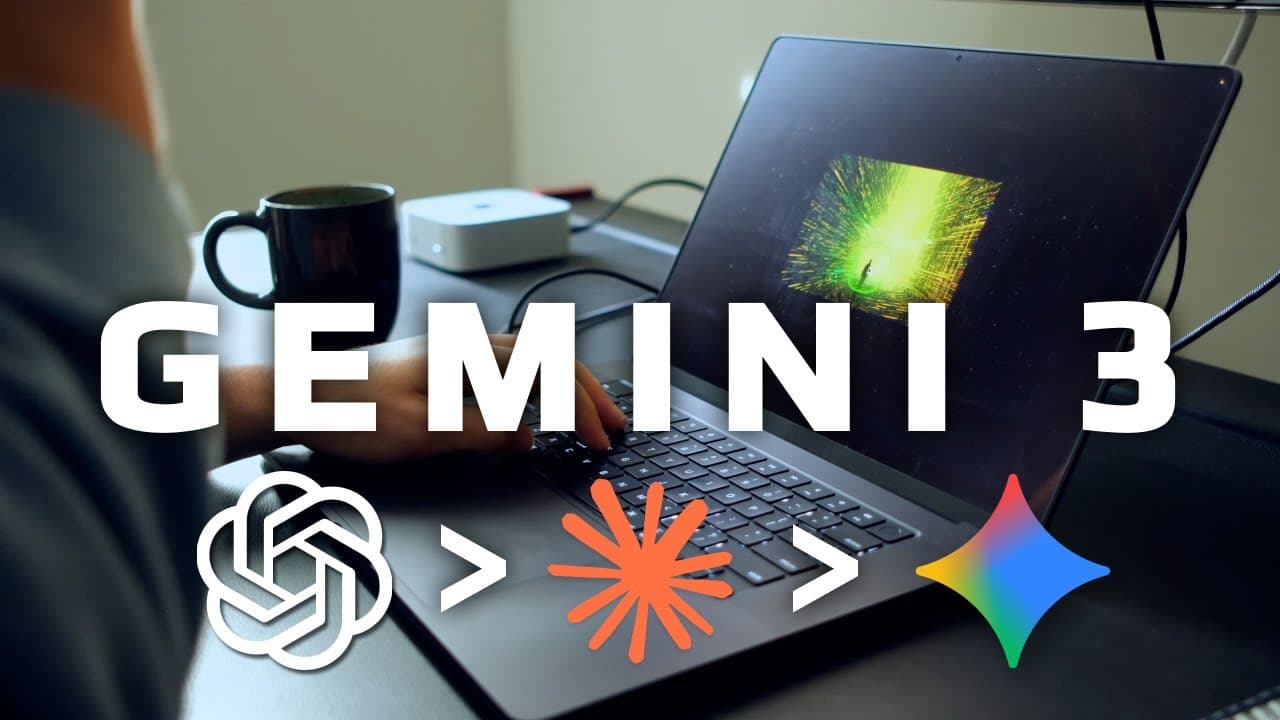
Give coding agents isolated computers, run many jobs in parallel, and select the best result to increase autonomy while reducing hands-on management. Gemini 3 Pro leads the cited third-party benchmarks, but the larger conclusion is that model rankings matter less as models improve. Performance on your own workflows, agent design, tool use, and available compute increasingly determine practical engineering value.
Transcript
Welcome back engineers. Indydev Dan here. We have the new Gemini 3 Pro anti-gravity next generation IDE and we have the Nano Banana Pro, not to mention OpenAI's GPT 5.1 Codeex Max Premium XL. Okay, we really got to improve our naming here. Let's dial in to the signal. What actually matters here? What are these releases actually saying? So, only two... Read More
Key Insights
- Gemini 3 Pro is presented as the top model across almost every third-party benchmark examined, surpassing Claude Code running Sonnet 4.5 while demonstrating strong results during practical use. The comparison still includes nuance because raw benchmark leadership does not guarantee superiority for every engineering workflow.
- Agent sandboxes are isolated computers assigned to individual AI agents, allowing each agent to execute commands, create applications, test results, and host outputs. This setup increases agent autonomy and lets engineers supervise less of the step-by-step work required to complete a task.
- Parallel compute is used to scale engineering impact by launching many independent agent sandboxes against multiple problems or identical prompts. The demonstration runs 15 sandboxes across Gemini 3 Pro, Claude Code, and Codex 5.1 Max, enabling concurrent development and comparison of results.
- The best-of-N approach is a workflow in which engineers run multiple attempts and select the strongest result rather than relying on a single generation. Dedicated sandboxes make this approach practical because each agent can work independently inside its own environment without blocking the others.
- Agentic coding benchmarks are most useful when they measure tool calling, terminal work, and longer task duration. Improvements in these areas indicate that an agent can remain active longer, operate engineering tools, and complete more substantial work instead of generating only a simple interface.
- Model intelligence is becoming less decisive as leading models gain overlapping capabilities. The argument presented is that the primary limitation is shifting from the language model to the surrounding agent, including its tools, workflow, environment, instructions, and ability to execute sustained work.
- A personal use-case benchmark is the most relevant way to compare models and agents because published benchmark scores cannot fully represent a specific engineering workflow. Engineers should evaluate whether each system completes their actual tasks reliably inside the agent environment they intend to use.
- Google Anti-Gravity is described as a low-signal VS Code fork compared with Cursor, while Nano Banana Pro is described as a high-capability image generation and editing tool. Among the releases discussed, Gemini 3 Pro and Nano Banana Pro are treated as the two consequential developments.
Install to Summarize YouTube Videos and Get Transcripts
Explore YouTube Video Summarizer or Get YouTube Transcript Extractor
Questions & Answers
Q: How can engineers give AI agents their own computers?
Engineers can place each agent inside a dedicated sandbox that functions as an isolated computer. The demonstration uses E2B to host and run these environments, then directs agents to plan, build, host, and test their outputs. Because every agent receives its own environment, multiple jobs can run concurrently with greater autonomy and less step-by-step management from the engineer.
Q: Why should coding agents run in parallel sandboxes?
Parallel sandboxes let engineers apply more compute to a problem without forcing agents to share one environment or wait for one another. Multiple agents can attempt the same assignment or handle different assignments simultaneously. The engineer can then compare completed outputs and choose the strongest result, turning parallel execution into a practical best-of-N development and evaluation workflow.
Q: How was Gemini 3 Pro compared with Claude Code and Codex?
The demonstration assigned the same set of prompts to Gemini 3 Pro, Claude Code running Sonnet 4.5, and Codex running GPT 5.1 Codex Max high. Five tasks were launched for each system, producing 15 agent sandboxes. The assignments included SVG creation, a SQLite interface, a Nano Banana interface, and a full-stack note-taking application.
Q: What tasks were assigned to the agent sandboxes?
The agents were asked to create and host an SVG of a pelican riding a skateboard, produce three banana-themed Pokémon evolution cards, build an easy SQLite CRUD interface, create a user interface for operating Nano Banana Pro, and develop a persistent full-stack note-taking application. The larger applications included front-end, back-end, and database work rather than only visual mockups.
Q: Does Gemini 3 Pro outperform Claude Code with Sonnet 4.5?
Gemini 3 Pro is presented as outperforming Claude Code with Sonnet 4.5 across almost every third-party benchmark reviewed, and practical usage is described as confirming that it is a highly capable model. The conclusion is qualified, however, because benchmark rankings do not establish the best choice for every workflow. Performance against a specific use case remains the decisive comparison.
Q: Which AI coding benchmarks matter most for engineering work?
Benchmarks focused on terminal use, tool calling, agentic coding, and long-duration task execution are described as especially meaningful. These measurements indicate whether an agent can remain productive over extended work, use engineering tools, and finish substantial assignments. They are considered more informative than demonstrations limited to generating a simple interface or a one-shot front-end application.
Q: Why are model benchmarks becoming less important?
Model benchmarks are becoming less decisive because leading models can already perform many overlapping tasks, so another intelligence increase may add less practical capability than earlier releases did. The surrounding agent system increasingly determines results. Tools, instructions, sandbox access, workflow design, sustained execution, and evaluation can matter more than which model leads a general benchmark table.
Q: How should engineers evaluate AI coding agents?
Engineers should test models and agents against the exact workflows they need to complete, inside the agent environment they plan to use. Published results can correlate with stronger performance, but they cannot replace a use-case benchmark. A useful evaluation should examine whether the agent can plan, use tools, build, test, host, and reliably finish the engineer's real assignments.
Summary & Key Takeaways
-
Gemini 3 Pro is presented as the leading model across the third-party benchmarks reviewed, giving Claude Code with Sonnet 4.5 serious competition. However, the central argument is that benchmark leadership alone does not define engineering value. Actual performance depends increasingly on the complete agentic experience and the engineer's specific use case.
-
Dedicated E2B sandboxes give each agent an isolated computer where it can plan, build, host, and test software with greater autonomy. The demonstration launches 15 sandboxes across Gemini 3 Pro, Claude Code, and Codex 5.1 Max, assigning identical tasks that range from SVG generation to persistent full-stack applications with databases.
-
Parallel agent execution makes compute a practical way to expand engineering output. Instead of supervising one agent and accepting its first result, engineers can launch multiple independent attempts, let them work concurrently, and choose the strongest output. The emerging constraint is therefore the quality of the agent system, workflow, tools, and evaluation process.
Read in Other Languages (beta)
Share This Summary 📚
Summarize YouTube Videos and Get Video Transcripts with 1-Click
Try YouTube Summary with ChatGPT & Claude or YouTube Transcript Generator
Explore More Summaries from IndyDevDan 📚



Summarize YouTube Videos and Get Video Transcripts with 1-Click
Try YouTube Summary with ChatGPT & Claude or YouTube Transcript Generator