How to parallelize Claude coding with Git worktrees for multi agent coding
TL;DR
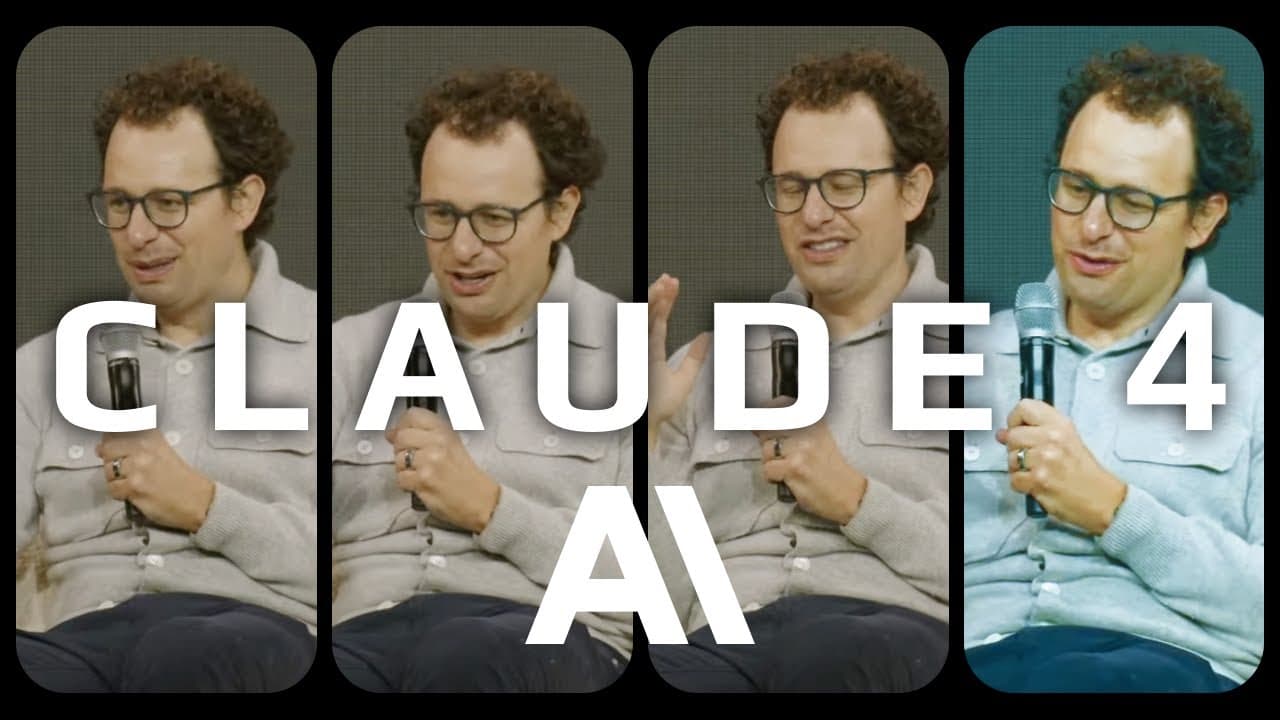
Parallel agent coding uses multiple Claude Code agents running on separate git worktrees to generate different UI rewrite versions simultaneously. The technique leverages Claude 4 Opus and Sonnet models to run three parallel instances, compare results, and merge the best version back into the main branch. This is presented as an advanced, though costly, approach to scale coding work.
Transcript
welcome back engineers indie Devdan here i'm going to spoil this one and just tell you this video is an absolute banger thanks to Enthropic we have the brand new Clawude 4 model series we have a new Sonnet and a new Opus model and very importantly a lot of engineers are going to miss this but we have Claw Code now generally available this means we ... Read More
Key Insights
- Claude 4 enables parallel agent coding by running multiple dedicated code environments using git work trees. This setup creates isolated copies of the codebase for simultaneous experimentation on the same feature.
- Agents operate in parallel with Claude Code and Opus 4 to implement a UI rewrite plan, then shift through outputs to identify the best version before merging.
- Non deterministic model behavior is expected, so parallel exploration provides hedging against failures and unlocks multiple future code paths.
- The workflow requires a clear plan first, followed by distributing work to several agents to execute the plan independently.
- Three parallel work trees are created to run distinct agent instances, each building its own version of the feature while sharing the same plan.
- The approach uses a dedicated environment per agent to avoid conflicts and ensure clean comparisons among outputs.
- Results are iterated, compared side by side, and the superior version is cherry picked for integration into the main timeline.
- This technique emphasizes the practical value of agentic coding for complex UI updates and advanced engineering workflows.
- More videos from this channel:
- More from this channel: IndyDevDan
Install to Summarize YouTube Videos and Get Transcripts
Explore YouTube Video Summarizer or Get YouTube Transcript Extractor
Questions & Answers
Q: How does parallel agent coding work with git work trees in Claude Code, and what is the practical benefit?
Parallel agent coding using git work trees creates multiple isolated copies of the same codebase, each assigned to a separate Claude Code agent. By running three or more agents simultaneously, you obtain different implementations of the same UI rewrite. The practical benefit is the ability to compare distinct approaches side by side, select the strongest version based on your criteria, and merge it back into the main branch, reducing risk and improving overall quality.
Q: What models are highlighted for agentic coding in this method, and why are they important?
The method highlights Claude 4 Opus and Sonnet models, plus Claude Code for the agentic workflow. These models are important because they offer advanced capabilities for planning, prompting, and executing engineering tasks at scale. Opus 4, in particular, is used to run multiple parallel instances, enabling faster exploration of different code futures while maintaining centralized planning.
Q: What is the role of a plan in this multi agent workflow, and how is it used across agents?
The plan acts as a single source of truth that defines the feature goal and the steps to achieve it. In this workflow, the plan is written once and distributed to all agents. Each agent then operates on its own dedicated code environment to implement the plan, ensuring consistency in objectives while allowing for diverse implementations.
Q: Why is non determinism of models mentioned, and how does parallelism address it?
Non determinism means different runs of the same prompt can produce different results. By running multiple agents in parallel, you hedge against the risk that a single model run might fail or produce suboptimal results. The parallel approach increases the chance that at least one agent generates a strong, usable implementation, from which the best can be selected.
Q: How many parallel work trees are demonstrated, and what does each contain?
Three parallel work trees are demonstrated. Each work tree contains its own copy of the codebase, separate branches, and an independent environment where a Claude Code agent applies the shared plan to build a version of the UI rewrite. This isolation prevents conflicts and enables clean comparisons between outputs.
Q: What is the practical cost or caveat mentioned with running this kind of setup?
The approach is described as expensive because running multiple high end AI agents in parallel incurs significant compute and token usage. The transcript emphasizes that parallel agentic coding requires substantial resources, planning, and cost awareness, but it can dramatically increase output and reliability for large scale coding tasks.
Q: How is the best version chosen and merged back into the main project?
After all agents complete their work, the outputs are evaluated side by side. The best version is cherry picked based on criteria such as functionality, quality, and UX considerations, then merged back into the main timeline or branch. This selective integration ensures the main branch benefits from the strongest candidate while maintaining stability.
Q: What does this reveal about the future of engineering workflows with Claude Code and similar tools?
The demonstration shows that advanced agentic coding can scale engineering tasks by enabling multiple autonomous AI agents to collaborate on the same feature. It points to a future where planning first and executing with parallel AI workstreams becomes a standard practice for complex UI updates and engineering workflows, increasing speed, reliability, and innovation while managing risk.
Summary & Key Takeaways
-
The discussion centers on using parallel Claude Code agents across multiple git work trees to create several independent codebase futures for a UI rewrite. It emphasizes planning first, then executing in parallel with dedicated environments for each agent. The outcome is a set of candidate solutions that can be compared and merged into main.
-
Three parallel work trees are created to isolate each agent's changes, preventing conflicts and enabling independent experimentation. The approach highlights non determinism in models and the value of hedging against failures by selecting the best performing version.
-
The overall goal is to demonstrate a scalable, multi agent workflow that leverages the latest Claude 4 models for agentic coding, while acknowledging the cost and complexity involved in running multiple agents in parallel.
Read in Other Languages (beta)
Share This Summary 📚
Summarize YouTube Videos and Get Video Transcripts with 1-Click
Try YouTube Summary with ChatGPT & Claude or YouTube Transcript Generator
Explore More Summaries from IndyDevDan 📚

Summarize YouTube Videos and Get Video Transcripts with 1-Click
Try YouTube Summary with ChatGPT & Claude or YouTube Transcript Generator