How Can System Prompt Engineering Fix Claude Opus 5’s Verbose Responses?
TL;DR
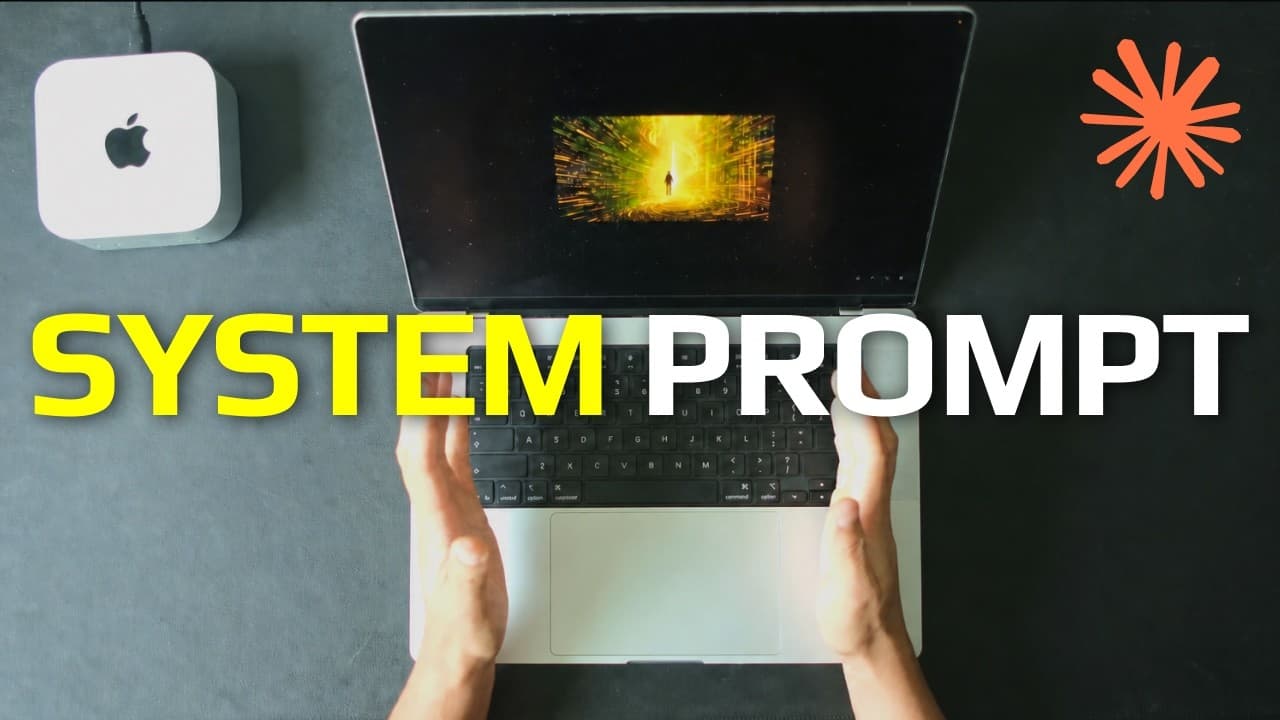
Make Claude Opus 5 more concise by using a system prompt that requires clear, specific communication across every task. The demonstrated workflow compares two Claude Code instances side by side, then incrementally adds positive rules, negative patterns, reference codes, and hard operational boundaries to reduce repetition, scope expansion, and output-token use. Read on for the exact principles behind a precise senior-engineer communication style.
Transcript
What's up, engineers? Andy Devdan here. Like me, you've probably gotten sick and tired of Opus 5's insanely verbose responses and its overuse of phrases like loadbearing, worth stating plainly, here's the honest truth, and a bunch of others. Or maybe you're tired of the Anthropic team trying to take credit in your Git commit messages for intelligen... Read More
Key Insights
- A system prompt is the governing instruction set for every task, while a user prompt describes the single task currently being performed. Because system-level guidance affects repeated interactions, each carefully chosen instruction can improve many future inputs and outputs.
- Clear, concise, actionable communication is established by stating the desired working relationship directly. The prompt connects this standard to solving problems and creating value for the team, business, and customers, giving the behavioral instructions an explicit practical purpose.
- Positive and negative patterns provide complementary behavioral guidance. Positive patterns tell the agent what to reproduce, while negative patterns identify wording, formatting, repetition, and communication habits it should avoid, including phrases such as "loadbearing" and "worth stating plainly."
- The most important information should appear at the end of a response because the user sees the last written material first. This placement allows the user to capture the essential conclusion quickly and decide whether the preceding detail deserves further attention.
- Plain and specific language compresses information more effectively than language optimized for quotability. The recommended prompt asks the agent to state each fact once, use the simplest useful domain terminology, and prioritize clarity and engineering value over conversational flourish.
- The level of detail should match the task and the request. A concise request should not trigger an unnecessarily long response, while the agent should provide enough information to solve the problem without repeating points or expanding into unrelated work.
- Incorrect assumptions should be challenged directly and accompanied by an explanation. The desired agent is a useful engineering partner that contributes accurate reasoning, rather than agreeing automatically or using flattering language that weakens the quality of technical collaboration.
- Hard operational boundaries keep the agent focused on exactly what was requested. Combined with compact reference codes such as D1, R1, and F1, these boundaries create a shared language, reduce repeated instructions, discourage surprise refactors, and limit unnecessary output tokens.
Install to Summarize YouTube Videos and Get Transcripts
Explore YouTube Video Summarizer or Get YouTube Transcript Extractor
Questions & Answers
Q: How can a system prompt make Claude Opus 5 less verbose?
Define concise communication as a standing requirement that applies to every task. Ask for plain, specific language, one statement per fact, task-appropriate detail, and no repeated conclusions, excessive formatting, unwanted phrases, or unrequested scope expansion.
Q: Why is prompt engineering not dead for AI coding agents?
The transcript argues that engineers communicate with agents through prompts, making prompt engineering essential to scaling their impact. It presents system prompts as especially powerful because every instruction influences many later tasks, inputs, and outputs.
Q: What is the difference between a user prompt and a system prompt?
A user prompt describes the single task at hand. A system prompt acts as the law for every task, governing recurring behavior such as communication style, detail, precision, and operational limits.
Q: Why are system prompts more powerful than individual user prompts?
Every word in a system prompt is multiplied across every user prompt handled under it. This gives system-level instructions recurring leverage over communication patterns and output-token use instead of limiting their effect to one task.
Q: What positive instructions help Opus 5 communicate like a senior engineer?
The recommended prompt asks for clear, concise, actionable communication using plain and specific language. It also requires each fact to be stated once, detail to match the task, incorrect assumptions to be challenged directly, and clarity and engineering value to take priority over quotability.
Q: What negative prompt patterns should be used to control Opus 5?
Negative patterns should identify specific habits the agent must avoid, including repetition, excessive formatting, unnecessary verbosity, and unwanted phrases. Examples named in the source include “loadbearing,” “worth stating plainly,” and “here’s the honest truth.”
Q: How can system prompt engineering reduce output-token costs?
A system prompt can reduce output-token use by preventing repeated facts, oversized explanations, unnecessary formatting, and work outside the requested scope. Because these constraints apply to every response, their effect can recur across many tasks.
Q: How should engineers improve an AI system prompt over time?
Start with a clear purpose and communication standard, then test it on representative work and compare the output with the default behavior. The demonstrated workflow improves the prompt incrementally by adding concrete instructions, examples, reference codes, and hard operational boundaries when broad guidance produces only modest changes.
Summary & Key Takeaways
-
System prompts provide broader leverage than individual user prompts because their instructions influence every task and response. A useful foundation establishes a clear, concise, actionable working relationship, explains that the purpose is solving problems and creating value, and treats the agent as an engineering collaborator instead of assigning it a decorative role.
-
Effective behavioral guidance combines positive patterns with negative patterns. Positive rules request plain and specific language, one statement per fact, task-appropriate detail, direct challenges to incorrect assumptions, and clarity over quotability. Negative rules identify unwanted phrases, repetition, excessive formatting, verbosity, and other habits that make responses slower or harder to scan.
-
The demonstrated workflow improves the system prompt incrementally and compares default Opus 5 against a customized version. High-level purpose statements create only modest changes, so concrete instructions, examples, reference codes, and operational boundaries are added. The resulting approach aims to produce precise responses, prevent scope expansion, and reduce unnecessary output-token consumption.
Read in Other Languages (beta)
Share This Summary 📚
Summarize YouTube Videos and Get Video Transcripts with 1-Click
Try YouTube Summary with ChatGPT & Claude or YouTube Transcript Generator
Explore More Summaries from IndyDevDan 📚



Summarize YouTube Videos and Get Video Transcripts with 1-Click
Try YouTube Summary with ChatGPT & Claude or YouTube Transcript Generator