How to Live Fully in the Present Moment
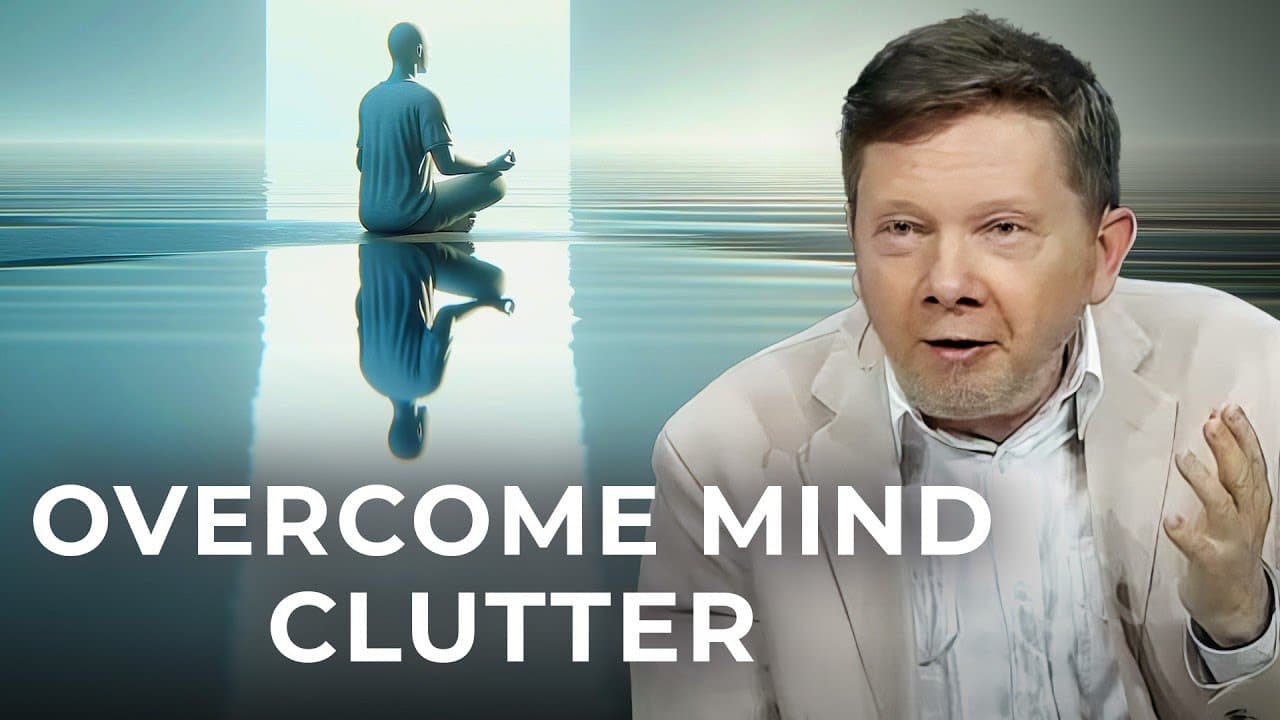
TL;DR
Accept the present moment as it already is, because resisting reality creates unnecessary suffering and keeps attention fixed on an imagined future or remembered past. Conscious living begins when you observe the nonstop voice in your head instead of treating its conditioned thoughts, judgments, and opinions as your identity.
Transcript
- Ultimately their opinion, they're beginning to defend their identity. Sense of identity is derived from the movement of thought. And so whenever somebody questions something that's connected with your thinking, it is regarded as an attack on your identity. (logo beep) Why not start with a good spiritual practice, especially for people in the back... Read More
Key Insights
- • The present moment is the only setting in which life unfolds, because nothing happens outside now. Recognizing this at a deeper level, rather than merely as an intellectual idea, changes a person's relationship with everyday experience.
- • Resistance to present reality creates unnecessary suffering and unhappiness. Since current circumstances already have their particular form, mentally arguing with their existence cannot change the fact that they are present.
- • Future-focused conditioning treats the next moment as more important than the current one. This underlying assumption prevents people from feeling fully alive or at home because fulfillment is continually projected into a future that has not arrived.
- • Spiritual awakening is a transformation of consciousness in which people begin to recognize their ordinary dreamlike state. The process deepens as they notice the persistent mental voice instead of remaining completely absorbed in its commentary.
- • The voice in the head continually analyzes, interprets, judges, likes, dislikes, remembers, and imagines possible problems. Identification with this compulsive thinking functions like a hypnotic trance because the thinker mistakes conditioned mental activity for personal identity.
- • The ego is the unobserved mind, meaning complete identification with conditioned thoughts and their accompanying emotions. Under this identification, people believe they are their mental positions rather than recognizing thoughts as activities that can be observed.
- • Defensiveness arises when a person equates an opinion with identity. Questioning the opinion is then unconsciously experienced as a personal attack, which can produce emotional escalation, hostility, and, in highly unconscious situations, physical violence.
- • Human thinking was an important evolutionary development connected with language and civilization, but it carried a heavy cost. Over time, the human sense of self became bound to thought, producing personal and collective forms of unconscious behavior.
- Related book: The Power of Now
- Export your Kindle highlights to Glasp: How to Download Highlights and Notes from Kindle
- More videos about this book:
- More from this channel: Eckhart Tolle
- More videos with Eckhart Tolle:
Install to Summarize YouTube Videos and Get Transcripts
Explore YouTube Video Summarizer or Get YouTube Transcript Extractor
Questions & Answers
Q: How can I live more fully in the present moment?
Become aware of your relationship with what is happening now, then practice welcoming, appreciating, or at least accepting it as it already is. Refrain from mentally complaining about circumstances that cannot be different in this instant. This alignment does not depend on reaching a future condition. It begins by recognizing that your entire life always unfolds in the present moment.
Q: Why does resisting the present moment cause suffering?
Resistance creates an antagonistic relationship with reality because the present situation already has the form it has. Mentally arguing with that fact does not undo its existence, but it adds conflict and dissatisfaction to the experience. Accepting the current moment removes this layer of unnecessary suffering and supports a more harmonious relationship with the only moment in which life can actually occur.
Q: Why is constantly waiting for the future dysfunctional?
Constantly prioritizing the future rests on an often-unspoken assumption that something more important is coming and that the current moment is merely a route toward it. Living from this mindset prevents full aliveness and keeps a person from feeling at home now. When little future seems to remain, the same pattern may turn backward, making past experiences the primary focus instead.
Q: What is the voice in the head described by Eckhart Tolle?
The voice in the head is the continuing stream of mental commentary that analyzes, interprets, judges, remembers, likes, dislikes, and imagines future events. Its content varies according to personal and cultural conditioning. The central problem is not simply that thoughts occur, but that people identify with them so completely that they experience the voice as who they are.
Q: What does spiritual awakening mean in this teaching?
Spiritual awakening means a shift or transformation in consciousness that loosens complete identification with the conditioned mind. Ordinary consciousness is described as dreamlike because people are absorbed in compulsive thought without recognizing it as thought. Awakening begins when the mental voice becomes observable, allowing a person to recognize that awareness exists apart from the stream of commentary and judgment.
Q: How does identifying with opinions create conflict?
When a viewpoint becomes part of a person's sense of self, disagreement no longer feels like a simple comparison of ideas. It is unconsciously experienced as an attack on identity. This produces defensiveness, aggression, and emotional escalation. The other person may then be treated as an enemy rather than as a human being who holds a different conditioned mental position.
Q: What is the ego according to Eckhart Tolle?
The ego is the unobserved mind, or complete identification with conditioned thinking and the emotions that accompany it. In this state, people derive their identity from thoughts, judgments, and mental positions. They do not merely have opinions, they experience those opinions as themselves. Observing mental activity begins to weaken this identification by revealing thought as something occurring within awareness.
Q: How are personal arguments connected to collective violence?
Personal arguments and collective violence can arise from the same mechanism: identification with conditioned mental positions. Two individuals may begin to hate each other over conflicting opinions, while nations or groups may turn different beliefs into hostility and violence. Internet communication can amplify this pattern by giving people an immediate channel for directing hatred toward those whose political, religious, or other views differ.
Summary & Key Takeaways
-
Living harmoniously begins with accepting, appreciating, or welcoming the present moment, since every event in life happens now. Complaining about current circumstances creates an antagonistic relationship with reality. Treating a future moment as more important prevents full aliveness and leaves a person continually searching for fulfillment somewhere other than here.
-
Spiritual awakening involves recognizing the nearly continuous mental voice that comments, judges, interprets, remembers, and imagines. Most people identify so completely with this conditioned stream of thought that they mistake it for themselves. Observing the voice creates the possibility of discovering an awareness that is not limited to thought or mental positions.
-
Conflict intensifies when opinions become part of personal identity. A challenge to a viewpoint can then feel like an attack, producing defensiveness, aggression, hatred, or even violence. The same unconscious mechanism operates in private arguments, political hostility, internet behavior, and collective conflict between groups or nations.
Read in Other Languages (beta)
Share This Summary 📚
Summarize YouTube Videos and Get Video Transcripts with 1-Click
Try YouTube Summary with ChatGPT & Claude or YouTube Transcript Generator
Explore More Summaries from Eckhart Tolle 📚


Summarize YouTube Videos and Get Video Transcripts with 1-Click
Try YouTube Summary with ChatGPT & Claude or YouTube Transcript Generator