How to Recognize Being Beyond the Thinking Mind
TL;DR
Recognize your true self by noticing the changeless presence that observes your changing body, thoughts, beliefs, and personalities. Meditation and self-inquiry help by loosening identification with the mind and returning attention to the present, where being can be felt directly as peace, love, and happiness rather than analyzed as a mental concept.
Transcript
in today's video I'm finally going to start my series on the power of now okay got this book right here I'm gonna be keeping it very very casual and I just want to be breaking this book down even simpler in simpler terms video by video so the reason I picked this book as the first book that I'm gonna do a breakdown of is because the truth is spoken... Read More
Key Insights
- Material wealth cannot provide lasting inner fulfillment when a person has not discovered the radiant joy and deep peace of being. Identification with the mind preserves suffering and creates fear of losing whatever has been accumulated in the external world.
- Enlightenment is the natural state of felt oneness with being, rather than a superhuman accomplishment that must be achieved later. Treating it as a distant goal serves the ego by keeping recognition of the ever-present self projected into the future.
- The illusion of separation arises from losing awareness of one’s connectedness with being. When a person perceives the self as an isolated fragment in a separate world, fear, anxiety, and suffering arise from that limited and mind-based identity.
- The body cannot be the unchanging self because its shape and condition continually change over time. The presence that observes those changes remains stable, suggesting that the deeper sense of self is the awareness perceiving the body rather than the body itself.
- Thoughts, beliefs, personalities, and identities are changing contents of the mind. Because each of them can be observed as it appears, changes, and disappears, the awareness that knows them is presented as more fundamental than any personal description or mental state.
- Felt oneness expresses itself as love, while felt separation expresses itself as fear. As identification shifts from the changing mind to the awareness illuminating experience, the inherent qualities of peace, love, and happiness become more directly available in the present.
- Being is the eternal, ever-present life beyond forms that undergo birth, death, growth, and decay. It has no form or quality, cannot be harmed, and remains aware while perceived experiences come and go like changing images on a screen.
- Meditation and self-inquiry work by directing attention away from constant mental involvement and into the present moment. The mind is not stopped through force or conflict, but quieted through attention, allowing the underlying presence that knows experience to become noticeable.
- Related book: The Power of Now
- Export your Kindle highlights to Glasp: How to Download Highlights and Notes from Kindle
- More videos about this book:
Install to Summarize YouTube Videos and Get Transcripts
Explore YouTube Video Summarizer or Get YouTube Transcript Extractor
Questions & Answers
Q: What does it mean to say that you are not your mind?
Saying that you are not your mind means that thoughts, beliefs, personalities, and personal identities are objects you can observe rather than your deepest self. These mental contents continually change, while the presence that knows their changes remains. Self-inquiry directs attention toward this stable awareness, described as being, instead of limiting identity to whatever the mind currently thinks or believes.
Q: How can I recognize the presence beyond my thoughts?
Begin by noticing that thoughts come and go while something remains aware of them. Meditation can help quiet mental activity through attention to the breath or the present moment. When the mind pauses, notice that existence and awareness have not disappeared. This remaining presence is the initial recognition of being, which can later be recognized as your actual self.
Q: Why does identification with the mind create fear and anxiety?
Identification with the mind makes a person experience the self as a small, isolated fragment living in a separate world. That felt separation produces vulnerability, fear, and anxiety because the body, beliefs, circumstances, and possessions can all change or disappear. The more completely identity is attached to these unstable forms, the more strongly suffering and fear of loss are experienced.
Q: What is enlightenment according to this interpretation?
Enlightenment is the recognition of one’s natural state of felt oneness with being. It is not a superhuman accomplishment, a future achievement, or something located outside the present moment. It occurs through knowing yourself as the awareness that illuminates the mind, body, and circumstances, rather than as the changing idea or identity that the mind has constructed.
Q: Why can material wealth not create lasting inner peace?
Material wealth cannot create lasting inner peace when a person remains identified with the mind and disconnected from being. No matter how much is accumulated, possessions remain subject to change and loss, so fear continues. The deeper treasure is the already-present joy, love, and unshakable peace of being, which does not depend on external achievement or ownership.
Q: How does observing change reveal the true self?
The body, thoughts, beliefs, and personalities all change, and those changes can be noticed. The teaching asks what remains present to observe them across their different forms. Because the observer is not changing along with every perceived object, it points toward a deeper, stable awareness. That changeless knowing presence is identified as being and as the true self.
Q: Why can being be felt but not understood mentally?
Being cannot be fully understood as a mental concept because it is the presence that knows the mind itself. Trying to think about or decipher being keeps attention occupied with thoughts, which are changing objects within awareness. Direct recognition requires temporarily setting aside belief in mental activity and feeling the ever-present awareness that remains before, during, and after thought.
Q: How do meditation and self-inquiry reduce mind identification?
Meditation and self-inquiry reduce mind identification by repeatedly redirecting attention into the present and loosening belief in thought. Beginner practices may use the breath or other pointers to quiet the mind long enough to reveal that awareness remains without active thinking. The goal is not to fight or forcibly suppress thoughts, since conflict can strengthen them, but to recognize the presence observing them.
Summary & Key Takeaways
-
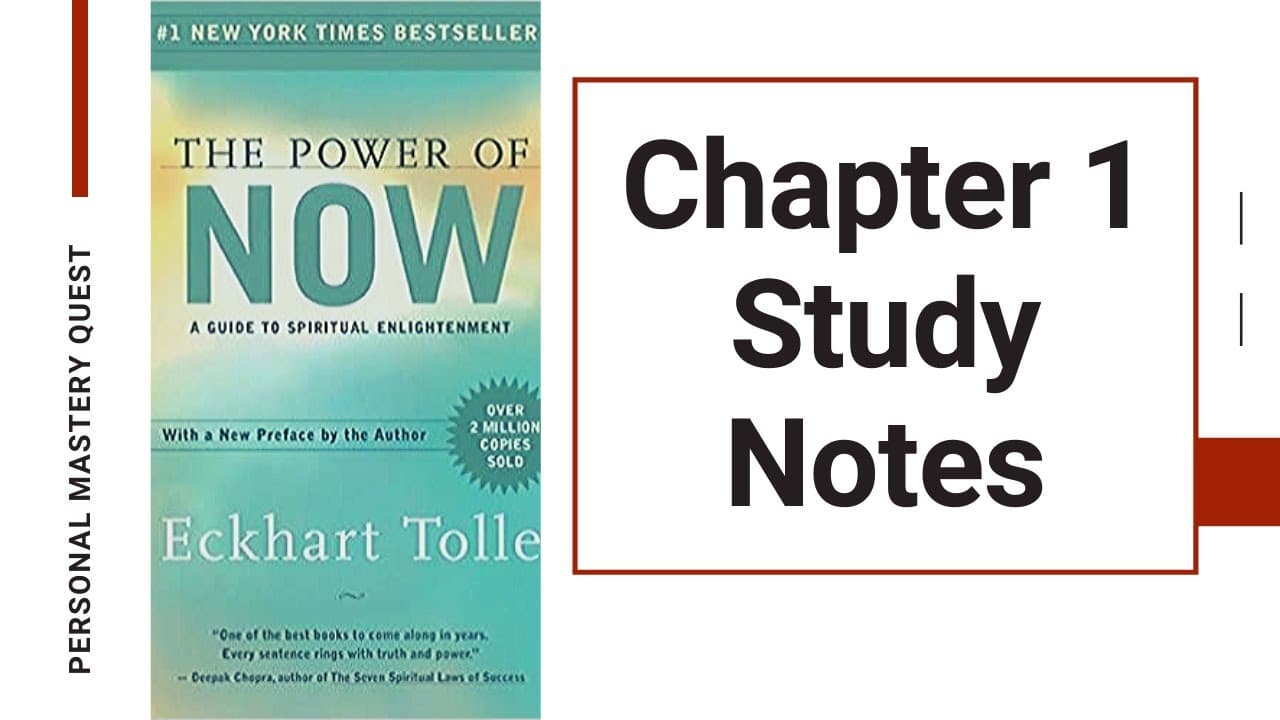
Chapter 1 begins with the claim that people remain inwardly poor despite material wealth when they have not discovered the joy and unshakable peace of being. External achievements cannot end suffering while identity remains attached to the mind, because possessions remain vulnerable to change and loss, which sustains anxiety and fear.
-
Enlightenment is presented as the natural recognition of oneness with being, not a superhuman achievement reserved for the future. The body, thoughts, beliefs, and personalities continually change, yet something stable observes those changes. Recognizing that observing presence as one’s true self weakens the illusion of being an isolated individual.
-
Being cannot be captured through thought or understood as a concept because it is the presence that knows thought and experience. Meditation and self-inquiry create opportunities to stop believing the mind, rest attention in the present, and notice that awareness remains. Repeated recognition gradually separates identity from mental activity without fighting it.
Read in Other Languages (beta)
Share This Summary 📚
Summarize YouTube Videos and Get Video Transcripts with 1-Click
Try YouTube Summary with ChatGPT & Claude or YouTube Transcript Generator