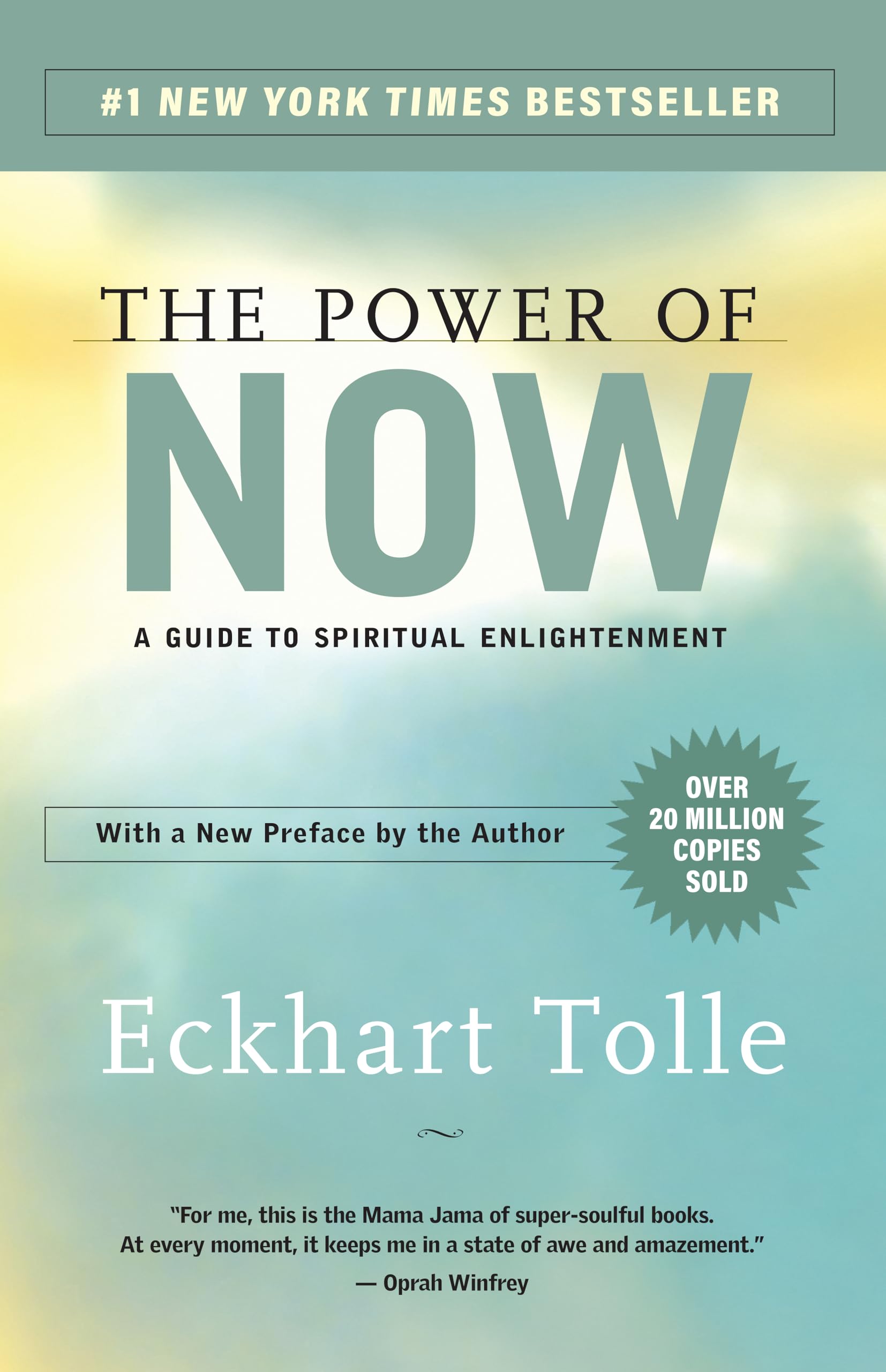
The Power of Now: A Guide to Spiritual Enlightenment
About This Book
Eckhart Tolle’s The Power of Now argues that most human suffering is self-created through identification with the mind. Across the most-highlighted passages, readers consistently gravitated to one central claim: freedom begins when you realize that you are not the voice in your head, not the compulsive thinker, and not the egoic story built from past and future.
Tolle frames the ego as a false self that survives by keeping attention trapped in psychological time. It replays the past for identity and projects into the future for fulfillment, while treating the present as either an obstacle or a means to an end. In his view, this is why anxiety, regret, resentment, stress, and inner conflict persist: the mind resists what is.
The book’s solution is deceptively simple: enter the Now. Tolle develops this through a sequence of ideas and practices.
- First, observe thought rather than merging with it.
- Second, feel emotions in the body instead of turning them into more thinking.
- Third, notice resistance, judgment, and nonacceptance as the immediate causes of pain.
- Fourth, practice surrender: accept the present moment, then act from clarity.
- Fifth, discover inner stillness, or “no-mind,” where creativity, peace, and a deeper sense of Being emerge.
A major thread is the “pain-body,” the accumulated emotional pain that feeds on unconscious identification. Tolle says it weakens when it is witnessed directly without judgment.
The structure blends spiritual philosophy with practical exercises: paying full attention to routine acts, feeling the inner body, watching the thinker, and asking what is happening inside you right now. For readers, the book’s enduring appeal seems to lie in this combination of radical spiritual claims and immediate, everyday application. Its message is not to fix life by thinking harder, but to become present enough that thought becomes a tool rather than a master.
Key Takeaways
- 1.You are not your mind; the first step toward freedom is noticing the thinker instead of identifying with it.
- 2.Psychological suffering grows when you resist the present moment through judgment, complaint, or inner nonacceptance.
- 3.The ego lives through past-based identity and future-based fulfillment, which is why presence weakens its grip.
- 4.Emotions reveal the state of the mind through the body, so feeling them directly can be more truthful than analyzing them.
- 5.Presence is not passivity: the practice is to accept the moment first, then act from clarity rather than resistance.
- 6.Accumulated pain persists when unconscious, but the so-called pain-body begins to dissolve when it is observed.
- 7.Creativity, peace, love, and joy arise most powerfully when thought is connected to stillness rather than constant mental noise.
Top Highlights
the single most vital step on your journey toward enlightenment is this: learn to disidentify from your mind.
Highlighted by 10 people
Enlightenment is not only the end of suffering and of continuous conflict within and without, but also the end of the dreadful enslavement to incessant thinking.
Highlighted by 9 people
Only past and future are considered important.
Highlighted by 9 people
Thinking and consciousness are not synonymous.
Highlighted by 9 people
Accept — then act. Whatever the present moment contains, accept it as if you had chosen it. Always work with it, not against it.
Highlighted by 8 people
Thinking has become a disease.
Highlighted by 7 people · 1 left a note
When you listen to that voice, listen to it impartially. That is to say, do not judge.
Highlighted by 7 people
Pleasure is always derived from something outside you, whereas joy arises from within.
Highlighted by 7 people
The pain that you create now is always some form of nonacceptance, some form of unconscious resistance to what is
Highlighted by 7 people
Buddha’s simple definition of enlightenment as “the end of suffering.”
Highlighted by 6 people · 1 left a note
AI Review
Glasp’s AI analysis of 29 reader highlights suggests a strong consensus classic: the book’s core ideas on presence, ego, and nonidentification are highly quotable and repeatedly saved. Reader notes are largely appreciative, with only minor hesitation around some abstract or "woowoo" language.
Pros
- +Highly resonant core message about disidentifying from the mind
- +Practical presence exercises embedded in ordinary activities
- +Memorable framing of anxiety, pain, and resistance
- +Strong quotability around ego, time, and acceptance
- +Connects spirituality with everyday emotional awareness
- +Useful distinction between thought, consciousness, and observation
Cons
- −Some metaphysical language may feel vague or overly abstract
- −Concepts like Being, inner energy, and pain-body may not persuade skeptical readers
- −Core ideas are reiterated often rather than argued analytically
Glasp AI analysis based on highlights from 29 readers.
Who Should Read This
This book is best for readers drawn to mindfulness, spirituality, meditation, or emotional self-observation. It especially fits people dealing with anxiety, overthinking, stress, recurring inner conflict, or the feeling that life is always happening somewhere in the future. Coaches, therapists, creatives, and readers of Buddhist or nondual ideas will find familiar themes. No formal background is required, but it helps if you’re open to contemplative language and can tolerate some metaphysical or “energy” terminology.
Frequently Asked Questions
What is the book about?
Who is it for?
What are the key lessons?
Is it worth reading?
What does Tolle mean by the ego?
What is the pain-body in the book?
Does the book say you should stop thinking completely?
How to Apply What You Read
- 1.Notice the voice in your head several times a day and label it as thought rather than self.
- 2.Practice full attention during one routine activity each day, such as washing your hands, walking, or closing the car door.
- 3.Ask yourself, "What is going on inside me right now?" and feel the answer in the body before analyzing it.
- 4.Accept the current moment before reacting, then choose whether to change the situation, leave it, or work with it.
- 5.Pause before problem-solving and spend a few breaths in silence so action comes from presence rather than agitation.
Discussion Questions
- Q1.Why do you think so many readers highlighted the idea that freedom begins by observing the thinker?
- Q2.Does the book’s distinction between practical time and psychological time feel persuasive in everyday life?
- Q3.How convincing is Tolle’s claim that most suffering comes from resistance to the present moment?
- Q4.What parts of the book feel practically useful, and what parts feel too abstract or metaphysical?
- Q5.How does the concept of the pain-body compare with modern ideas about trauma, triggers, or emotional conditioning?
- Q6.Can acceptance of the present coexist with ambition and long-term goals, or do those impulses conflict?
- Q7.What changes when you treat thoughts and emotions as objects of awareness rather than as your identity?
Recommended Books


Revisit Your Highlights, Deepen Your Understanding
Import your Kindle highlights to review, organize, and share the ideas that matter most to you.
Get the free browser extension