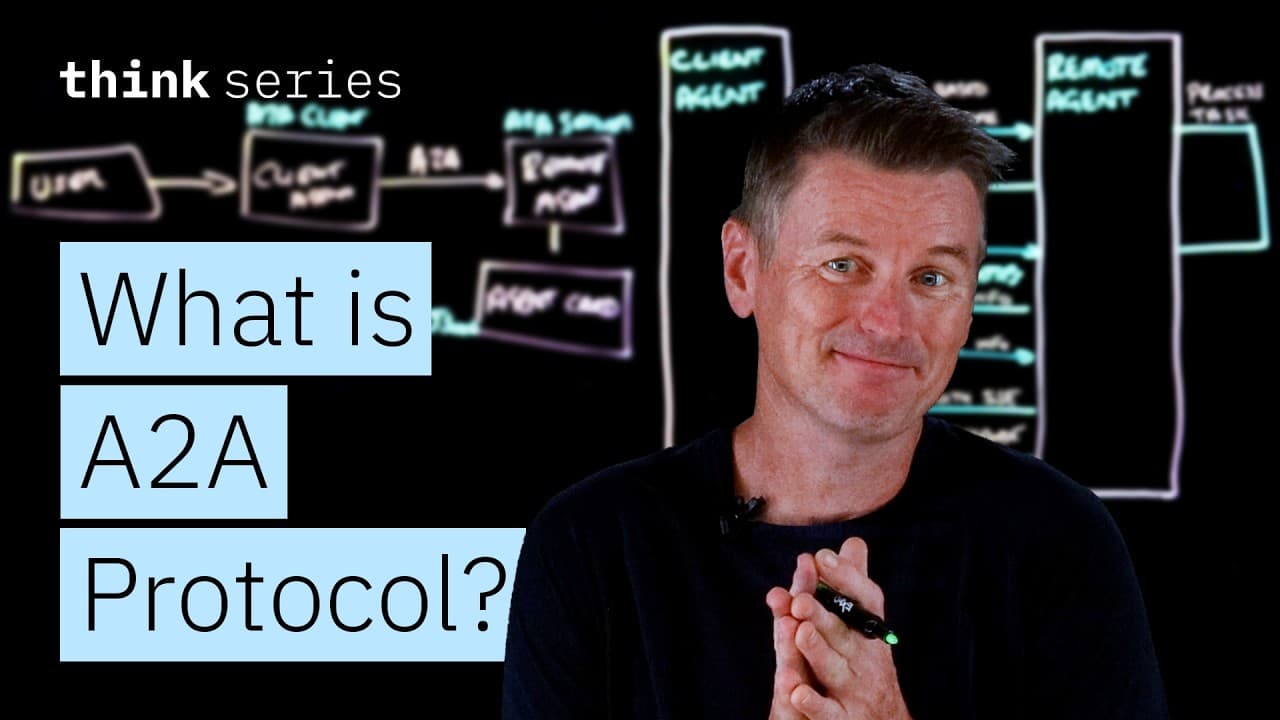
How do AI agents collaborate with A2A protocol?
TL;DR
A2A provides discovery, authentication, and standardized communication for agent to agent tasks. It uses agent cards, JSON RPC 2.0 over HTTPS, and optional streaming via SSE for long tasks. It preserves privacy by treating agents as opaque and relies on existing web standards for easy adoption.
Transcript
I may have brought up the topic of AI agents once or twice before. AI agents are autonomous systems. They perceive their environment. They make decisions based on those decisions. They can take actions. And this is all in service of achieving a goal. But how do different agents talk to each other to solve complex problems that a given agent can't s... Read More
Key Insights
- A2A enables multi agent collaboration through discovery, authentication, and communication stages.
- An agent card publishes identity, capabilities, and an endpoint for two way communication.
- Authentication occurs via security schemes defined in the agent card, followed by authorization by the remote agent.
- Communication uses JSON RPC 2.0 over HTTPS to exchange tasks and results.
- Artifacts are generated outputs from a task, such as documents or data.
- Streaming via Server Sent Events is available for long running tasks.
- A2A treats agents as opaque to protect privacy and IP, avoiding exposure of inner workings.
- The protocol relies on established web standards like HTTP and JSON for easier enterprise adoption.
Install to Summarize YouTube Videos and Get Transcripts
Explore YouTube Video Summarizer or Get YouTube Transcript Extractor
Questions & Answers
Q: A real search query question about the video (e.g. 'How to...', 'What is...', 'Why does...'). Question 1
A2A works by coordinating three stages discovery authentication and communication. Discovery lets a client agent find a remote agent by reading an agent card which describes identity capabilities and an endpoint. Authentication uses a security scheme from the agent card and authorization is handled by the remote agent before tasks are sent.
Q: Question 2
In the A2A model what is an agent card and what information does it contain The agent card is a metadata document served on the remote agent's domain it includes identity capabilities skills and a service endpoint URL that enables two way communication along with any authentication requirements. This card is essential for discovery and trust.
Q: Question 3
How does A2A ensure secure communication between clients and remote agents The client authenticates using the security scheme in the agent card and after successful authentication the remote agent handles authorization and access control. Communication then uses JSON RPC 2.0 over HTTPS to exchange tasks and results securely.
Q: Question 4
What happens if a task requires more information in A2A If additional information is needed the remote agent can notify the client agent and the client provides the details. The updated data is sent back to the remote agent which continues processing until the task completes and produces the necessary artifacts.
Q: Question 5
What is a long running task in A2A and how is it handled Streaming support via Server Sent Events allows status updates over an open HTTP connection when a task takes longer due to human interaction or external events This keeps the client informed while the remote agent processes.
Q: Question 6
What are artifacts in A2A Artifacts are tangible outputs generated during a task such as documents images or structured data These artifacts are returned to the client agent after the remote agent completes its work and can be used by the user or further automation.
Q: Question 7
Why is privacy emphasized in A2A The protocol treats AI agents as opaque entities so their internal memory proprietary logic or specific tool implementations remain hidden This protects intellectual property and sensitive data while still enabling collaboration through standard interfaces.
Q: Question 8
What standards does A2A rely on The protocol builds on HTTP JSON RPC and JSON metadata plus live streaming via SSE It aligns with common web standards to ease enterprise adoption and integration with existing systems while providing a universal channel for agent ecosystems.
Summary & Key Takeaways
-
A concise overview explains that A2A enables multiple autonomous agents to coordinate through a common, standards based protocol. It highlights three stages: discovery, authentication, and communication, with a focus on secure, private interactions and scalable collaboration between client and remote agents.
-
The video emphasizes practical components like agent cards that describe identity and capabilities, a JSON metadata document, and the use of JSON RPC 2.0 for task exchange, all over HTTPS. It also notes streaming support for long running tasks.
-
Privacy and standards are central themes, with A2A designed to keep internal agent logic private while leveraging HTTP, JSON RPC, and standard security practices for enterprise adoption.
Read in Other Languages (beta)
Share This Summary 📚
Summarize YouTube Videos and Get Video Transcripts with 1-Click
Try YouTube Summary with ChatGPT & Claude or YouTube Transcript Generator
Explore More Summaries from IBM Technology 📚

Summarize YouTube Videos and Get Video Transcripts with 1-Click
Try YouTube Summary with ChatGPT & Claude or YouTube Transcript Generator