How do functions act as vectors in linear algebra
TL;DR
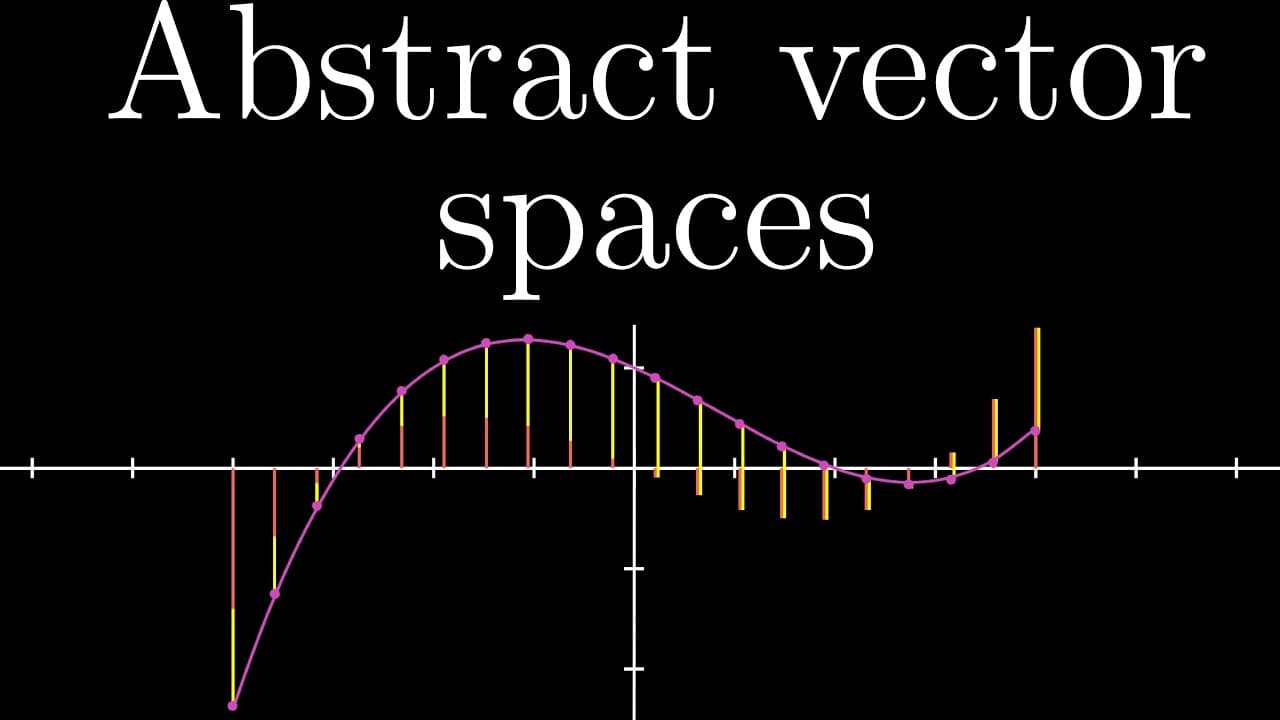
A vector space is defined by how objects can be added and scaled, not by their appearance. Functions form a vector space under pointwise addition and scaling, behaving like arrows or coordinate lists. Linear transformations preserve these operations, and derivatives illustrate a concrete linear operator, making infinite dimensional spaces manageable through basis vectors and matrix representations.
Transcript
I'd like to revisit a deceptively simple question that I asked in the very first video of this series. What are vectors? Is a two-dimensional vector, for example, fundamentally an arrow on a flat plane that we can describe with coordinates for convenience? Or is it fundamentally that pair of real numbers which is just nicely visualized as an arrow ... Read More
Key Insights
- Vectors can be generalized beyond arrows to include functions.
- A linear transformation preserves addition and scaling.
- Derivatives act as linear operators in function spaces.
- Basis functions allow infinite dimensional vector spaces to be handled.
- Matrix representations can describe operators on function spaces.
- Coordinate systems and bases reveal the same structure across objects.
- Polynomials with infinite basis form infinite coordinate vectors.
- The core idea is that many objects are vector spaces governed by the same rules.
Install to Summarize YouTube Videos and Get Transcripts
Explore YouTube Video Summarizer or Get YouTube Transcript Extractor
Questions & Answers
Q: How is a vector defined beyond an arrow in space?
A vector can be viewed as an object that supports addition and scalar multiplication, regardless of whether it is an arrow, a list of numbers, or a function. This abstraction lets us treat different mathematical objects with the same algebraic rules, enabling unified techniques like linear transformations and basis representations across diverse spaces.
Q: What makes a transformation linear?
A transformation is linear if it preserves both addition and scalar multiplication. That means applying the transformation to a sum gives the same result as summing the transformed inputs, and applying it to a scaled input equals the scaled transformed output. These properties ensure compatibility with the vector space structure and enable matrix representations.
Q: How does the derivative fit into linear algebra?
The derivative is an operator that maps one function to another and is linear because it satisfies additivity and scaling: the derivative of a sum equals the sum of derivatives, and the derivative of a scaled function equals the scaled derivative. This makes the derivative a natural linear operator in the space of functions.
Q: What is a basis in the context of function spaces?
A basis in a function space is a set of functions from which every function in the space can be formed by finite linear combinations of the basis elements. Choosing a natural basis, like powers of x for polynomials, allows every polynomial to be expressed as coordinates along these basis functions, analogous to standard vector coordinates.
Q: Can infinite-dimensional spaces be handled with matrices?
Yes, even though a function space may be infinite dimensional, we can describe linear transformations using infinite matrices whose columns are the coordinates of the transformed basis functions. While practical computations often truncate, the theoretical framework still relies on matrix-like representations to capture how a transformation acts on the whole space.
Q: What is the relationship between vectors, functions, and spaces in linear algebra?
All of these objects share the same underlying structure: they form vector spaces with defined rules for addition and scaling. Linear algebra studies how transformations act on these spaces, how to represent them with coordinates, and how properties like determinants, eigenvectors, and inner products generalize across different vector-like objects.
Q: Why is a linear transformation completely described by the basis?
Because any vector in the space can be expressed as a combination of basis vectors, applying the linear transformation to the entire vector reduces to applying it to each basis vector and combining the results. This means the image of any vector is determined entirely by the transformation of the basis, making the basis sufficient to characterize the transformation.
Q: How does the video unify different mathematical objects under linear algebra?
It shows that arrows, lists of numbers, and functions can all be treated as vector spaces with the same two operations, addition and scaling. Linear transformations, matrix representations, and concepts like eigenvectors or inner products then apply uniformly, revealing a common framework that explains diverse mathematical phenomena through the language of linear algebra.
Summary & Key Takeaways
-
This video argues that vectors can be generalized beyond arrows or lists of numbers to include functions, describing how addition and scaling apply to functions just as they do to ordinary vectors. It also introduces the concept of linear transformations, which preserve these operations, using the derivative as a key example.
-
A basis lets us describe any function in a vector space by scaling and adding basis functions, leading to a matrix representation even in infinite dimensions. The derivative becomes a linear operator expressible via a (potentially infinite) matrix, showing the unity of linear algebra across object types.
-
Axioms define vector spaces and guarantee that transformations are compatible with vector addition and scalar multiplication. This framework enables applying familiar tools like matrix multiplication to function spaces, reinforcing that many seemingly different mathematical objects share a common structure under the linear algebra umbrella.
Read in Other Languages (beta)
Share This Summary 📚
Summarize YouTube Videos and Get Video Transcripts with 1-Click
Try YouTube Summary with ChatGPT & Claude or YouTube Transcript Generator
Explore More Summaries from 3Blue1Brown 📚

Summarize YouTube Videos and Get Video Transcripts with 1-Click
Try YouTube Summary with ChatGPT & Claude or YouTube Transcript Generator