How Does the Brain Shape Dreams and the Self?
TL;DR
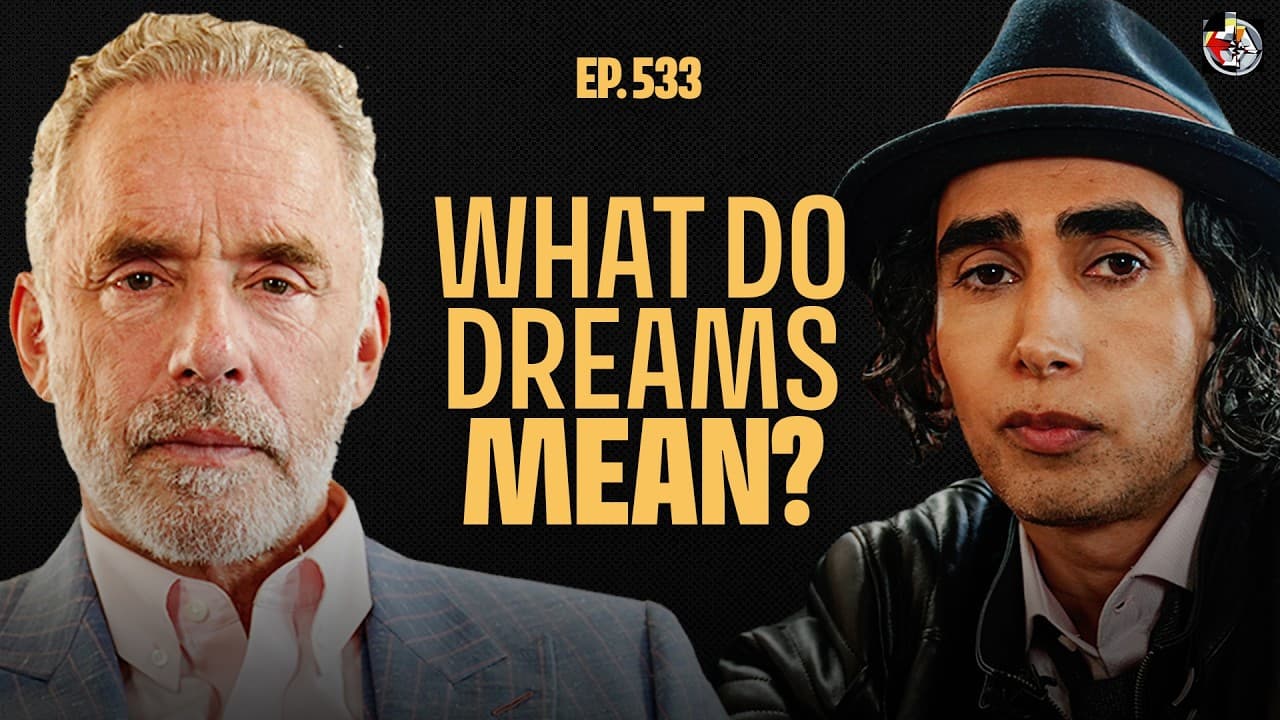
The brain is a dynamic, highly malleable system whose activity helps construct embodiment, perception, emotion, and behavior. Dreams may provide a space for exploring anomalies, while sleep paralysis combines REM-related bodily paralysis with waking awareness and frightening perceptions. Experiments such as the rubber hand illusion show that the brain can remap touch and the subjective sense of bodily ownership.
Transcript
so we look at the brain as something that's malleable and not fixed it's a dynamic object so the parial loes and the superior parial lul is specifically involved in creating a subjective sense of a self the feeling that I occupy this body and not somebody else's body right yung's idea was that the dream was a place of exploration for the remapping ... Read More
Key Insights
- The brain is a dynamic and highly malleable system, not a fixed object. Jalal describes its modules as fluid and hyperplastic, allowing anatomy, perception, emotion, behavior, and subjective experience to be examined as interacting parts of a changing whole.
- The subjective sense of self is associated with the parietal lobes, particularly the superior parietal lobule. This region contributes to the feeling that a person occupies their own body rather than somebody else’s body, linking brain function with embodiment and identity.
- The rubber hand illusion changes bodily perception through synchronized stimulation. When a hidden hand and a visible surface are stroked and tapped in matching patterns, a participant can begin experiencing literal touch sensations as if they arise from the visible surface.
- Somatosensory brain regions become active during the rubber hand illusion. The reported sensation is not presented as a metaphor, but as a perceptual remapping in which the brain assigns touch to something outside the participant’s visibly absent real hand.
- A useful neuroscience curriculum connects anatomical names with functions and broader contexts. Jalal organizes foundational structures such as the cortex and brain stem within narratives involving perception, disorders, experiments, art, and human nature, reducing reliance on isolated memorization.
- Clinical conditions can clarify the functions of particular brain structures. Jalal links obsessive-compulsive disorder with overactivity in the orbitofrontal cortex and discusses the striatum and basal ganglia in the context of Parkinson’s disease, integrating anatomy with recognizable functional problems.
- REM sleep paralysis leaves the body immobilized while dreaming continues. If awareness returns before the paralysis ends, a person may feel frozen, unable to speak, or compelled to wake themselves by attempting movement, yelling, or receiving help from another person.
- Dreams can function as a place for exploring and remapping anomalies. The discussion connects dream fantasy, adaptation, fear, culture, and conception, suggesting that unusual nocturnal experiences are shaped by both brain states and the meanings people assign to them.
Install to Summarize YouTube Videos and Get Transcripts
Explore YouTube Video Summarizer or Get YouTube Transcript Extractor
Questions & Answers
Q: How does the brain create a subjective sense of self?
The subjective sense of self is associated with the parietal lobes, especially the superior parietal lobule. This part of the brain contributes to the feeling that a person occupies their own body rather than another person’s body. The discussion treats embodiment as a constructed perception that can remain stable in ordinary life but can also be altered through carefully designed experiments.
Q: What does the rubber hand illusion demonstrate?
The rubber hand illusion demonstrates that bodily ownership and touch location can be remapped. A participant places a real hand beneath a table while a researcher strokes and taps it. The researcher simultaneously applies matching movements to a visible surface. After roughly two minutes, the participant may experience literal touch sensations as arising from that visible surface rather than solely from the hidden hand.
Q: Why is brain plasticity important for understanding perception?
Brain plasticity matters because perception is presented as dynamic rather than permanently fixed. Jalal describes the brain as highly malleable, with modules that can change how sensations and bodily ownership are organized. The rubber hand experiment illustrates this flexibility by showing that synchronized sensory information can shift where a person believes touch is occurring and what seems incorporated into the body.
Q: What happens to the body during REM sleep paralysis?
During REM sleep, the body is described as paralyzed from head to toe while dreaming occurs. Sleep paralysis happens when a person becomes aware while that immobilization remains active. The person may know that something unusual is happening but feel unable to move or speak. Attempts to escape can include trying to throw oneself from bed, yelling, or relying on another person to provide physical stimulation.
Q: Why can sleep paralysis feel like a monster attack?
Sleep paralysis can combine bodily immobilization, fear, and vivid dreamlike perception. Jalal describes sensing a monster approach from the corner of a room, climb onto his chest, and strangle him. Because the person is aware yet unable to move or speak normally, the experience can feel immediate and physically threatening rather than like an ordinary dream remembered after waking.
Q: How should introductory neuroscience be taught?
Introductory neuroscience should connect brain structures with their functions and place them within an intelligible narrative. Jalal includes foundational anatomy, such as the cortex and brain stem, but avoids presenting the material as names that must simply be memorized. He instead connects anatomy with experiments, disorders, perception, behavior, art, human nature, and examples from his own research and that of colleagues.
Q: How do neurological disorders help explain brain function?
Neurological and psychiatric conditions provide contexts for understanding what particular brain structures do. Jalal mentions overactivity in the orbitofrontal cortex when discussing obsessive-compulsive disorder. He also introduces the striatum and basal ganglia through Parkinson’s disease. These examples connect anatomical terminology with functional consequences, making the organization of the brain easier to understand than isolated memorization would.
Q: What role might dreams play in processing unusual experiences?
Dreams are presented as a possible arena for exploration and the remapping of anomalies. The discussion connects this idea with dream fantasy, adaptation, fear, culture, and conception. Rather than treating dreams only as random images, the conversation considers how they may engage unusual experiences and how cultural meanings can shape a person’s emotional interpretation of frightening nocturnal events.
Summary & Key Takeaways
-
Dr. Baland Jalal presents the brain as a fluid, highly plastic system rather than a collection of fixed modules. His introductory neuroscience course connects essential anatomy with function, perception, emotion, behavior, art, and human nature. Clinical examples include brain structures associated with obsessive-compulsive disorder and Parkinson’s disease.
-
The rubber hand illusion demonstrates how synchronized visual and tactile stimulation can alter perceived bodily ownership. When a researcher repeatedly strokes a hidden real hand while matching those movements on a visible surface, the participant may experience touch as arising from that surface, accompanied by activity in somatosensory brain regions.
-
Dreams and sleep paralysis illustrate how brain states can generate compelling subjective realities. REM sleep involves paralysis while dreaming, and waking during that condition can leave someone unable to move or speak. Fearful experiences may include sensing an approaching monster, chest pressure, strangulation, or other culturally interpreted threats.
Read in Other Languages (beta)
Share This Summary 📚
Summarize YouTube Videos and Get Video Transcripts with 1-Click
Try YouTube Summary with ChatGPT & Claude or YouTube Transcript Generator
Explore More Summaries from Jordan B Peterson 📚





Summarize YouTube Videos and Get Video Transcripts with 1-Click
Try YouTube Summary with ChatGPT & Claude or YouTube Transcript Generator