How Does Phenomenology Shape Personality Theory?

TL;DR
Rapid scientific and technological change can destabilize the inherited belief systems people use to interpret the world and decide how to act. Cultural structures develop through broad agreement over long periods, so they cannot easily keep pace with technologies such as contraception and digital dating, while religion can both unite insiders and separate them from outsiders.
Transcript
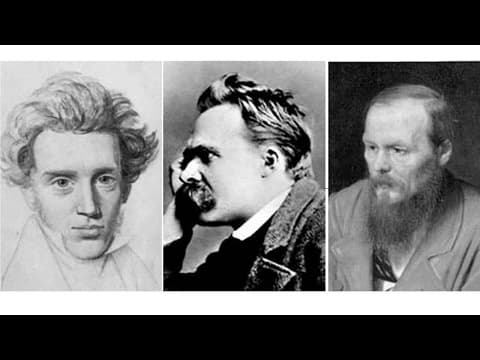
So last time, we talked a little bit about the state of the world of belief, I suppose, by the end of the nineteenth century and I talked to you a little about Nietzsche, and Dostoevsky, and Kierkegaard. Um, a very large number of the clinical theories that we’re going to be discussing for another two lectures after this one have been influenced by... Read More
Key Insights
- Philosophers can identify deep cultural structures of meaning, including their strengths, weaknesses, and possible transformations. The lecture connects this philosophical work to clinical personality theories because those theories often inherit assumptions developed by thinkers who recognized cultural changes before most other people did.
- Nietzsche and Dostoevsky are presented as leading interpreters of the fragmentation of Western meaning near the end of the nineteenth century. The rise of the scientific worldview is identified as a major cause of this disruption, leaving modern people caught between inherited beliefs and transformed conditions.
- Cultural discontinuity occurs when belief systems and technological systems change the world faster than ancient cultural constructs can adapt. The resulting conflict between modernism and traditional belief is described as globally significant, including within the struggle between Islamic fundamentalism and modernity.
- Efficient contraception is described as the radical technological element in women's emancipation because it placed reproductive capacity under voluntary choice. The lecture argues that this change affected family size, marriage, economic productivity, and many other fundamental social structures more deeply than a purely political explanation suggests.
- Women's education and rights are associated in the lecture with sharply rising economic productivity and rapidly declining birth rates. Iran is offered as an example of movement from family sizes well above replacement to sizes below replacement within one or two generations.
- Population decline is presented as a likely consequence of falling fertility after a projected peak of nine billion people within thirty to fifty years. The lecture points to Western countries, China, and Japan as places where younger generations are not having enough children to replace the population.
- Religion is described as a large-scale expression of human grouping rather than the fundamental cause of tribal conflict. Religious systems may separate outsiders, but they also allow thousands or millions of people to share a hierarchy of values and coexist relatively peacefully within it.
- Collective norms require widespread agreement about whether social rules are useful and just. Because even small behavioral changes can provoke prolonged disagreement, large belief systems develop slowly and may fragment into revolutionary or violent movements when their legitimacy loses broad acceptance.
- Related book: 12 Rules for Life
- Export your Kindle highlights to Glasp: How to Download Highlights and Notes from Kindle
Install to Summarize YouTube Videos and Get Transcripts
Explore YouTube Video Summarizer or Get YouTube Transcript Extractor
Questions & Answers
Q: How does rapid technological change affect cultural beliefs?
Rapid technological and cognitive change can make inherited beliefs uncertain as explanations and insufficient as guides to action. Cultural constructs may take centuries, thousands of years, or even longer to develop, while major technologies can alter everyday life within a much shorter period. The lecture argues that this mismatch produces cultural discontinuity because shared norms cannot adapt at the same speed as transformed practical conditions.
Q: Why are philosophers relevant to clinical personality theories?
Many clinical personality theories are influenced by philosophers who explored the deep systems of meaning underlying culture. The lecture suggests that highly intelligent and highly open thinkers can be ahead of their time, identifying cultural structures, weaknesses, strengths, and likely transformations before these become obvious. Nietzsche, Dostoevsky, and Kierkegaard therefore provide intellectual context for understanding the clinical theories discussed in the course.
Q: Why did Nietzsche and Dostoevsky anticipate a crisis of meaning?
Nietzsche and Dostoevsky recognized that the cultural systems of meaning supporting Western civilization were fragmenting near the end of the nineteenth century. The lecture identifies the rise of the scientific worldview as probably the most important cause. Their concern was that the breakdown of established beliefs would leave modern people without continuous, dependable frameworks for interpreting reality and deciding how to act.
Q: How did contraception transform traditional social structures?
Efficient contraception, particularly the birth control pill, placed women's reproductive capacities under voluntary choice. According to the lecture, this change radically affected fundamental social structures, including marriage and family formation. It also contributed to declining family sizes and altered the practical conditions surrounding women's emancipation. These transformations occurred too quickly for cultural constructs developed across centuries to adjust without uncertainty and conflict.
Q: How are women's rights connected to economic productivity?
The lecture states that educating women is followed by a dramatic rise in economic productivity and describes granting rights to women as the best predictor of increasing productivity in a modernizing state. It also acknowledges uncertainty about causation. The effect may come directly from women's rights, or both outcomes may reflect an underlying belief structure capable of extending the concept of rights more broadly.
Q: Why does the lecture predict that population may decline?
The lecture says projections placed the population peak at nine billion people within thirty to fifty years, followed by stabilization or rapid decline. Falling family sizes after women gain education and reproductive choice are presented as part of this process. Western countries, China, and Japan are cited as places where younger people are not having enough children to replace the existing population, although the projection is described as uncertain.
Q: Does religion primarily cause tribal violence?
The lecture argues that tribalism, rather than religion itself, underlies much group conflict. Chimpanzees are used as evidence that intergroup aggression can exist without religious motives. Large religions are described as manifestations of grouping tendencies that also produce dominance hierarchies. Although religious identities can divide insiders from outsiders, shared traditions can also unite very large populations within a common hierarchy of values.
Q: What is terror management theory in the lecture?
Terror management theory is presented as the idea that belief systems protect people from fear of death. Ernest Becker, identified in the lecture as a sociologist and a Freudian, argued that cultural systems let people attribute finite and infinite significance to their actions and understand themselves in relation to mortality. The lecture adds that terror management theories do not specify this protective mechanism particularly well.
Summary & Key Takeaways
-
The lecture places clinical personality theories within a philosophical background shaped by Nietzsche, Dostoevsky, and Kierkegaard. Nietzsche and Dostoevsky are presented as especially perceptive observers of how Western systems of meaning fragmented near the end of the nineteenth century, partly because the scientific worldview challenged traditional beliefs and produced cultural discontinuity.
-
Rapid cognitive and technological change can make inherited cultural systems uncertain in theory and insufficient in practice. Efficient contraception is offered as a major example because voluntary reproductive choice transformed family size, marriage, women's social position, and economic life faster than longstanding cultural structures could adapt to the resulting conditions.
-
Large belief systems depend on mutual agreement about shared rules and values. Religion can divide outsiders, but it can also unite thousands or millions of people within a common hierarchy. Terror management theory adds that cultural beliefs help people understand their actions in relation to mortality, although the lecture says its mechanism is insufficiently specified.
Read in Other Languages (beta)
Share This Summary 📚
Summarize YouTube Videos and Get Video Transcripts with 1-Click
Try YouTube Summary with ChatGPT & Claude or YouTube Transcript Generator
Explore More Summaries from Jordan B Peterson 📚



Summarize YouTube Videos and Get Video Transcripts with 1-Click
Try YouTube Summary with ChatGPT & Claude or YouTube Transcript Generator