Jacob Howland on How the Talmud and Plato Overlap
TL;DR
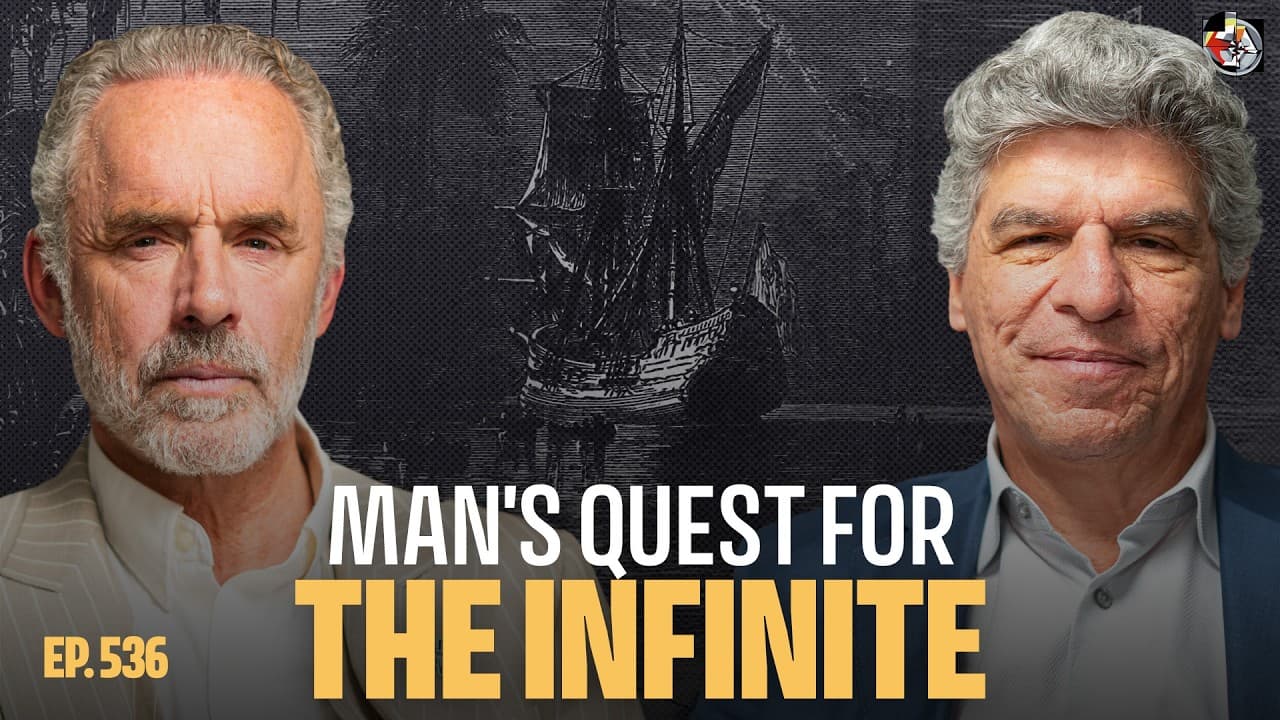
The root word of 'question' is 'quest,' framing a question as a plea awaiting revelation followed by internalized dialogue. The Babylonian Talmud, at two and a half million words, works much like Plato's dialogues: it privileges questions over answers and stages fictional debates between rabbis who lived centuries apart, often beginning from a practical problem.
Transcript
One of the things I figured out recently the significance of the fact that the root word of question is quest. You have a question which is your plea to the gods. Let's say you await a revelation and then the critical process is something like internalized dialogue. I got interested in the Talmud. It's a lot like the Platonic dialogues and you have... Read More
Key Insights
- The root word of 'question' is 'quest,' meaning a question functions as a plea to the gods where one awaits a revelation, followed by a critical process of internalized dialogue.
- The Babylonian Talmud contains two and a half million words and is the main Talmud, while the Jerusalem Talmud contains about a million words.
- The Talmud resembles the Platonic dialogues because it is a fictional colloquy that brings rabbis who lived centuries apart into debate and discussion.
- The Talmud privileges questions over answers, with most debates and discussions leaving questions unresolved rather than settled.
- Both the Talmud and Plato often begin with a practical question, such as who owns a tomato plant that leans from one vegetable plot into a neighbor's plot.
- Jacob Howland is Dean of Intellectual Foundations at the University of Austin and was McFarlin Professor of Philosophy Emeritus at the University of Tulsa, where he taught from 1988 to 2020.
- The conversation centers on the relationship between Athens and Jerusalem, framed as the tension between enlightenment rationality and science and the underlying metaphysical or narrative substrate.
- One fundamental question appears in both the Hebrew Bible and Plato, and confronts what happens when finite beings try to find meaning and are afflicted by infinity in some way.
Install to Summarize YouTube Videos and Get Transcripts
Explore YouTube Video Summarizer or Get YouTube Transcript Extractor
Questions & Answers
Q: How does the Talmud resemble Plato's dialogues?
Jacob Howland describes the Talmud as a fictional colloquy, which he says is the only way to describe it, that brings rabbis who maybe lived centuries apart into debate and discussion. Like the Platonic dialogues, the Talmud will start with a practical question and then open outward. He compares this to how Plato's dialogue the Laches begins with Socrates running into a couple of men discussing whether their kids should study with a new-fangled weapon, and within a few pages they are talking about deeper matters.
Q: What is the connection between the words 'question' and 'quest'?
Howland says he recently figured out the significance of the fact that the root word of question is quest. On this view, a question is your plea to the gods, where you await a revelation. The critical process that follows is something like internalized dialogue. This framing suggests that questioning is not merely intellectual but a kind of pursuit or petition, awaiting an answer and then working it through in inner debate, which parallels the questioning method found in both the Talmud and Platonic philosophy.
Q: How large is the Talmud and how many are there?
According to Howland, there are two Talmuds. The main one is the Babylonian Talmud, which contains two and a half million words. The Jerusalem Talmud is about a million words, but the Babylonian one is the main one. He calls it a massive corpus. This scale reflects the enormous body of accumulated debate, discussion, and commentary the Talmud represents, staging fictional dialogue among rabbis separated by great stretches of time and privileging questions throughout.
Q: Who is Jacob Howland?
Jacob Howland is a philosopher and longtime academic who is Senior Vice President for Academic Affairs and Dean of Intellectual Foundations at the University of Austin. Previously he was McFarlin Professor of Philosophy Emeritus at the University of Tulsa, where he taught from 1988 to 2020 and served as the first chairman of the combined department of philosophy and religion. He studied philosophy, history, and English at Swarthmore, fell in love with Plato, and did graduate work at Penn State, writing a dissertation on Plato's political philosophy.
Q: What is the alignment problem discussed in relation to AI?
Peterson describes the alignment problem as the challenge of how to ensure that autonomous intelligences, which is what large language models are developing into, will have the well-being of human beings as one of their priorities or maybe their top priority. Howland is interested in the interface between modern technology, AI for example, and philosophy, partly in an attempt to solve this problem. Peterson notes he has used LLMs quite a bit and helped program custom ones, calling them uncanny machines whose direction no one knows.
Q: What fundamental question appears in both the Hebrew Bible and Plato?
Howland says there is a question he knows to be absolutely fundamental because it shows up both in the Hebrew Bible and in Plato. The discussion frames it around what happens in a universe where finite beings try to find some meaning and encounter or are afflicted by infinity in some way, which is described as a terrifying thought. The broader conversation connects this to the relationship between Athens and Jerusalem, rationality and science, and the underlying metaphysical substrate beneath the enlightenment project.
Q: Why does Howland think ancient stories matter today?
Howland argues that if we lose touch with those ancient stories, we lose our ability to actually understand what is going on. He points to Elijah, whose foes were the nature worshippers, and notes this is relevant in today's society given the rise of nature worship. The conversation frames ancient religious texts as a narrative substructure beneath enlightenment rationality, arguing that the flaws in the enlightenment have become so structural that a new pathway forward has to be found and is likely already emerging.
Q: What new educational institutions are mentioned in the conversation?
The conversation references several new institutions attempting to reorient modern higher education, including the University of Austin, where Howland is involved, along with Peterson Academy and Rosston College, with which Peterson has been involved. Peterson describes the University of Austin as one of a handful of institutions attempting to traditionally reorient modern higher education, and he presents the appearance of these new institutions as an indication that something revolutionary on the intellectual side is beginning to emerge.
Summary & Key Takeaways
-
Jordan Peterson speaks with philosopher Jacob Howland, a longtime academic involved with the new University of Austin, which attempts to traditionally reorient modern higher education. Howland is also interested in the interface between modern technology like AI and philosophy, partly to address the alignment problem of ensuring autonomous intelligences prioritize human well-being.
-
Howland grew up split between aesthetic and scientific influences: his father was a Cornell biology professor descended from a Mayflower passenger, and his mother was a Jewish writer from blue-collar Chicago. He initially planned to study physics but fell in love with Plato, studying philosophy, history, and English at Swarthmore.
-
After moving to Tulsa, Howland grew interested in the Talmud and noticed its resemblance to the Platonic dialogues. Both privilege questions over answers and begin from practical problems before opening into deeper inquiry, staging debates among figures separated by time much like Plato staged dialogues with Socrates.
Read in Other Languages (beta)
Share This Summary 📚
Summarize YouTube Videos and Get Video Transcripts with 1-Click
Try YouTube Summary with ChatGPT & Claude or YouTube Transcript Generator
Explore More Summaries from Jordan B Peterson 📚


Summarize YouTube Videos and Get Video Transcripts with 1-Click
Try YouTube Summary with ChatGPT & Claude or YouTube Transcript Generator