What causes people to treat birthdays as normal days
TL;DR
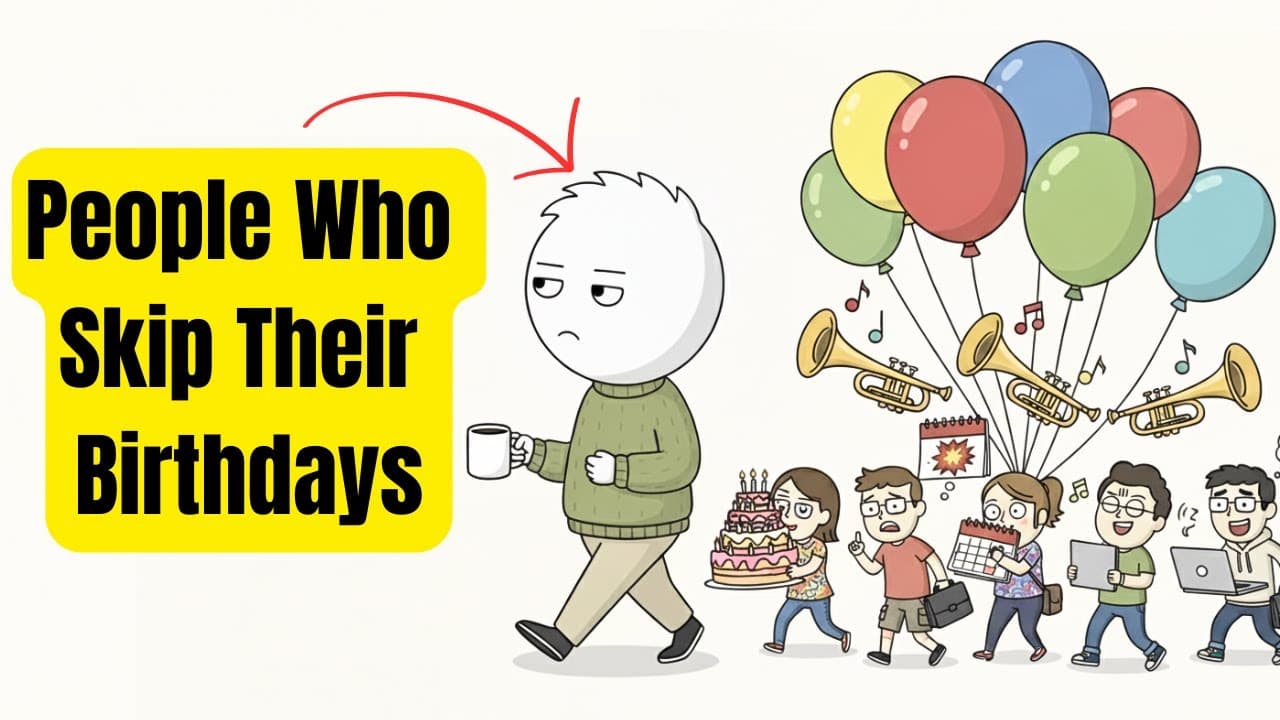
The video argues that treating birthdays like ordinary days is a strategic coping mechanism. It highlights how control over celebrations, fear of disappointment, mortality awareness, and high internal standards shape this behavior. Cultural context and authentic self worth also influence whether someone coins a casual approach to their birthday.
Transcript
Your birthday is tomorrow and you just don't care. While everyone around you is planning their birthday month like it's a royal coronation, you're treating the anniversary of your existence like Tuesday. Your friends think you're weird. Your family thinks you're being difficult. But what if you're not being weird? You're being smart. Or what if you... Read More
Key Insights
- Birthdays can trigger the spotlight effect anxiety, making attention feel uncomfortable and motivating some people to minimize the day to preserve autonomy.
- The key to why some treat birthdays casually is a desire to stay in control of the narrative, since others often decide how celebrations unfold.
- Prediction error from unmet birthday expectations can lead to a protective strategy of normalizing the day to dodge disappointment.
- Mortality awareness associated with birthdays can either intensify celebration or drive avoidance as a calming mechanism.
- High internal locus of control correlates with lower satisfaction from traditional celebrations, pushing some toward normal day behavior.
- Idealization paralysis describes people who dream of a flawless birthday and refrain from acting to avoid perceived failure when reality falls short.
- Cultural programming shapes birthday significance, with some cultures not emphasizing individual birthdays, making casual treatment more common.
- Authentic self-worth reduces the need for special birthday validation, whereas some use the day to compensate for lacking self-esteem on other days.
- More videos from this channel:
- More from this channel: Psychology Simplified
Install to Summarize YouTube Videos and Get Transcripts
Explore YouTube Video Summarizer or Get YouTube Transcript Extractor
Questions & Answers
Q: What is the spotlight effect anxiety and how does it relate to birthdays?
Spotlight effect anxiety is the fear of being the center of attention and how others perceive you. In the context of birthdays, it can make people feel exposed or uncomfortable when attention is on them, prompting some to treat the day as normal to avoid feeling watched or judged. This protective mechanism aligns with a broader desire for personal control over how and when others celebrate them.
Q: How does control influence birthday behavior according to the video?
Control influences birthday behavior by giving individuals power over how they are celebrated. If people fear losing narrative agency to others, they may reject elaborate plans or public attention. By treating the day as ordinary, they keep the agenda in their own hands, avoiding unwanted gifts, venues, or songs that could make them feel vulnerable.
Q: What role does mortality awareness play in the psychology of birthday behavior?
Mortality awareness makes birthdays reminders of aging and time passing. Some cope by celebrating more to affirm life and vitality, while others minimize the day to reduce existential anxiety. This dynamic is part of terror management theory, which explains how reminders of death influence behavior and emotional responses around milestones.
Q: What is idealization paralysis and how does it affect birthdays?
Idealization paralysis occurs when someone envisions a perfect birthday so vividly that reality cannot measure up, leading to inaction. People with this trait may refrain from acting on their birthday plans, preferring to protect the fantasy rather than risk disappointment. This reflects high openness and neuroticism in personality traits.
Q: How can culture alter how birthdays are celebrated, according to the transcript?
Culture shapes how birthdays are valued: some cultures emphasize family and elders over individual celebrations, and some do not celebrate on the actual birth date. This context can make casual birthday behavior normal rather than unusual, highlighting that baseline expectations differ across cultural backgrounds.
Q: What is authentic self worth and how does it relate to birthday celebrations?
Authentic self worth means valuing oneself from internal validation rather than external praise. People with secure self esteem may not rely on birthdays for their sense of worth, treating the day as optional. This contrasts with those who seek big celebrations as a compensation for days when they feel less valued.
Q: How does prediction error affect expectations around birthdays?
Prediction error arises when birthday outcomes do not match internal simulations of how the day should unfold. A large gap between expectation and reality can cause disappointment, leading some to curb expectations and treat the day as normal as a coping strategy to avoid emotional setbacks.
Q: Why might someone who is highly birthday obsessed still appear to treat birthdays normally?
Some individuals are the most birthday obsessed because they privately experience intense emotions and unmet expectations, yet externally they avoid overt celebration to protect themselves from potential disappointment. This paradox shows how internal drives can diverge from observable behavior, resulting in seemingly ordinary responses on an important day.
Summary & Key Takeaways
-
A casual birthday approach can be a rational response to control concerns, prediction errors, and the fear of disappointment, rather than a sign of indifference. The video ties these behaviors to attachment styles, autonomy needs, and mortality awareness, showing a spectrum of motivations.
-
Cultural and familial context matters, as some cultures de emphasize individual birthdays while others elevate them. This background influences whether treating birthdays casually is normal for a person or a sign of deeper psychological processing.
-
Healthy self esteem can reduce the need for external validation on birthdays, making the day feel optional rather than essential, while some people may still pursue intense celebration as a compensatory behavior for other days in the year.
Read in Other Languages (beta)
Share This Summary 📚
Summarize YouTube Videos and Get Video Transcripts with 1-Click
Try YouTube Summary with ChatGPT & Claude or YouTube Transcript Generator
Explore More Summaries from Psychology Simplified 📚



Summarize YouTube Videos and Get Video Transcripts with 1-Click
Try YouTube Summary with ChatGPT & Claude or YouTube Transcript Generator