How to Trade ICT Power of Three AMD Setups
TL;DR
Trade ICT Power of Three by identifying accumulation, waiting for manipulation outside the range, and seeking the distribution move. Start with higher-time-frame order flow or a draw on liquidity, then use either a reversal entry during manipulation or a continuation entry during distribution. The framework works across one-minute, five-minute, and higher-time-frame price action, so read on for entry and confirmation details.
Transcript
how's it going everyone this video is going to be over ict's power of three or accumulation manipulation and distribution we'll first briefly go over what open high low close and open low high close is before jumping into what the power of three is how to identify it and some examples now before we begin the most important part is to have some high... Read More
Key Insights
-
- Higher-time-frame order flow or a draw on liquidity is required to give the setup a directional narrative. Without that context, identifying accumulation, manipulation, and distribution becomes pattern trading rather than an informed attempt to anticipate where price may expand.
-
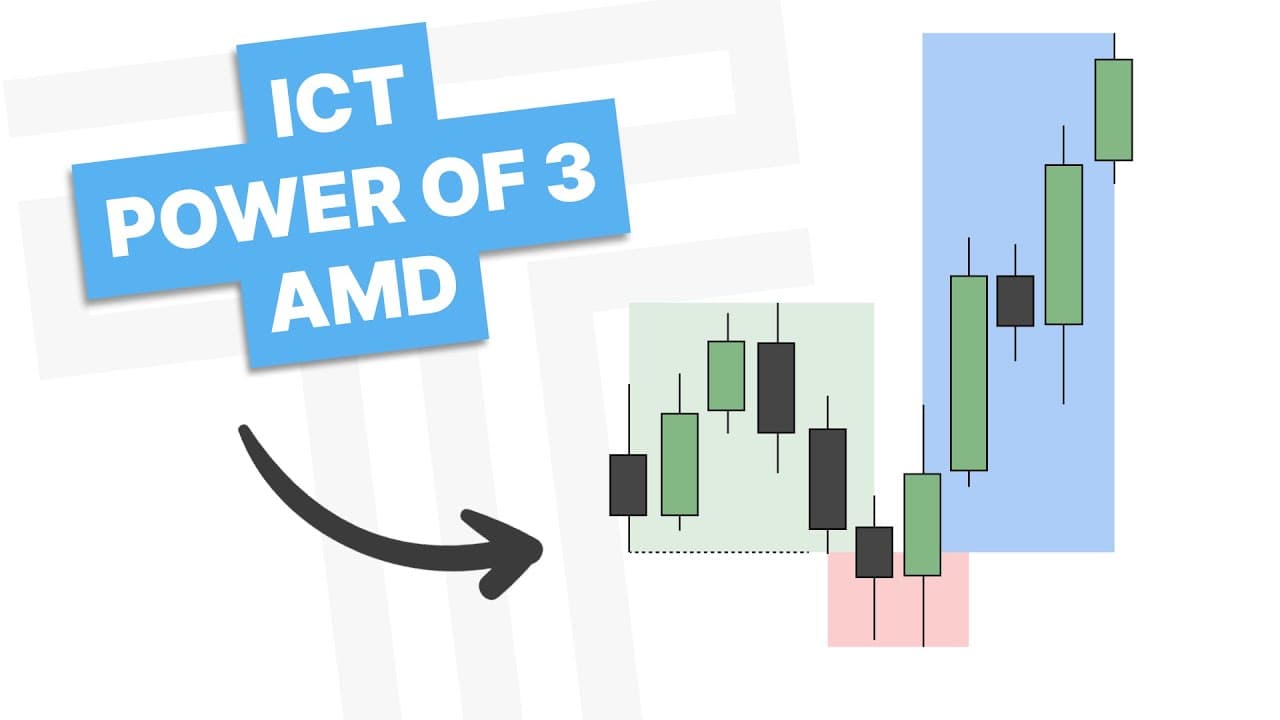
- ICT Power of Three is a sequence of accumulation, manipulation, and distribution. Price first consolidates, briefly breaks outside the range to interact with liquidity and traders' positions, then reverses and expands in the direction of the distribution phase.
-
- Accumulation is a range or consolidation that builds liquidity above old highs and below old lows. These areas contain buy stops and sell stops that can later be reached during the manipulation phase before price begins its larger directional movement.
-
- Manipulation is a false breakout beyond the accumulation range. A downside manipulation can stop early long positions and induce breakout sellers before an upward distribution, while an upside manipulation can stop shorts and attract breakout buyers before price distributes lower.
-
- Distribution is the expansion phase that creates the bulk of the intraday range. In an open-low-high-close profile, downside manipulation creates the lower wick before upward expansion, while an open-high-low-close profile uses upside manipulation before downward expansion.
-
- Reversal and continuation patterns provide two possible entry approaches. A trader can seek a reversal within the manipulation to capture more of the distribution, or wait for distribution to begin and use a continuation setup if the initial reversal is missed or unsuitable.
-
- Aggressive movement out of and back into a range can reveal accumulation more clearly than searching for a perfect consolidation. Displacement back inside supports the manipulation interpretation, while failure to displace back can indicate that price is likely to continue beyond the range.
-
- Standard-deviation projections can estimate potential distribution targets by measuring the manipulation move. The examples monitor the first standard deviation, the 2 to 2.5 area, and the 4 to 4.5 area, then compare those projections with equal lows, session lows, or other PD arrays.
- "the most important part is to have some higher time frame order flow or Draw on liquidity" (0:28)
- "the power of three or AMD refers to accumulation manipulation and distribution" (1:11)
- "now accumulation is a range or a consolidation" (1:17)
- "now when we enter manipulation it is a false breakout outside of this range" (1:25)
- "the first thing I want to talk about is this concept is fractal" (3:06)
Install to Summarize YouTube Videos and Get Transcripts
Explore YouTube Video Summarizer or Get YouTube Transcript Extractor
Questions & Answers
Q: What is ICT Power of Three, or AMD?
ICT Power of Three, also called AMD, is a sequence of accumulation, manipulation, and distribution. Price consolidates during accumulation, makes a false breakout during manipulation, and then expands directionally during distribution.
Q: Why is higher-time-frame context important for ICT Power of Three?
Higher-time-frame order flow or a draw on liquidity provides the setup's directional narrative. Without that context, the approach becomes pattern trading rather than an attempt to anticipate the likely expansion direction.
Q: How do you identify accumulation in an AMD setup?
Accumulation is a range or consolidation. It creates buy stops above old highs and sell stops below old lows, forming liquidity that price can interact with during manipulation.
Q: What confirms manipulation in the Power of Three model?
Manipulation is a false breakout outside the accumulation range. In the chart examples, price moves aggressively beyond the range, sweeps a low, and then moves aggressively back inside the range.
Q: How does manipulation affect traders' positions?
A downside manipulation can stop traders who entered long during accumulation and induce breakout sellers before price reverses higher. An upside manipulation can stop early shorts and induce breakout buyers before price reverses and distributes lower.
Q: How can traders enter an ICT Power of Three setup?
One approach is to look for a reversal pattern within manipulation and attempt to capture the whole distribution. The second is to wait for distribution to begin and seek a continuation entry if the reversal was missed or is unsuitable.
Q: Which entry tools are used in the chart examples?
The examples use an inversion or the Box setup based on a previous candle body's low. One example places the stop at the manipulation low and looks for 2 R, while another targets an old high.
Q: Can ICT Power of Three be used on multiple time frames?
Yes, the transcript describes the concept as fractal and applies it to lower and higher time frames. The examples move from a one-minute chart to a five-minute chart and then examine the daily candle's intraday profile.
Summary & Key Takeaways
-
ICT Power of Three describes a three-stage price sequence: accumulation, manipulation, and distribution. Accumulation forms a consolidation with buy stops above old highs and sell stops below old lows. Manipulation creates a false breakout that stops existing positions and attracts breakout traders before price reverses into the intended expansion move.
-
Entries can be taken through a reversal pattern inside the manipulation or a continuation pattern after distribution begins. The examples use inversions, the Box setup, prior candle bodies, and protective stops beyond the manipulation low. The objective is to capture the expansion move or a substantial portion of the intraday range.
-
The framework is fractal and can be applied to lower-time-frame ranges or the profile of an entire daily candle. Asian or London consolidation may become accumulation, London may create the daily wick through manipulation, and New York may deliver distribution. Standard-deviation projections and nearby liquidity can provide possible distribution targets.
Read in Other Languages (beta)
Share This Summary 📚
Summarize YouTube Videos and Get Video Transcripts with 1-Click
Try YouTube Summary with ChatGPT & Claude or YouTube Transcript Generator
Explore More Summaries from TTrades 📚


Summarize YouTube Videos and Get Video Transcripts with 1-Click
Try YouTube Summary with ChatGPT & Claude or YouTube Transcript Generator