How to Use Order Blocks for Trade Continuations
TL;DR
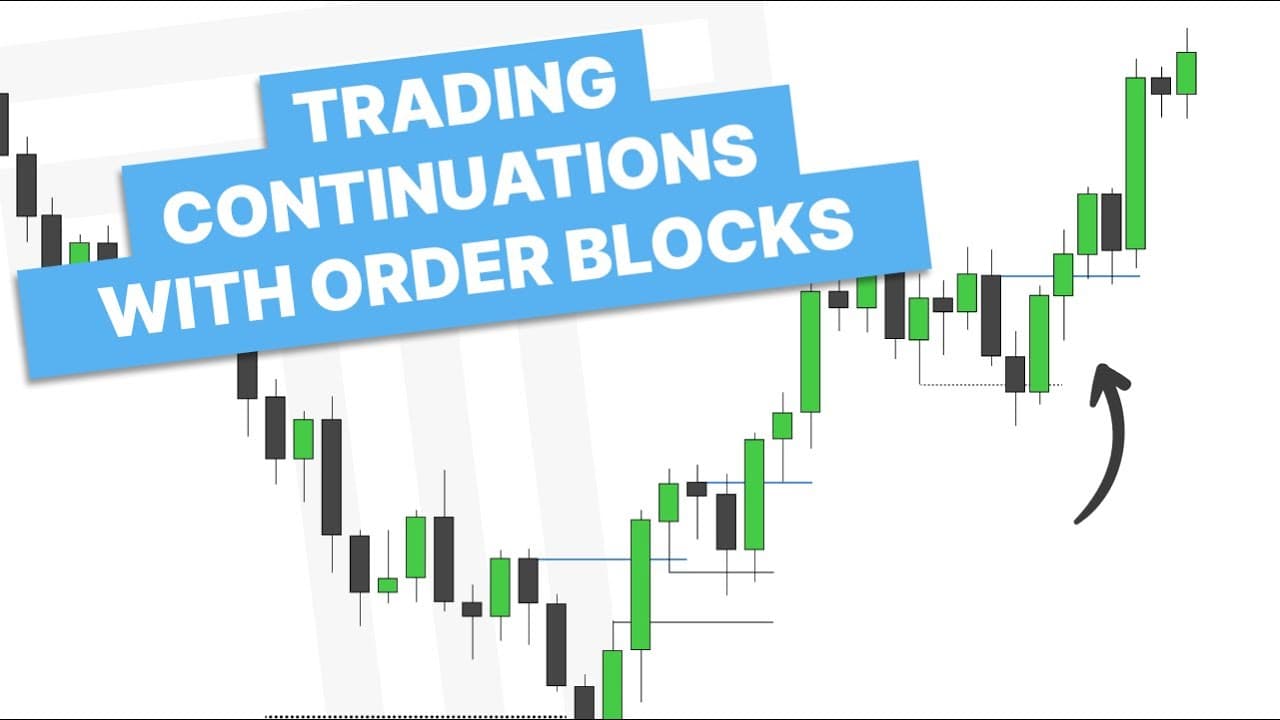
Order blocks can be used to identify trade continuation opportunities after a reversal has been confirmed. By waiting for a higher low to form and utilizing fair value gaps or sweeps of lows, traders can position themselves for better risk-to-reward trades. This method allows traders to capitalize on expansions without needing to catch initial reversal moves.
Transcript
how's it going everyone this video is going to be over using order blocks for continuations now if you've seen my reversal sequence video you know how I look at reversals and many think that if they miss the reversal entry they are left behind and that is simply not true that just means the reversal is confirmed and then I can look for continuation... Read More
Key Insights
- Order blocks are used to identify continuation entries after a reversal is confirmed.
- A higher low formation is crucial for confirming continuation opportunities.
- Fair value gaps and sweeps of lows are key levels for entry points.
- Using correlated assets and SMT can validate order blocks without a sweep.
- Reversal entries can be missed, but continuation entries offer another chance.
- Aligning multiple time frames increases the probability of successful trades.
- Volume imbalances can serve as important levels in combination with order blocks.
- Fractal nature of order blocks allows application across different time frames.
Install to Summarize YouTube Videos and Get Transcripts
Explore YouTube Video Summarizer or Get YouTube Transcript Extractor
Questions & Answers
Q: How to identify continuation entries using order blocks?
Continuation entries using order blocks are identified by waiting for a higher low to form after a confirmed reversal. Traders look for price retracements into fair value gaps or sweeps of lows, which serve as key levels for entry. By placing stops below these lows, traders can optimize their risk-to-reward ratios and capitalize on expansion moves.
Q: What are fair value gaps in trading?
Fair value gaps in trading refer to price levels where there is an imbalance between buyers and sellers, often seen as gaps on a price chart. These gaps are significant as they can act as key levels of support or resistance. Traders use them to identify potential entry or exit points, particularly in continuation strategies using order blocks.
Q: Why is a higher low formation important in continuation trades?
A higher low formation is important in continuation trades as it confirms the strength of the trend and provides a more reliable entry point. It indicates that buyers are stepping in at higher levels, supporting the continuation of the upward trend. This formation allows traders to place stops at more strategic levels, enhancing the risk-to-reward ratio of the trade.
Q: How do correlated assets and SMT validate order blocks?
Correlated assets and SMT (Smart Money Techniques) validate order blocks by providing additional confirmation of a price move. When one asset shows a sweep of lows while a correlated asset does not, it suggests a divergence that can indicate a strong reversal or continuation point. This validation helps traders identify high-probability trades when using order blocks.
Q: What role do volume imbalances play in order block trading?
Volume imbalances play a critical role in order block trading as they highlight areas of significant buying or selling pressure. These imbalances often occur at key levels, such as fair value gaps, and can act as additional confirmation for entry or exit points. By incorporating volume imbalances, traders can enhance their analysis and improve the accuracy of their trades.
Q: Can order block strategies be applied to different time frames?
Yes, order block strategies can be applied to different time frames due to their fractal nature. This means that the same principles used on lower time frames can be scaled up to higher time frames, allowing traders to align their strategies for greater consistency. This flexibility makes order block trading a versatile approach suitable for various market conditions.
Q: What is the significance of a reversal sequence in trading?
A reversal sequence in trading signifies a potential change in market direction, often marked by a series of price actions that indicate a shift from a downtrend to an uptrend or vice versa. Recognizing this sequence allows traders to identify the end of a trend and the beginning of a new one, providing opportunities for both reversal and continuation trades.
Q: How do you manage risk in order block trading?
Risk in order block trading is managed by strategically placing stop-loss orders below key levels such as higher lows or fair value gaps. This approach ensures that potential losses are minimized if the trade does not move as anticipated. Additionally, by focusing on high-probability entries and aligning trades with the broader trend, traders can enhance their risk-to-reward ratios.
Summary & Key Takeaways
-
Order blocks provide a method for traders to enter continuation trades after a reversal has been confirmed. By focusing on higher low formations and fair value gaps, traders can find optimal entry points with favorable risk-to-reward ratios. This approach allows participation in expansion moves without needing to catch the initial reversal.
-
Continuation entries are identified through the formation of order blocks, typically after a reversal sequence has been confirmed. Traders look for price retracements into fair value gaps or sweeps of lows to position themselves for the next leg of a trend, utilizing correlated assets and SMT for additional validation.
-
Order block trading is applicable across different time frames, allowing traders to align their strategies for higher probability trades. By focusing on key levels such as fair value gaps and volume imbalances, traders can effectively manage entries and exits, maximizing their potential for profit in trending markets.
Read in Other Languages (beta)
Share This Summary 📚
Summarize YouTube Videos and Get Video Transcripts with 1-Click
Try YouTube Summary with ChatGPT & Claude or YouTube Transcript Generator
Explore More Summaries from TTrades 📚
Summarize YouTube Videos and Get Video Transcripts with 1-Click
Try YouTube Summary with ChatGPT & Claude or YouTube Transcript Generator