How to Trade Candlestick Wicks for Reversals
TL;DR
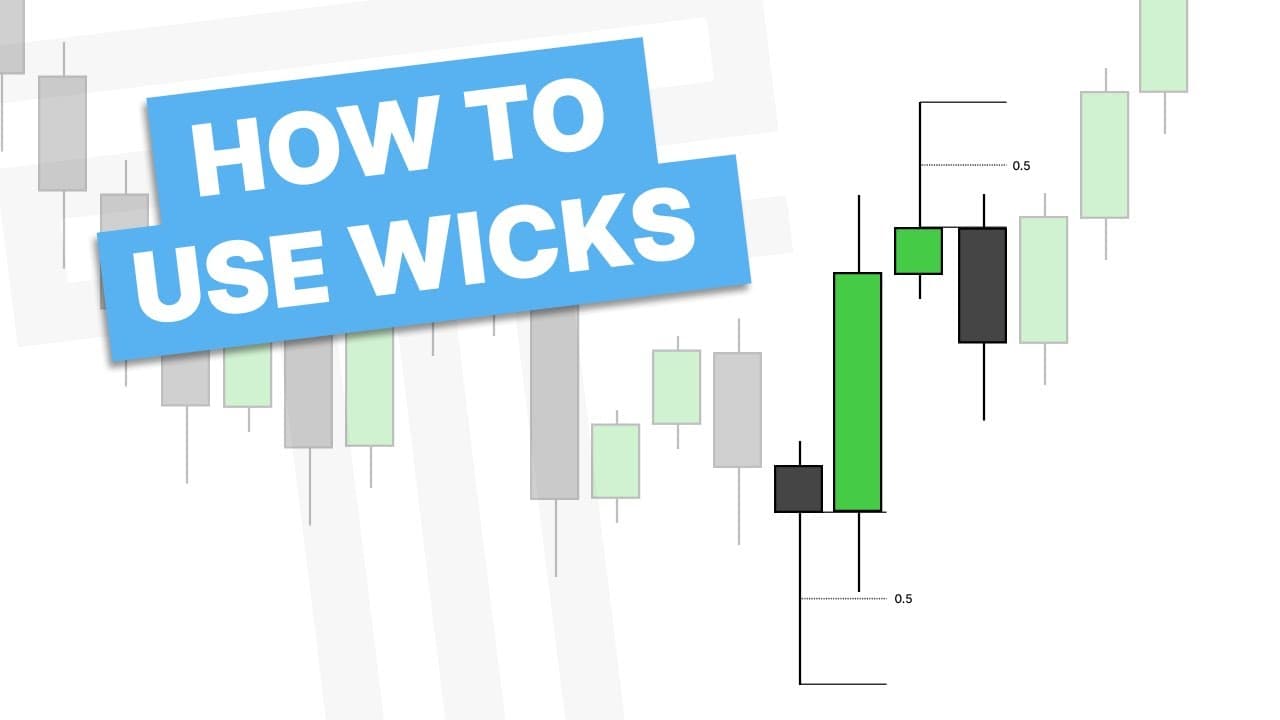
Mark 0.5 of a candle's wick, measured from the body to the high or low, and watch whether the next candle's price action holds that midpoint. For a bullish move, price should open, form its low in the upper half of the wick, then expand higher. Closing back through the 50% level means the wick was disrespected and the opposite extreme is more likely to be taken out.
Transcript
how's it going everyone this video is going to be over Wicks I'm first going to talk about what Wicks are on the lower time frame and then talk about what it looks like for a wick to be respected or for a wick to be disrespected so what are Wicks Wicks are generally a lower time frame reversal where during a given time period price had an aggressiv... Read More
Key Insights
- A wick forms when price makes an aggressive move in one direction and then reverses back within a single time period, so what looks like one candle on a higher time frame is a full reversal sequence on the lower time frame.
- The level to mark on any wick is 0.5, measured from the candle body to the wick's high or low. This midpoint splits the wick into a half that should hold price and a half that should not be violated.
- A respected bullish wick produces a specific sequence on the higher time frame candle: price opens, forms its low inside the upper half of the wick, trades to its high, and closes, leaving the 50% level untouched from below.
- A respected bearish wick shows the mirror sequence: price opens, forms its high inside the lower half of the wick, then expands lower into targets such as previous days' lows before closing.
- A wick is disrespected when price trades through and closes beyond the 50% level. Once that happens, the opposite extreme of the wick candle becomes the more likely target rather than the anticipated expansion.
- The setup is often paired with a liquidity sweep: price takes out a previous day high or low, closes back inside the range, and that rejection leaves the large wick that gets marked for the next period's reaction.
- Time frame pairing matters throughout the examples: daily wicks are monitored on the hourly chart, and hourly wicks are monitored on the 5 minute chart, so the lower time frame confirms whether the higher time frame wick is holding.
- Context can lower probability even when the pattern is present. In the gold example, a wick appeared while price sat inside a consolidation range that had taken out the high but not the low, which made the bullish reaction less likely before it failed.
Install to Summarize YouTube Videos and Get Transcripts
Explore YouTube Video Summarizer or Get YouTube Transcript Extractor
Questions & Answers
Q: What is a candlestick wick and why does it signal a reversal?
A wick is generally a lower time frame reversal. During a given time period, price had an aggressive reaction: it moved aggressively lower and then back higher, or aggressively higher and then back lower. That round trip leaves a wick on the higher time frame candle. Dropping to the lower time frame reveals the actual push and rejection inside that period, which is why the wick area marks where price was rejected and can act as a reversal zone on subsequent candles.
Q: How do you mark a wick on a chart?
The main focus is marking out 0.5 of the wick, measured from the candle body to the low for a lower wick, or from the body to the high for an upper wick. That gives a midpoint that splits the wick into two halves. For a bullish expectation, the upper half of the wick should support price higher. For a bearish expectation, the lower half should support price lower. Everything after that is watching whether price holds or violates that 50% level.
Q: What does it look like when a wick is respected?
On a bullish wick, price opens, forms its low inside the upper half of the wick, then trades higher and closes, producing an open, low, high, close sequence on the higher time frame candle. On a bearish wick, price opens, forms its high inside the lower half of the wick, then expands lower. In both cases the 50% level of the wick is never closed through, and the lower time frame shows the reversal building inside that half before expansion.
Q: How do you know when a wick has been disrespected?
A wick is disrespected when price trades through the 50% level and closes beyond it instead of reversing inside the wick's designated half. In the examples, after price closed over 50% of a bearish wick, it became more likely to reach for the high than to expand lower. After price fell through 50% of a bullish wick, it became more likely to trade through the low. The failed reversal effectively flips the expected direction.
Q: Which time frames should you use to trade wicks?
The approach pairs a higher time frame wick with a lower time frame for confirmation. Daily candle wicks are monitored on the hourly chart, where you watch for the open, low or high, and expansion to form relative to the marked 50% level. Hourly candle wicks are monitored on the 5 minute chart in the same way. The higher time frame provides the level and the directional bias, while the lower time frame shows in real time whether that level is being respected.
Q: Why does price sweep a previous day high or low before a wick setup?
Several examples begin with price trading into a previous day high or low, taking that level out, and then closing back inside the range. That rejection is what creates the large wick in the first place. Combined with a daily bias, the sweep and close back inside signals a likely reversal for the following period, so the wick left behind by the sweep becomes the area to mark at 0.5 and monitor on the lower time frame.
Q: What role do fair value gaps play in this wick strategy?
Fair value gaps appear alongside wicks in several of the examples. In one case, price reached into a fair value gap and closed back inside the previous candle's range, leaving a large wick, and the subsequent low formed inside that gap before expanding higher. In a failed example, price closed over 50% of the wick while inverting a fair value gap, which turned that area into support and led price higher to take out the high instead of expanding lower.
Q: How do you manage a trade when the wick level is not cleanly respected?
In the final example, price closed over the marked level, so the reversal was not taken immediately. The options given are to skip the trade entirely or to wait for more confirmation, such as a close below the level. Once that confirming close appeared, the entry was on the close, the stop was placed on the high, and the target was 2R, which was reached. The point made is that nothing works perfectly every time, so the amount of confirmation required varies with what the lower time frame shows.
Summary & Key Takeaways
-
A wick is a lower time frame reversal: within a single time period, price moved aggressively in one direction and then came back, leaving the wick behind. Viewing that same period on a lower time frame shows the actual push and rejection that created the shape, which is why wicks act as reversal areas.
-
The level to mark is 0.5 of the wick, measured from the candle body to the wick's high or low. For a bullish continuation, the upper half of the wick should support price higher. For a bearish continuation, the lower half should support price lower. The next candle ideally opens, forms its extreme inside that half, then expands away.
-
When the 50% level is traded through and price closes on the other side of it, the wick is disrespected and the reversal has failed. In the examples shown, price then reached for the opposite extreme, taking out the low after a failed bullish wick or the high after a failed bearish wick, sometimes inverting a fair value gap in the process.
Read in Other Languages (beta)
Share This Summary 📚
Summarize YouTube Videos and Get Video Transcripts with 1-Click
Try YouTube Summary with ChatGPT & Claude or YouTube Transcript Generator
Explore More Summaries from TTrades 📚
Summarize YouTube Videos and Get Video Transcripts with 1-Click
Try YouTube Summary with ChatGPT & Claude or YouTube Transcript Generator