How to Use SMT Divergence in Trading
TL;DR
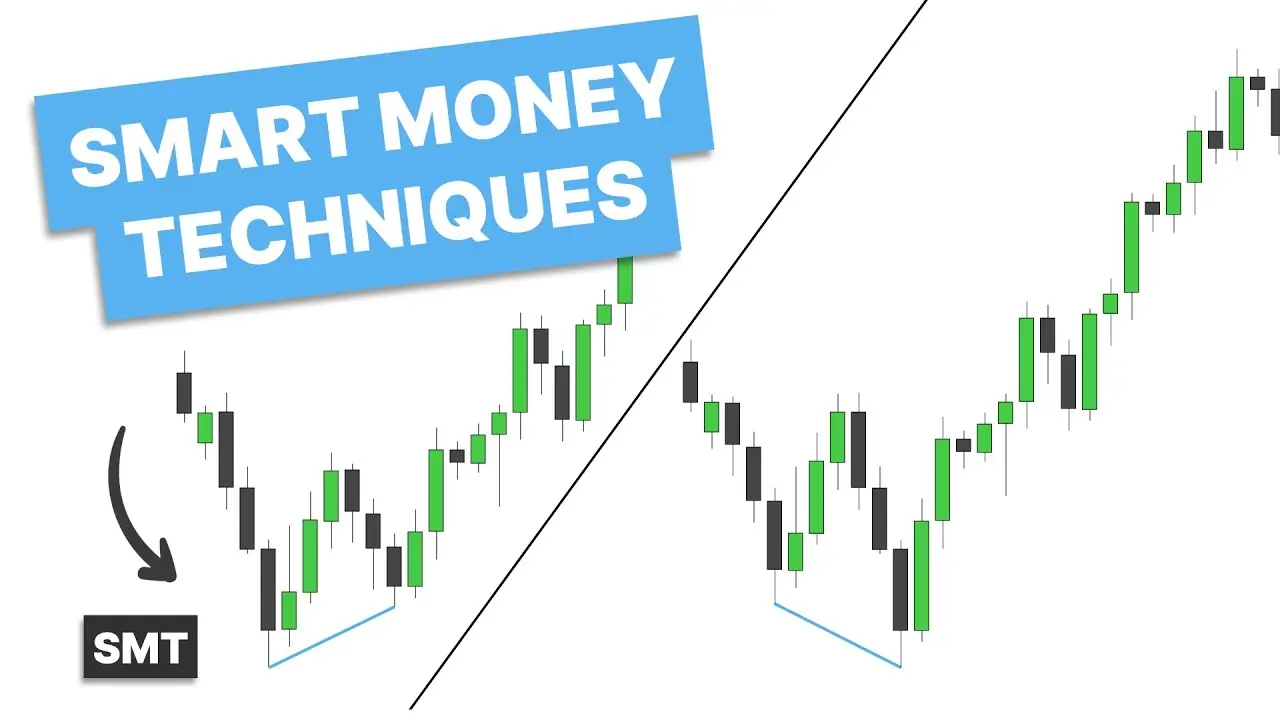
SMT divergence is a technique used in trading to identify potential reversals by observing divergences in correlated or inversely correlated assets. By comparing the price movements of such assets, traders can spot discrepancies that indicate a divergence, which, when aligned with other technical factors, can confirm reversal points. This method is a confluence tool rather than a standalone strategy.
Transcript
how's it going everyone this video is going to be over smt or smart money techniques or smart money tools we'll first hop into a PDF to go over what it is how to identify it and then hop into the charts to go over a few examples and how it is used now if you haven't already be sure to check the link in the description below for access to my free Di... Read More
Key Insights
- SMT divergence is used to identify potential reversals by observing divergences in correlated assets.
- Correlated pairs like ES and NQ should move in the same direction; divergence indicates SMT.
- Bearish SMT occurs when one asset makes a high and higher high while the other makes a high and lower high.
- SMT is a confluence tool for reversals, not a standalone trading strategy.
- Lower time frame SMTs can confirm reversals when aligned with higher time frame levels.
- Session highs, lows, and higher time frame levels are key areas to look for SMTs.
- Inversely correlated assets, like EUR/USD vs. USD, require observing opposite price movements for SMT.
- SMT within a fair value gap occurs when one asset reaches into the gap while the other does not.
Install to Summarize YouTube Videos and Get Transcripts
Explore YouTube Video Summarizer or Get YouTube Transcript Extractor
Questions & Answers
Q: How to use SMT divergence in trading?
SMT divergence is used to identify potential reversals by observing divergences in correlated or inversely correlated assets. Traders look for discrepancies in price movements, such as one asset making a higher high while another makes a lower high. This divergence, when aligned with other technical indicators and higher time frame levels, can confirm reversal points. It's a confluence tool rather than a standalone strategy.
Q: What is a bearish SMT example?
A bearish SMT example occurs when two correlated assets, such as ES and NQ, are expected to move in the same direction, but one diverges. If one asset makes a high and a higher high while the other makes a high and a lower high, this indicates a bearish SMT. This divergence suggests a potential reversal, especially when aligned with other technical factors.
Q: When should SMT be used for trading?
SMT should be used as a confluence tool for trading, particularly in identifying potential reversals. It is most effective when aligned with higher time frame levels, session highs and lows, and other technical indicators. Traders should not rely on SMT alone but use it to confirm reversal points in conjunction with a pre-existing trading strategy.
Q: How does SMT work with inversely correlated assets?
With inversely correlated assets, such as EUR/USD versus USD, SMT works by observing opposite price movements. For example, when one asset makes a new high, the inversely correlated asset should make a new low. A divergence occurs when the expected opposite movement does not happen, indicating a potential reversal. This requires practice and understanding of the assets' correlation.
Q: What is SMT within a fair value gap?
SMT within a fair value gap occurs when one asset reaches into the gap, indicating a potential reversal, while the other does not. This divergence highlights a discrepancy in price action, which, when aligned with other technical factors, can confirm a reversal point. It is a more advanced use of SMT, requiring an understanding of internal range liquidity and price dynamics.
Q: Why is SMT not a standalone strategy?
SMT is not a standalone strategy because it serves as a confluence tool to confirm potential reversals rather than providing direct trade signals. It requires alignment with other technical indicators, higher time frame levels, and a pre-existing trading strategy to be effective. Relying solely on SMT can lead to false signals without the support of additional analysis.
Q: What are session highs and lows in SMT?
Session highs and lows are key levels in SMT where traders look for potential divergences. These are the highest and lowest points reached during a trading session. SMT occurring at these levels can indicate a potential reversal, especially when aligned with other technical factors. They serve as important reference points for identifying SMT in trading.
Q: How is SMT used with higher time frame levels?
SMT is used with higher time frame levels to confirm potential reversals. By aligning SMT with key levels such as session highs, lows, and other significant price points on higher time frames, traders can increase the reliability of reversal signals. This approach ensures that SMT is not used in isolation but as part of a comprehensive trading strategy.
Summary & Key Takeaways
-
SMT divergence helps traders spot potential reversals by analyzing divergences in price movements of correlated or inversely correlated assets. It serves as a confluence tool rather than a standalone strategy. By aligning SMT with higher time frame levels and other technical indicators, traders can confirm reversal points.
-
Correlated assets should move in tandem, and any deviation, such as one asset making a higher high while another makes a lower high, indicates SMT. This divergence can be used to anticipate reversals, especially when aligned with session highs, lows, and other key levels.
-
Inversely correlated assets require observing opposite price movements for SMT. SMT within a fair value gap occurs when one asset reaches into the gap while the other does not, indicating a potential reversal. This technique aids in confirming reversal points when combined with other trading concepts.
Read in Other Languages (beta)
Share This Summary 📚
Summarize YouTube Videos and Get Video Transcripts with 1-Click
Try YouTube Summary with ChatGPT & Claude or YouTube Transcript Generator
Explore More Summaries from TTrades 📚
Summarize YouTube Videos and Get Video Transcripts with 1-Click
Try YouTube Summary with ChatGPT & Claude or YouTube Transcript Generator