How to Configure Hermes Agent for Reliable Work
TL;DR
Use Opus for the strongest task completion, ChatGPT if an existing subscription keeps costs manageable, or GLM 5.2 for the lowest-cost option presented. Run at least two Hermes profiles so one can diagnose and repair another, and reduce unnecessary friction by choosing accounts and platforms that fit your workflow while remaining accountable for every instruction.
Transcript
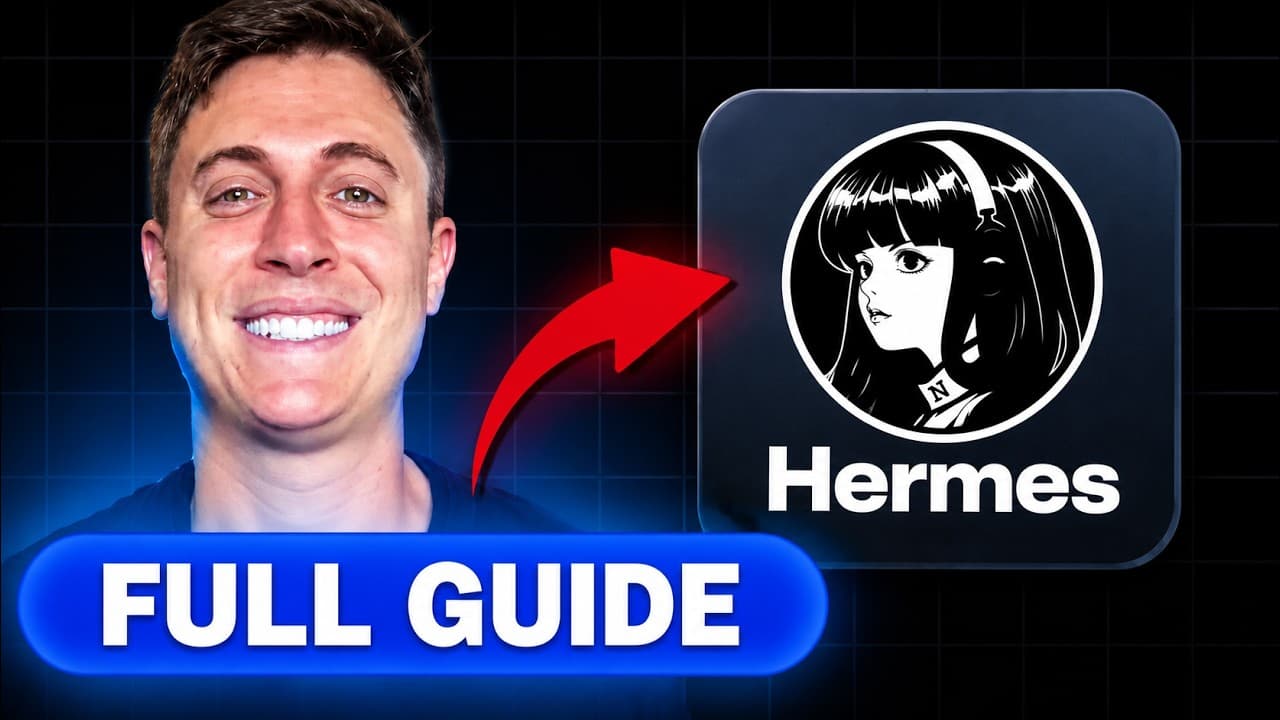
Hermes Agent is the most powerful software ever made. When used correctly, you literally have your own full-time AI employee. Here's the thing, though. When used incorrectly, it's basically just a normal chatbot. In this video, I will go over every lesson I've learned from using Hermes Agent for hundreds of hours the last four months. If you stick ... Read More
Key Insights
- Opus is the presenter's first choice for Hermes Agent because, in his experience, it continues working through difficult tasks and reliably reaches completion. He considers that dependability valuable enough to justify spending about $40 per day and $1,400 during the previous month on Opus credits.
- ChatGPT is the presenter's practical recommendation for people who already pay for a subscription and do not want another major expense. He says versions 5.5 and later work well enough with Hermes, although he finds them less dependable, warm, and enjoyable than Opus.
- GLM 5.2 is the lowest-cost model option recommended in the transcript. The presenter describes it as substantially cheaper than Opus and ChatGPT while still capable of completing work, although he considers its conversational style more robotic than the two more expensive alternatives.
- Multiple Hermes profiles are a failover system because agents can monitor, diagnose, and repair one another when an account, token, or service stops working. The presenter recommends maintaining at least two agents and suggests that some users may benefit from a third or fourth profile.
- A Hermes profile is another agent configuration within the platform. Users can ask an existing agent to create a new profile, specify the desired model and name, or open the Hermes dashboard, select Profiles, click Create, and complete the provided configuration flow.
- Model diversity is useful because a backup profile can remain available when the account powering another profile fails. The presenter runs his primary agent with Opus and a secondary agent with ChatGPT, and he also suggests considering a Gemini account or Open Claw as additional backup options.
- Dedicated hardware and separate accounts are not presented as requirements for every Hermes agent. The presenter argues that buying another Mac Mini and creating separate Gmail, Apple, and iMessage accounts adds needless friction, provided users carefully control their prompts and accept responsibility for their instructions.
- Hermes Desktop is the presenter's preferred interface while working at a computer. He describes it as an effective way to use the agent and quickly switch among profiles, making it especially relevant to the multi-profile setup recommended for resilience and access to different models.
Install to Summarize YouTube Videos and Get Transcripts
Explore YouTube Video Summarizer or Get YouTube Transcript Extractor
Questions & Answers
Q: Which model should I use with Hermes Agent?
Opus is the presenter's recommendation when dependable task completion matters most, especially for a serious online business that already generates revenue. ChatGPT 5.5 or later is the practical alternative for someone who already pays for a ChatGPT subscription. GLM 5.2 is recommended for users prioritizing cost savings, though the presenter describes it as more robotic than Opus or ChatGPT.
Q: How much can Opus cost when used with Hermes Agent?
The presenter reports spending approximately $1,400 on Opus credits for Hermes Agent during the previous month, averaging about $40 per day. He considers the expense worthwhile because, in his experience, Opus persists until assigned tasks are finished. These figures describe his own usage, not a fixed subscription price or a guaranteed cost for every Hermes user.
Q: Why should I run multiple Hermes Agent profiles?
Running at least two profiles creates a failover arrangement in which one agent can monitor and repair another. The presenter says Hermes can still break occasionally, even though he finds it more stable than Open Claw. If an account connection or token fails, a working profile can inspect the problem, diagnose the error, and attempt to restore the unavailable profile.
Q: How do I create a second Hermes Agent profile?
You can ask an existing Hermes agent to create a new Hermes profile, then specify the model and, if desired, a custom name. The alternative is to open the Hermes dashboard, navigate to Profiles, click Create in the upper-right area, and follow the interface to select a model, assign a name, build the profile, and launch it.
Q: Can one Hermes agent repair another agent?
The presenter's example indicates that one profile can help repair another. After his ChatGPT-powered profile stopped working because of an apparent account or token issue, he captured a screenshot and sent it to his primary Hermes profile with a request to identify and fix the errors. The primary profile completed the work, and the unavailable ChatGPT-powered profile returned to operation.
Q: Should Hermes Agent have separate computers and accounts?
The presenter argues that separate hardware and accounts are not necessary for every agent and may add substantial friction. He specifically discourages assuming that each profile requires its own Mac Mini, Gmail account, Apple account, or iMessage account. His preferred approach is to use primary devices and accounts while carefully considering every prompt and remaining personally accountable for the agent's instructions.
Q: What security approach does the presenter recommend for Hermes Agent?
The presenter recommends focusing on deliberate prompting and personal accountability instead of automatically isolating every agent. He states that Hermes performs the task specified in its prompt and does not independently decide to access unrelated photos, messages, or email contacts. This is his stated position in the transcript, paired with his warning that users should think deeply about what they instruct an agent to do.
Q: What is the best platform for using Hermes Agent at a computer?
The presenter says he uses Hermes Desktop when he is at his computer. He values its user experience and its ability to switch quickly among multiple profiles, which supports his recommendation to keep several agents available. The supplied transcript names three main platforms overall, but the available portion specifically identifies and describes only Hermes Desktop, so the other two are not established here.
Summary & Key Takeaways
-
Model selection should reflect performance needs and budget. The presenter recommends Opus for serious revenue-generating work because he finds it the most dependable, ChatGPT for users who already have a subscription, and GLM 5.2 for stronger cost savings. He reports spending about $40 per day and $1,400 in one month on Opus credits.
-
Multiple Hermes profiles provide operational redundancy. The presenter runs a primary Opus-powered agent and a second ChatGPT-powered agent so they can monitor and repair each other. When the second agent stopped working after an apparent account or token problem, the primary agent diagnosed the screenshot, completed the repair, and restored the unavailable profile.
-
The presenter discourages automatically separating every agent from personal computers and accounts because the extra setup can create substantial friction. He argues that Hermes follows the prompts it receives, so users should think carefully about their instructions and remain personally accountable. Profiles can be created conversationally through an existing agent or manually through the Hermes dashboard.
Read in Other Languages (beta)
Share This Summary 📚
Summarize YouTube Videos and Get Video Transcripts with 1-Click
Try YouTube Summary with ChatGPT & Claude or YouTube Transcript Generator
Explore More Summaries from Alex Finn 📚

Summarize YouTube Videos and Get Video Transcripts with 1-Click
Try YouTube Summary with ChatGPT & Claude or YouTube Transcript Generator