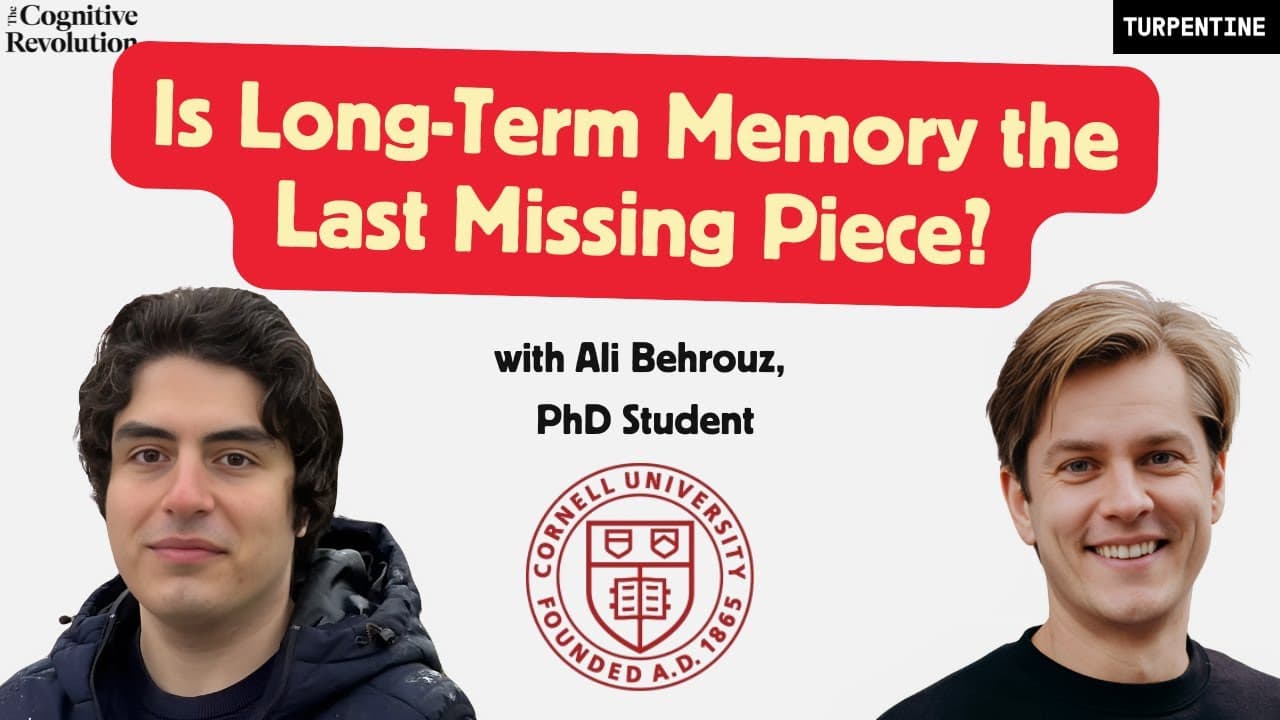
Titans: Neural Long-Term Memory for LLMs, with author Ali Behrouz
TL;DR
Ali Behrouz explores neural memory modules for better long-term AI memory.
Transcript
Hello and welcome back to the cognitive revolution. Today I am thrilled to share my conversation with Alli Beirus, PhD student at Cornell and lead author of the fascinating paper on integrated large language model memory, Titans, learning to memorize at test time. This paper represents another significant step forward in addressing what I've often ... Read More
Key Insights
- Ali Behrouz's research focuses on improving long-term memory in large language models using neural networks as memory modules.
- Traditional models struggle with maintaining coherence over long contexts, a gap Titans aims to fill.
- Titans introduces architectures like memory as context and memory as gate to enhance memory retention.
- The memory module in Titans is a neural network, allowing dynamic interactions and runtime updates via gradient descent.
- The concept of surprise and momentum is used to determine which information should be retained in memory.
- Titans can handle long contexts with millions of tokens, outperforming other models in long-context tasks.
- Challenges like catastrophic forgetting and the need for effective reinforcement learning models are addressed.
- Hybrid models combining attention and RNNs offer the potential for more powerful AI systems.
Install to Summarize YouTube Videos and Get Transcripts
Explore YouTube Video Summarizer or Get YouTube Transcript Extractor
Questions & Answers
Q: What is the main focus of Ali Behrouz's research?
Ali Behrouz's research focuses on enhancing long-term memory mechanisms in large language models by using neural networks as memory modules. His work aims to address the limitations of current models in maintaining coherence over long contexts by introducing architectures such as memory as context and memory as gate.
Q: How does the Titans architecture differ from traditional models?
The Titans architecture differs from traditional models by using a neural network as the memory module, allowing for dynamic interactions and runtime updates via gradient descent. This approach enables the model to better retain and recall information over long contexts, addressing the missing middle layer of memory in large language models.
Q: What role does surprise and momentum play in Titans?
In Titans, surprise and momentum are used to determine which information should be retained in memory. The model updates its memory based on the surprise of a token, with momentum ensuring that the memory update considers the context of the surprise, allowing for more effective long-term memory retention.
Q: What are the potential applications of Titans?
Titans has potential applications in areas requiring long-term memory retention and coherence, such as reinforcement learning, decision-making tasks, and long-running AI agents. By improving memory mechanisms, Titans can enhance the performance and reliability of AI systems in complex, high-context environments.
Q: How does Titans handle long contexts compared to other models?
Titans is capable of handling long contexts with millions of tokens, outperforming other models in long-context tasks. Its architecture allows for efficient memory management and retrieval, making it suitable for applications requiring extended context retention and processing.
Q: What challenges does Titans address in AI memory systems?
Titans addresses challenges such as catastrophic forgetting and the need for more effective memory mechanisms in reinforcement learning and decision-making tasks. By introducing a neural network as the memory module, Titans offers a more flexible and dynamic approach to memory management in AI systems.
Q: What are the benefits of hybrid models in AI?
Hybrid models, like those proposed in Titans, combine the strengths of attention mechanisms and RNNs, offering the potential for more powerful AI systems. These models can leverage the best of both worlds, improving memory retention and coherence while maintaining efficiency and scalability.
Q: What future directions does Ali Behrouz suggest for AI memory mechanisms?
Ali Behrouz suggests exploring more advanced architectures for memory modules, improving memory management strategies, and developing more effective models for reinforcement learning and decision-making tasks. These directions aim to enhance the performance and applicability of AI systems in complex, high-context environments.
Summary & Key Takeaways
-
Ali Behrouz discusses his paper, Titans, which proposes a neural network as a memory module for large language models, addressing the missing middle layer of memory.
-
Titans' architecture includes memory as context and memory as gate, improving long-term memory retention and coherence in AI systems.
-
The conversation explores technical details, challenges, and future directions in AI memory systems, highlighting the potential for significant advancements in AI applications.
Read in Other Languages (beta)
Share This Summary 📚
Summarize YouTube Videos and Get Video Transcripts with 1-Click
Try YouTube Summary with ChatGPT & Claude or YouTube Transcript Generator
Explore More Summaries from Cognitive Revolution "How AI Changes Everything" 📚



Summarize YouTube Videos and Get Video Transcripts with 1-Click
Try YouTube Summary with ChatGPT & Claude or YouTube Transcript Generator