What Is the Relationship Between Kinetic Energy and Momentum?
TL;DR
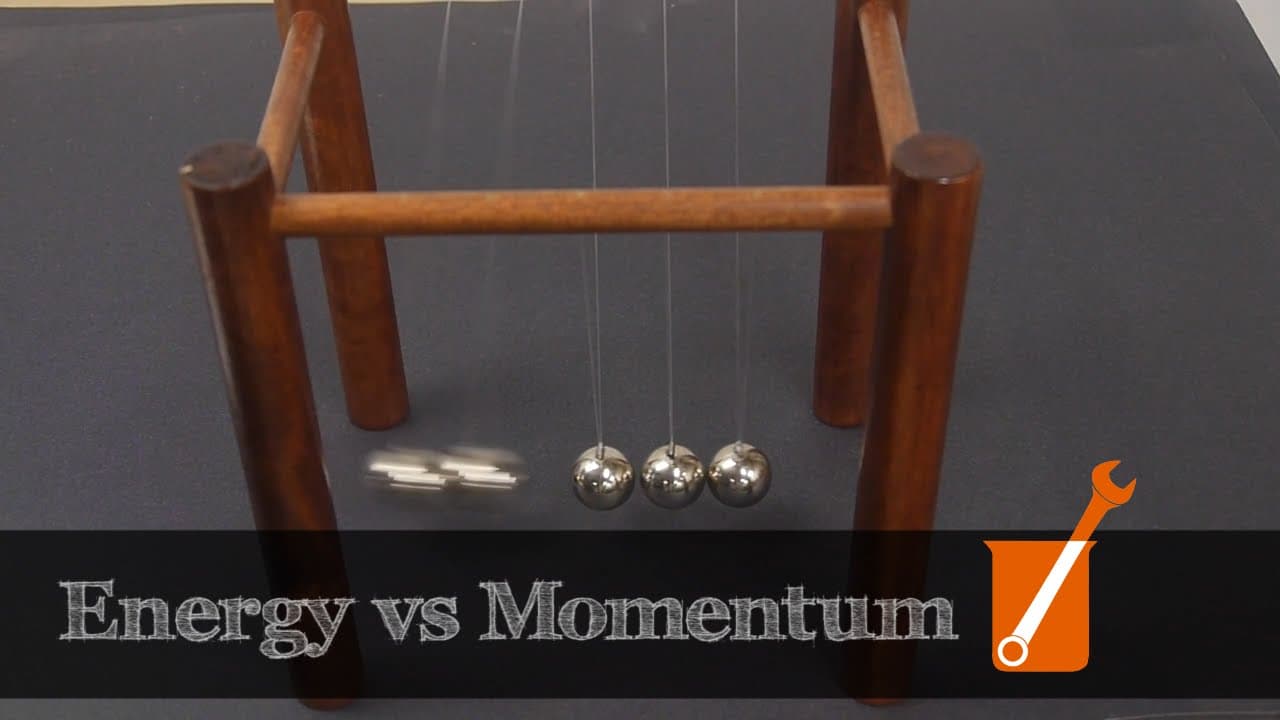
Kinetic energy is a scalar quantity representing the energy of motion, while momentum is a vector quantity that accounts for direction. The relationship between them explains systems like Newton's Cradle and how energy is conserved during collisions. Radiometers operate through momentum transfer from photons, not direct photon pressure.
Transcript
hello in my video on crooks radiometers i dispelled the myth that these are actually spun around by photon pressure and i said that if in fact photons caused these to spin they would go the other way because photons bouncing off the white sides would impart momentum and cause them to spin the other way than they actually do but wait one of my viewe... Read More
Key Insights
- ❓ Radiometers are not directly moved by photon pressure, but rather by the transfer of momentum from photons.
- ❓ Kinetic energy is a scalar quantity that represents the energy of an object's motion, while momentum is a vector quantity that represents the quantity of motion.
- 🙃 The conservation of momentum explains why the number of balls in Newton's Cradle remains the same on both sides after collisions.
- 🧑🦼 The efficiency of a Pelton wheel, used in water wheels, is optimized at a speed of V/2, balancing force and torque requirements.
- 🎭 Bouncing objects convert some kinetic energy to other forms, such as heat or sound.
- 💆 Photons have momentum due to their relativistic mass, which can be calculated using simple equations.
Install to Summarize YouTube Videos and Get Transcripts
Explore YouTube Video Summarizer or Get YouTube Transcript Extractor
Questions & Answers
Q: Why do radiometers rotate if not due to photon pressure?
Radiometers rotate due to the transfer of momentum from photons. When photons hit the black side of the veins, their kinetic energy is converted to thermal energy. The reflected photons hitting the white veins impart more momentum, causing the rotor to spin.
Q: How does the momentum of an object affect the force it exerts when colliding with another object?
According to the momentum equation (mass x velocity), an object with higher momentum will exert more force when colliding with another object. This is demonstrated in the video with the bouncing ball experiment.
Q: Why does the Pelton wheel rotate most efficiently at a speed of V/2?
The optimum speed for a Pelton wheel is V/2 because it balances the need for force (higher speed) and the ability to do work (non-zero torque). A stationary bucket does not produce work, and a bucket moving at the same speed as the water does not experience enough force.
Q: How is energy transferred in bouncing objects?
In bouncing objects, some of the kinetic energy is converted to other forms of energy, such as heat or sound. The non-bouncy ball converts more kinetic energy to heat, while the bouncy ball retains most of its kinetic energy as it rebounds.
Summary & Key Takeaways
-
The video starts by debunking the myth that radiometers are moved by photon pressure. Instead, it explains that photons bouncing off the white veins of the radiometer only contribute to the rotation through momentum transfer.
-
It introduces the concepts of kinetic energy and momentum, using Newton's Cradle as an example. It explains that kinetic energy is a scalar quantity, while momentum is a vector quantity.
-
The video then demonstrates how momentum is conserved in different scenarios, such as lifting multiple balls in Newton's Cradle. It also explores how energy is converted and transferred in bouncing objects.
Read in Other Languages (beta)
Share This Summary 📚
Summarize YouTube Videos and Get Video Transcripts with 1-Click
Try YouTube Summary with ChatGPT & Claude or YouTube Transcript Generator
Explore More Summaries from Applied Science 📚




Summarize YouTube Videos and Get Video Transcripts with 1-Click
Try YouTube Summary with ChatGPT & Claude or YouTube Transcript Generator