Smart Money Concepts: How to Combine Liquidity Sweeps, FVGs, and Order Blocks
TL;DR
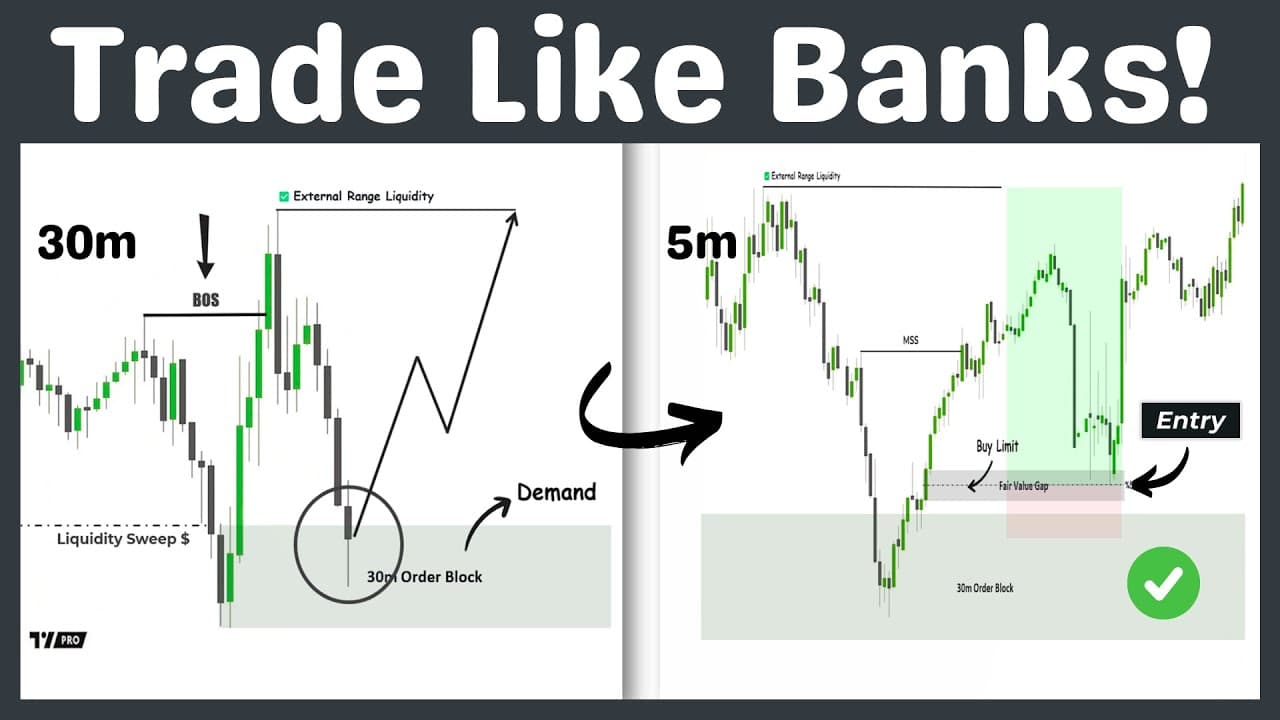
Combine liquidity sweeps, order blocks, and fair value gaps by finding a swept key level on a 30- or 15-minute chart, marking the order block behind the sweep and structure break, and confirming the entry on a 5- or 1-minute chart. The model applies in both bullish and bearish conditions and offers conservative or aggressive entries. Read on for the precise confirmation, entry, and target rules.
Transcript
Hey traders, and welcome back to another episode of Smart Risk. Most traders lose money not because they're lazy, but because they don't have a trustworthy rules-based setup. And without a solid setup, trading isn't trading. It's just gambling. That's why today I'm going to break down one of my most powerful smart money concept strategies. a setup ... Read More
Key Insights
- Liquidity sweeps occur when price moves sharply below or above a key level, triggering reversals.
- Order blocks are zones where smart money has previously entered trades, acting as support or resistance.
- Fair value gaps are price areas that often attract price back to them before continuing the trend.
- Using higher time frames helps identify overall market conditions and potential setups.
- Lower time frames provide confirmation signals and precise entry points for trades.
- The strategy works in both bullish and bearish markets by reversing the entry logic.
- Conservative entries involve waiting for market structure shifts on lower time frames.
- Aggressive entries use inversed fair value gaps as new support or resistance levels.
Install to Summarize YouTube Videos and Get Transcripts
Explore YouTube Video Summarizer or Get YouTube Transcript Extractor
Questions & Answers
Q: How do you combine liquidity sweeps, order blocks, and fair value gaps in one trading strategy?
First, identify a liquidity sweep and break of structure on the higher time frame, then mark the order block that initiated both moves. When price revisits that block, move to the lower time frame and use a market structure shift with a fair value gap, or an inversed fair value gap, to confirm the entry.
Q: How do you identify a valid liquidity sweep?
Look for price to take out a key level and immediately reverse, followed by a break of structure. In a bullish setup, the swept level may be a major low, the lows of a demand zone, or a cluster of lows; the bearish version may sweep a supply-zone high or equal highs.
Q: What role does the order block play in this strategy?
The order block tied to the liquidity sweep and break of structure becomes the higher-time-frame point of interest. Price may revisit it as a demand zone in a bullish setup or a supply zone in a bearish setup before continuing in the expected direction.
Q: Which time frames are used for analysis and entry confirmation?
Use the 30-minute or 15-minute chart to assess market conditions and identify liquidity sweeps with their associated order blocks. A setup found on the 30-minute chart is confirmed on the 5-minute chart, while a 15-minute setup is paired with the 1-minute chart.
Q: How does the conservative bullish entry method work?
After price returns to the higher-time-frame order block, look on the lower time frame for a market structure shift or clear change of character. Then identify a bullish fair value gap within the structure-shift leg and place a buy limit order at its midpoint, or 50% level.
Q: What is the aggressive entry method?
After price taps the higher-time-frame order block, look on the lower time frame for a violated fair value gap that becomes an inversed fair value gap. This gap may act as a new support zone for a buy entry, while a simultaneous market structure shift adds another layer of confirmation.
Q: How is the take-profit selected for a bullish trade?
The bullish setup targets higher-time-frame buyside liquidity. This target is used after the lower-time-frame confirmation and buy entry have been established.
Q: How does the strategy change in bearish market conditions?
The bullish logic is reversed: price revisits an area where buyside liquidity was previously swept, such as the high of a supply zone or a cluster of equal highs. A swift rejection from that area sets up a potential decline and continuation of the bearish trend.
Summary & Key Takeaways
-
This trading strategy combines liquidity sweeps, order blocks, and fair value gaps to identify high-probability setups. By focusing on areas where smart money has previously entered, traders can find entry points for bullish and bearish trends. The method involves analyzing higher time frames for market conditions and using lower time frames for precise entries.
-
In bullish scenarios, traders look for price to return to a zone that has swept sellside liquidity, then identify order blocks as demand zones. For bearish markets, the setup reverses, targeting zones where buyside liquidity has been swept. Both conservative and aggressive entry methods are used based on market structure shifts and fair value gaps.
-
The strategy requires working across multiple time frames, with higher time frames spotting liquidity sweeps and order blocks, and lower time frames confirming reversals and entry points. This approach is adaptable to different trading styles and market conditions, enhancing the probability of successful trades.
Read in Other Languages (beta)
Share This Summary 📚
Summarize YouTube Videos and Get Video Transcripts with 1-Click
Try YouTube Summary with ChatGPT & Claude or YouTube Transcript Generator
Explore More Summaries from Smart Risk 📚

Summarize YouTube Videos and Get Video Transcripts with 1-Click
Try YouTube Summary with ChatGPT & Claude or YouTube Transcript Generator