How to Build an MCP Server for AI Agents
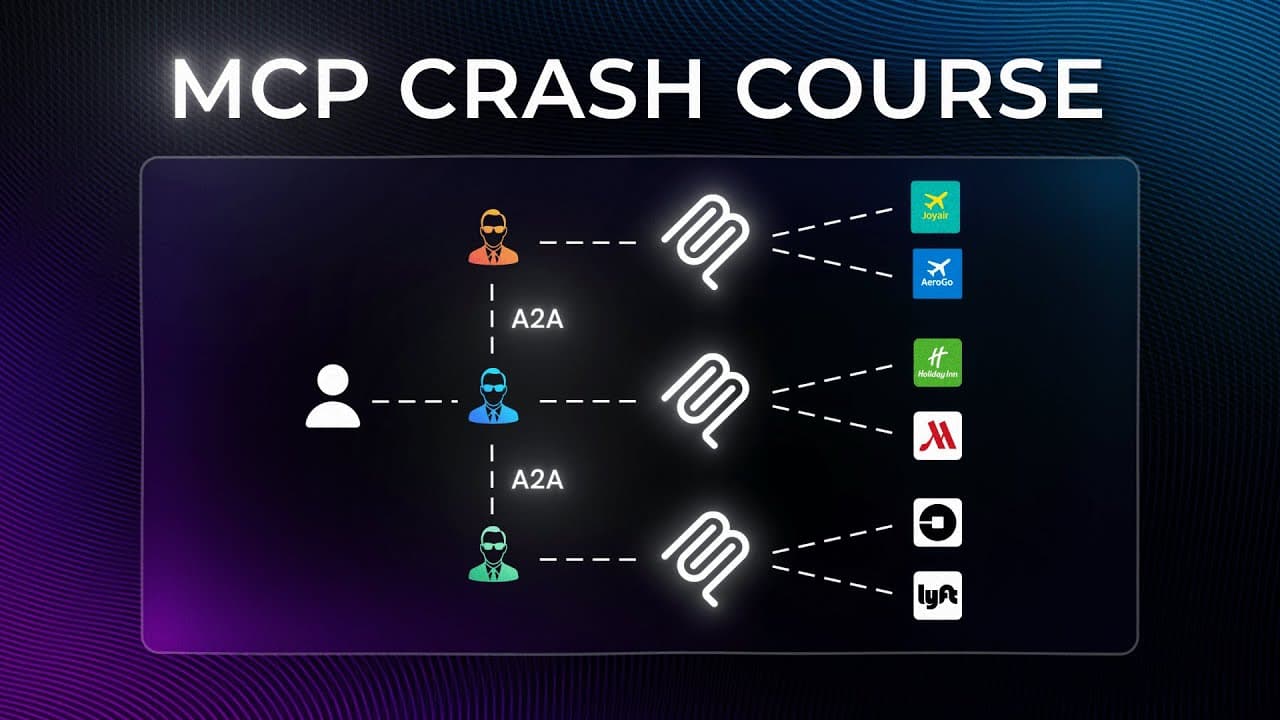
TL;DR
Model Context Protocol gives AI agents the context needed to discover and use tools that interact with third-party platforms. MCP uses a client-server architecture, with clients commonly embedded in coding agents and servers exposing capabilities for applications, browsers, or databases. The tutorial progresses from MCP basics and JSON-RPC 2.0 to using an existing server and building both a server and client.
Transcript
Model context protocol. What exactly is it and why is everyone talking about it? This is a crisp, nononsense, no BS hands-on introduction to model context protocol for the absolute beginners. So, no prior knowledge required. We'll cover everything from the absolute basics. We'll understand why MCPs are needed in the first place. What are MCPs? We'l... Read More
Key Insights
- Large language models generate supported outputs but cannot independently complete external actions such as retrieving flights, consulting stored preferences, or booking a selection. An AI agent provides the surrounding workflow that invokes the model, communicates with external systems, evaluates progress, and continues until its assigned task is complete.
- An AI agent is comparable to a traditional automation workflow that can use an LLM for decisions. The model can help interpret user input, choose conditional routes, determine which tools to invoke, process returned information, control iterations, and recognize when the workflow has achieved its goal.
- Tools are the mechanism through which an AI agent interacts with external platforms. A flight workflow, for example, can pass an origin, destination, and travel date to airline tools, collect their results, combine those results with user preferences, and then perform the selected booking action.
- Third-party APIs differ in endpoint names, input conventions, and response structures. Supporting many airlines or other services through individually written integrations therefore creates substantial integration work, because an application would otherwise need custom code that understands the interface exposed by every provider.
- Model Context Protocol provides agents with context for choosing appropriate APIs and interacting with third-party platforms. It serves as a guide that makes external capabilities discoverable and usable, reducing the need for every agent application to implement each service integration independently.
- MCP follows a client-server architecture in which an agent uses an MCP client to communicate with an MCP server. MCP clients can be embedded in coding agents and desktop tools, while servers can connect agents to capabilities such as browser information, databases, or application services.
- MCP servers can support troubleshooting and data investigation by exposing relevant external information. Examples include access to browser console logs and HTML elements for frontend debugging, plus read-only data access that lets an agent combine information from several sources to investigate missing data or transactions.
- MCP servers may be built and maintained by application owners, vendors, or community developers who understand the underlying APIs. Community implementations require caution because the tutorial notes that they may not be tested or updated to match the latest versions of a vendor's APIs.
Install to Summarize YouTube Videos and Get Transcripts
Explore YouTube Video Summarizer or Get YouTube Transcript Extractor
Questions & Answers
Q: Why do AI agents need Model Context Protocol?
AI agents need Model Context Protocol because external platforms expose different APIs, endpoint names, request formats, and response structures. Without a shared approach, developers may need to write separate integration code for every airline, database, website, or application. MCP gives agents the context required to discover suitable capabilities, choose the appropriate APIs, and interact with third-party platforms through tools.
Q: What is the difference between an LLM and an AI agent?
An LLM processes input and returns generated content in supported forms, but it does not independently carry out an external action. An AI agent surrounds the LLM with a workflow that can use tools, consult memory, contact third-party systems, and iterate. The agent asks the LLM to interpret requests and make decisions, then performs actions until the assigned goal is completed.
Q: How does an AI agent complete a flight-booking request?
An AI agent first sends the user's wording to an LLM so details such as the destination can be extracted. It then asks which external tools are relevant, retrieves flight information from airline services, and obtains the user's preferences from a database or memory. The LLM evaluates those details, after which the agent books the selected flight and returns the booking information.
Q: What are tools in an AI agent workflow?
Tools allow an AI agent to interact with another platform. In the flight example, a tool call sends query parameters such as the origin, destination, and travel date to an airline service. The agent can invoke several airline tools, append their returned results, and provide the combined information to an LLM for evaluation before taking the next action.
Q: How does the MCP client-server architecture work?
MCP uses a client-server architecture. An AI agent communicates through an MCP client, which can be embedded in coding agents or desktop tools. The client connects to an MCP server that makes external capabilities available to the agent. Those capabilities may involve an application, local database, browser information, or another third-party platform that the workflow needs to access.
Q: Who can build and maintain an MCP server?
An application owner or business can build and maintain an MCP server so AI agents can interact with its service. Vendors also announce official servers for their products, and official integrations can be listed in the Model Context Protocol repository on GitHub. Community developers may create alternatives when no official implementation exists, provided they understand how the underlying APIs work.
Q: Are community-built MCP servers safe to use?
Community-built MCP servers should be used at the user's own risk. The tutorial states that there is no guarantee that these implementations have been tested or remain current with the latest versions of a vendor's APIs. Official servers maintained by the application owner may provide clearer maintenance responsibility, while community versions require users to assess their suitability and freshness.
Q: How can a beginner practice building an MCP server and client?
A beginner can follow the free lab environment linked in the description and begin with the first lab. The tutorial requires no prior MCP knowledge and progresses through MCP basics, components, client-server architecture, use cases, and JSON-RPC 2.0. It then demonstrates using an existing MCP server before building an MCP server and MCP client from scratch.
Summary & Key Takeaways
-
AI agents extend language models by combining LLM decision-making with tools, memory, external services, and iterative workflows. An agent can interpret a request, determine which systems to contact, retrieve relevant information, consult stored preferences, ask the LLM to evaluate the results, perform an action, and report the outcome.
-
MCP addresses the difficulty of integrating agents with third-party platforms that expose different APIs, request formats, and responses. It supplies agents with context for discovering and using available capabilities. The architecture separates MCP clients, commonly embedded within coding agents, from MCP servers maintained by vendors, businesses, or community developers.
-
The practical learning path begins with a free lab environment, introduces MCP components and architecture, and identifies JSON-RPC 2.0 as the protocol covered. It then demonstrates how to use an existing MCP server before showing how to build an MCP server and MCP client from scratch for hands-on beginner practice.
Read in Other Languages (beta)
Share This Summary 📚
Summarize YouTube Videos and Get Video Transcripts with 1-Click
Try YouTube Summary with ChatGPT & Claude or YouTube Transcript Generator
Explore More Summaries from KodeKloud 📚
Summarize YouTube Videos and Get Video Transcripts with 1-Click
Try YouTube Summary with ChatGPT & Claude or YouTube Transcript Generator