How to nail system design interviews for beginners
TL;DR
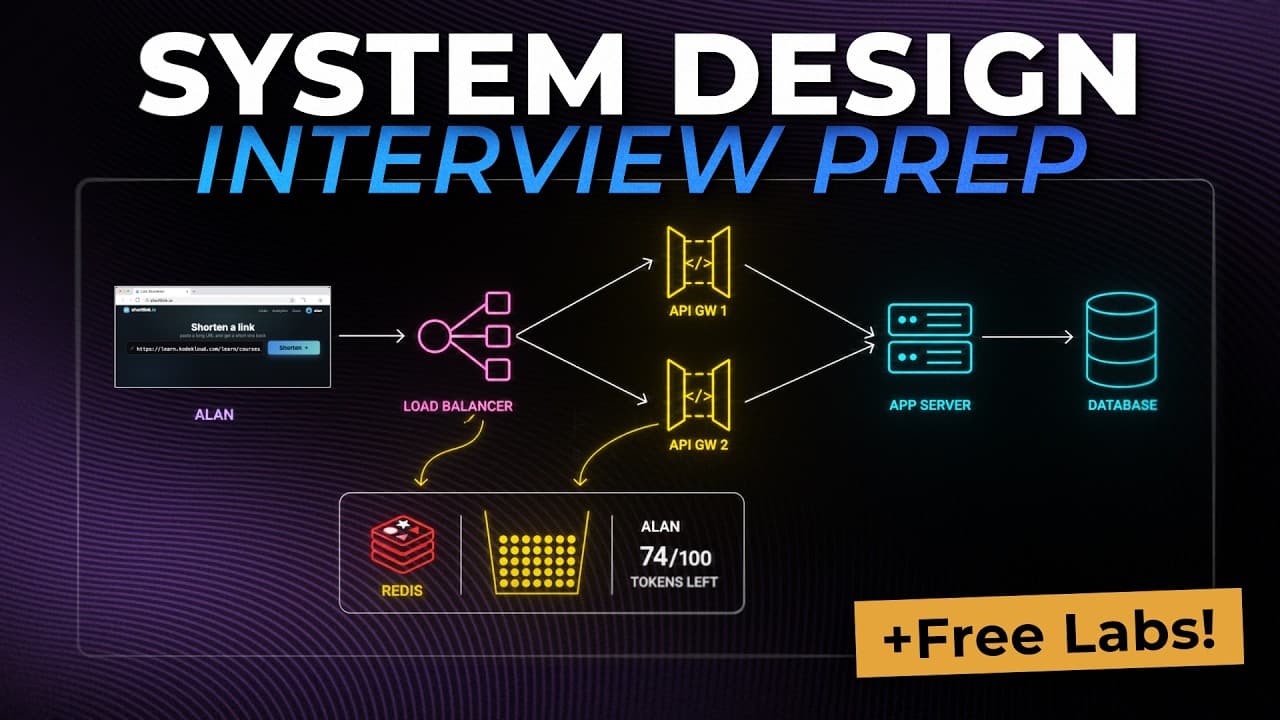
The video teaches a six step framework for system design interviews, tailored for absolute beginners. It walks through clarifying requirements, doing back of envelope estimates, defining APIs, high level design, deep dives on hard components, and bottlenecks with scaling. It also provides four hands on labs to practice core concepts and emphasizes asking the right questions and staying concrete under pressure.
Transcript
Welcome to the system design interview prep video. This video is designed for absolute beginners who do not have any prior system design experience. System design interviews are generally very intense and hectic because you have to think about multiple components and the pros and cons of each component. My goal is to provide you a framework that yo... Read More
Key Insights
- Six step framework is the core method taught for system design interviews.
- Clarifying requirements is the first and most important step to convert a vague prompt into concrete scope.
- Back of envelope estimation helps determine scale and informs architecture decisions.
- Defining clear APIs shapes what data must be stored and how components interact.
- High level design visualizes the system with basic components and data flow.
- Deep dives focus on the hardest part of the problem to demonstrate depth and reasoning.
- Bottlenecks and scaling discuss potential failure points and how to mitigate them.
- Good interview questions should be about information that changes the design, not generic yes/no questions.
Install to Summarize YouTube Videos and Get Transcripts
Explore YouTube Video Summarizer or Get YouTube Transcript Extractor
Questions & Answers
Q: How is the six step framework used in a system design interview?
The six step framework is used to structure the interview so you start by clarifying requirements to ground the problem, then estimate scale with back of the envelope calculations, define the API that outlines the required data, create a high level design with major components, perform deep dives on the hardest parts, and finish with bottlenecks and scaling considerations. This orderly progression helps you stay on track, avoid over engineering, and demonstrate judgment under ambiguity. It is designed to be reusable for different prompts and to guide you to a concrete, finishable solution within 45 minutes.
Q: What should you do during clarifying requirements?
During clarifying requirements, you convert a vague prompt like design Instagram into concrete goals such as defined user actions, data to store, and performance targets. You should ask questions that affect the design only if they change the outcome. If not, you state clear assumptions and proceed. The goal is to nail down functional and non functional requirements, including user count, growth rate, read versus write balance, data loss tolerance, and latency expectations for critical actions.
Q: Why is back of the envelope estimation important?
Back of the envelope estimation provides defensible numbers that guide architecture decisions and capacity planning. It helps you decide where to optimize, what storage needs exist, and how caching or sharding might be required. By validating numbers with the interviewer, you ensure your design matches real constraints rather than assumptions, which makes your solution practical and credible under interview pressure.
Q: What role do APIs play in the framework?
APIs define how clients interact with the system and reveal the required data structures, such as user profiles, feeds, and uploads. Limiting to a few essential calls forces you to scope the problem and design around concrete data flows. This helps in mapping components to data stores and in identifying where caching or asynchronous processing would be most beneficial.
Q: What is covered in the high level design step?
The high level design step draws the essential components and their interactions to satisfy the requirements. It usually includes a user, app servers, data stores for users and relationships, and storage for assets or feeds. Arrows illustrate data flow, latency expectations are considered, and the design stays focused on the defined API and data models rather than the fine technical details.
Q: What is the purpose of deep dives in this framework?
Deep dives focus on the most challenging parts of the system, such as generating a user feed at scale or ensuring durable message delivery, to demonstrate technical depth. You analyze potential problems, trade offs, and concrete solutions, explaining why certain approaches work and what new problems they introduce. This shows you can reason through complexity rather than just sketch an architecture.
Q: How should bottlenecks be addressed in the design?
Bottlenecks are analyzed to identify early failure points as traffic grows. You propose practical mitigations like caching, load balancing, or sharding, and discuss how each change affects latency, consistency, and operational complexity. The goal is to present a realistic plan to scale gracefully while acknowledging limitations and prioritizing key performance targets.
Q: What makes a good interviewer question according to the video?
A good interviewer question is one that changes the design based on real constraints, not a generic yes or no. It asks about growth rates, read versus write balance, critical latency requirements, or data loss tolerance, which influence architectural choices. Such questions help you calibrate assumptions and steer the solution toward a feasible, well reasoned design.
Summary & Key Takeaways
-
The course introduces a six step framework to tackle vague prompts in system design interviews to finish within 45 minutes. It emphasizes concrete problem framing, requirement clarification, and avoiding over engineering while focusing on practical trade offs. The video also includes hands on labs to apply the framework to real problems like a URL shortener and a notification system.
-
The framework sections are clarified step by step: requirements, estimation, API definition, high level design, deep dives, bottlenecks. The approach helps candidates show judgment under ambiguity, technical depth, communication and collaboration rather than perfect technology knowledge.
-
The video ends with guidance on asking the interviewer questions that affect the design, using defensible numbers, and a summary of what interviewers expect in feedback besides tech details, centering on structure and adaptability over time.
Read in Other Languages (beta)
Share This Summary 📚
Summarize YouTube Videos and Get Video Transcripts with 1-Click
Try YouTube Summary with ChatGPT & Claude or YouTube Transcript Generator
Explore More Summaries from KodeKloud 📚

Summarize YouTube Videos and Get Video Transcripts with 1-Click
Try YouTube Summary with ChatGPT & Claude or YouTube Transcript Generator