How Does MCP Differ From Direct API Integration?
TL;DR
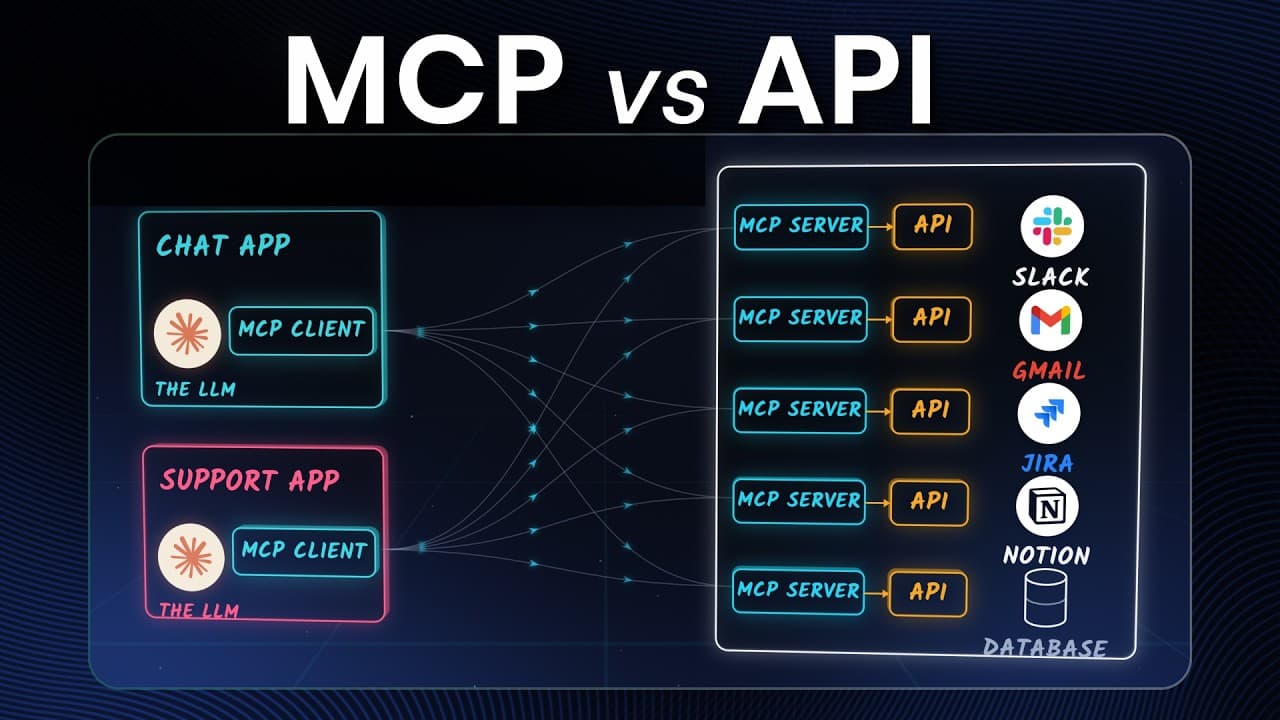
MCP does not replace APIs. It provides a common AI-facing layer that lets applications discover and invoke standardized actions while MCP servers handle the underlying API calls. Direct API integration can work well for one application, but MCP becomes more useful when several AI applications need reusable access to the same services without maintaining separate integration code for every pairing.
Transcript
You have probably seen people fighting about MCP versus API. One side says MCP changes everything. The other side says, "We already have APIs. Why do we need a new thing?" In this video, we will settle this properly. What MCP actually is, where it sits in your application, and how does it compare with APIs? And in the second half of this video, we ... Read More
Key Insights
- An API is a communication mechanism through which one program sends a request to another program's endpoint and receives a response. It is clean and predictable for conventional software, but developers must implement and maintain the surrounding integration logic.
- An LLM does not directly execute API calls. It receives context and available capabilities, then produces text describing the action it wants, while application code outside the model performs the operation and returns the result.
- Traditional integrations multiply across applications and services. In the example, two applications connecting independently to 10 services require 20 separate integrations, while a third application raises that total to 30 integrations that teams must build and maintain.
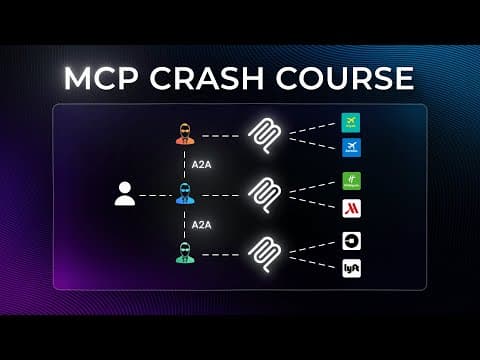
- MCP reduces repeated integration work by placing an MCP client in each application and an MCP server beside each service. In the example, two clients plus 10 servers produce roughly 12 pieces instead of 20 separate application-to-service integrations.
- MCP discovery lets a client ask connected servers which actions they offer. The application exposes that action list to the model, allowing the model to choose from a labeled toolbox of capabilities that the application has permitted it to use.
- An MCP server is the component that communicates with the service's existing API. During Jira ticket creation, the model requests an action, the client forwards it, the server calls Jira, and the resulting ticket number travels back to the model.
- A direct API execution layer can combine full API documentation, credentials, a sandbox, and model-generated code. For Slack message summarization, that code may need to resolve a channel ID, convert dates, fetch history, and replace raw user IDs with readable names.
- An MCP execution layer can hide low-level service details behind concise actions designed for AI applications. A Slack server can handle channel lookup, time formatting, pagination, authentication, and message cleanup, then return readable messages for the model to summarize.
Install to Summarize YouTube Videos and Get Transcripts
Explore YouTube Video Summarizer or Get YouTube Transcript Extractor
Questions & Answers
Q: What is the difference between MCP and an API?
An API enables direct communication between programs through defined endpoints, requests, and responses. MCP is a common AI-facing layer that can sit in front of those APIs. An MCP server translates standardized action requests into calls to the service's normal API, while an MCP client connects the application to that server. The underlying API remains responsible for the actual service operation.
Q: Does MCP replace existing APIs?
MCP does not replace existing APIs. When a system already exposes an API, its MCP server sits in front of that API as a translator for AI applications. The model chooses an advertised action, the MCP client carries the request, and the MCP server calls the same underlying API that was already available. The service's API continues doing the actual work.
Q: Can an LLM make an API call directly?
An LLM does not directly make an API call in the architecture described. It reads the situation and available capabilities, then writes what action it wants the application to perform. Ordinary software outside the model receives that request, executes the API call, and returns the result. The model then reads the result and produces its final response.
Q: How does MCP reduce repeated integration work?
MCP separates applications from service-specific integrations. Each AI application uses an MCP client, and each service exposes its capabilities through an MCP server. The example compares two applications connected to 10 services: direct pairwise development creates 20 integrations, while the MCP structure requires roughly two clients plus 10 servers. A later application can reuse the existing servers by adding another client.
Q: What is MCP discovery and how does it work?
MCP discovery is the process in which an application's MCP client connects to servers and asks which actions are available. A server might advertise actions for sending a message, reading channel history, or searching older messages. The application presents this list to the model, and the model selects the action that best matches the task from the capabilities the application permits.
Q: How does an MCP request create a Jira ticket?
The application sends the customer's message and discovered actions to the model. The model returns a request to create a high-priority Jira ticket, but nothing has happened yet. The application passes that request to its MCP client, which contacts the Jira MCP server. The server calls Jira's API, receives the ticket number, and sends that result back for the model's final reply.
Q: Can an AI agent use API documentation instead of MCP?
An AI agent can use API documentation without MCP, and the example says this approach works. The application can provide Slack's API specification, credentials, and a sandbox where the model writes Python code. That code can resolve a channel identifier, convert a date, fetch message history, and clean user identifiers. The team still owns the sandbox, credentials, generated integration code, and repairs.
Q: When is a direct API integration suitable instead of MCP?
A direct API integration can be suitable for one application, especially when the team is comfortable providing documentation, credentials, a sandbox, and maintenance. The approach can complete the Slack summarization task successfully. MCP starts providing clearer reuse benefits when a second or third AI application needs the same services, because existing servers can supply a shared execution layer instead of requiring separate integrations.
Summary & Key Takeaways
-
An API lets two programs communicate through requests and responses, but developers must build the authentication, calls, error handling, retries, and decision rules for each integration. Adding an LLM changes who chooses an action, not who executes it. The surrounding application still performs the requested API operation.
-
MCP separates reusable service integrations from individual AI applications. Each application has an MCP client, while each connected service has an MCP server that advertises available actions. The application presents those discovered actions to the model, which selects an appropriate action, while ordinary software carries and executes the request.
-
A direct API approach can give a model documentation and a sandbox where generated code handles service-specific details. An MCP server instead provides a ready-made execution layer with a concise action menu and handles details such as identifiers, time formats, pagination, authentication, and data cleanup before returning readable results.
Read in Other Languages (beta)
Share This Summary 📚
Summarize YouTube Videos and Get Video Transcripts with 1-Click
Try YouTube Summary with ChatGPT & Claude or YouTube Transcript Generator
Explore More Summaries from KodeKloud 📚


Summarize YouTube Videos and Get Video Transcripts with 1-Click
Try YouTube Summary with ChatGPT & Claude or YouTube Transcript Generator