What is RAG and how it improves document search
TL;DR
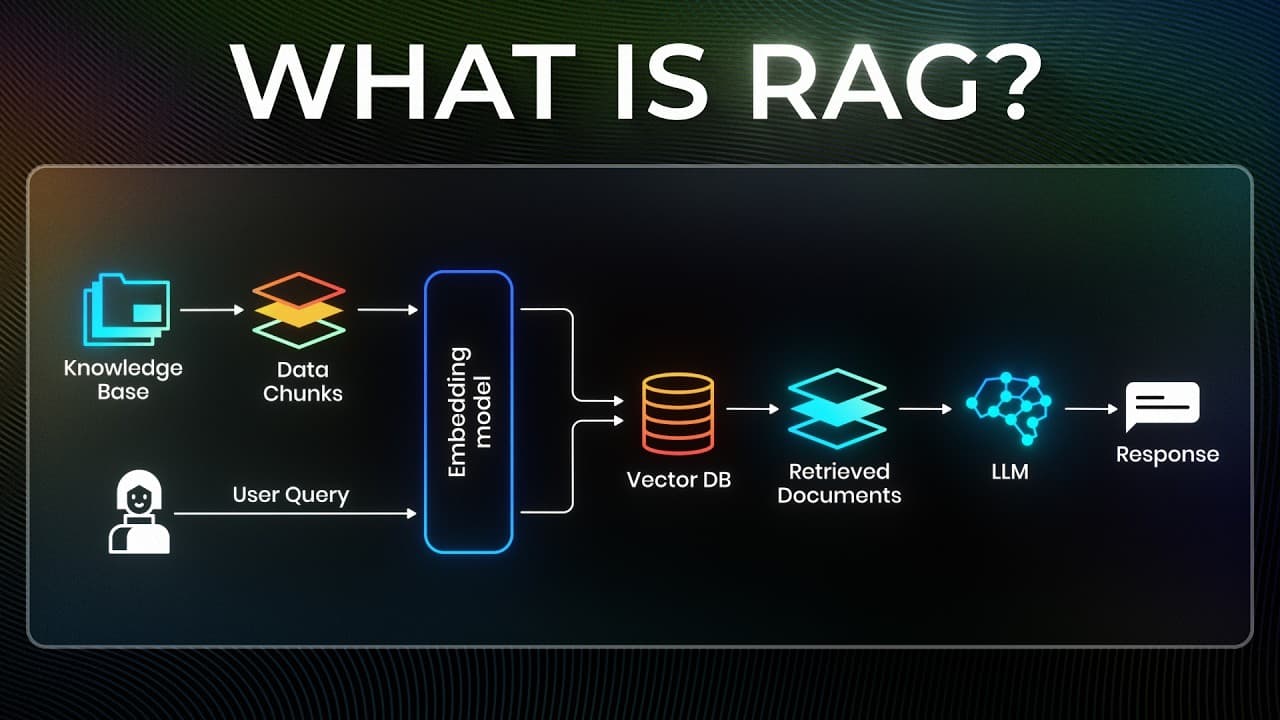
RAG combines semantic search with up to date data by storing documents as vector embeddings and retrieving relevant chunks at runtime. It then augments the prompt with those chunks before generating a grounded answer, improving accuracy for large private corpora without fine tuning. This approach balances speed, scale, and accuracy across massive document sets.
Transcript
So, your company has 500 gigabytes of documents in their server and you're asked to connect an AI assistant just like chatpt to answer questions about these documents and you think to yourself, man, how am I supposed to get this done? From your experience, you know that typical chat applications can't accept more than a dozen files. So, you have to... Read More
Key Insights
- RAG uses semantic search to match meaning rather than keywords, enabling scalable retrieval from large corpora.
- The three steps of RAG are Retrieval, Augmentation, and Generation, with each stage contributing to grounding and accuracy.
- Semantic search compares question embeddings against document embeddings to find relevant content efficiently.
- Augmentation injects retrieved data into the prompt at runtime to keep answers current and document-grounded.
- Generation uses the augmented prompt to produce a response that reflects the private data set, not just pre-trained knowledge.
- Chunking strategy is critical; 500 word chunks with high overlap preserve context across boundaries.
- Embedding strategy matters; choosing the right model affects similarity scoring and retrieval quality.
- Based on the lab example, a vector database stores chunked document embeddings for fast retrieval and grounding of answers.
Install to Summarize YouTube Videos and Get Transcripts
Explore YouTube Video Summarizer or Get YouTube Transcript Extractor
Questions & Answers
Q: A real search query question about the video (e.g. 'How to...', 'What is...', 'Why does...', 'When should...'). Question 1
RAG (Retrieval Augmented Generation) is a method that stores documents as vector embeddings and uses semantic search to retrieve relevant chunks at runtime. It then augments the prompt with those chunks before the generation step, allowing the AI to answer questions grounded in up-to-date private data. This approach avoids relying solely on pre-trained knowledge and scales to large corpora.
Q: Question 2
The three steps of RAG are Retrieval, Augmentation, and Generation. Retrieval converts the user query and documents into embeddings and performs a similarity-based search to find relevant content. Augmentation injects that content into the prompt so the model can reason with current data. Generation produces the final answer grounded in the retrieved material.
Q: Question 3
Semantic search differs from keyword search by focusing on meaning and context rather than exact terms. In RAG, both the question and documents are turned into vectors, and similarity between these vectors determines relevance. This allows finding content that is semantically related even if exact keywords do not match.
Q: Question 4
Chunking strategy affects retrieval quality because it determines how context is preserved across document boundaries. The video demonstrates using 500 word chunks with 400 or 400 overlap to maintain continuity, which improves recall for long legal-like paragraphs and preserves meaning across segments.
Q: Question 5
Embedding strategy selects which embedding model to use for converting text into vectors. The choice impacts how accurately semantic relationships are captured and how efficiently the system can compare question embeddings to document embeddings during retrieval. Different data types may require different embedding models.
Q: Question 6
The lab workflow includes initializing a vector database, chunking documents, embedding chunks, storing them, and running semantic search against queries. This end-to-end process creates a working RAG system capable of returning grounded answers with sources from the private document set.
Q: Question 7
Augmentation in RAG serves to ground the model’s response in real data by feeding retrieved document chunks into the prompt at runtime. This prevents hallucinations from pre training and ensures the answer reflects the actual content of the company docs and source materials used in the retrieval step.
Q: Question 8
Grounding in private data is achieved by using a vector store that persists document chunks and by applying a similarity threshold for retrieval. By controlling thresholds and filters, the system avoids low quality matches and keeps answers tied to the relevant sections of the documents in the corpus.
Summary & Key Takeaways
-
RAG combines retrieval, augmentation, and generation to groundedly answer questions from private document corpora. It uses vector embeddings to store semantic representations and semantic search to fetch relevant chunks. The final answer is generated using the retrieved context, ensuring up to date and relevant results.
-
Chunking and embedding strategies are critical in RAG. Ingested data is split into overlapping chunks and embedded with models to preserve context. The chunk size, overlap, and embedding model choice directly affect retrieval quality and answer accuracy.
-
A practical lab demonstrates end-to-end RAG, including environment setup, vector database initialization, chunking tests, embedding verification, and a simple UI for querying. The workflow emphasizes grounding answers in private documents and tuning for retrieval quality.
Read in Other Languages (beta)
Share This Summary 📚
Summarize YouTube Videos and Get Video Transcripts with 1-Click
Try YouTube Summary with ChatGPT & Claude or YouTube Transcript Generator
Explore More Summaries from KodeKloud 📚


Summarize YouTube Videos and Get Video Transcripts with 1-Click
Try YouTube Summary with ChatGPT & Claude or YouTube Transcript Generator