How Does Model Context Protocol (MCP) Help AI Agents? Beginner AI Flight Booking Demo
TL;DR
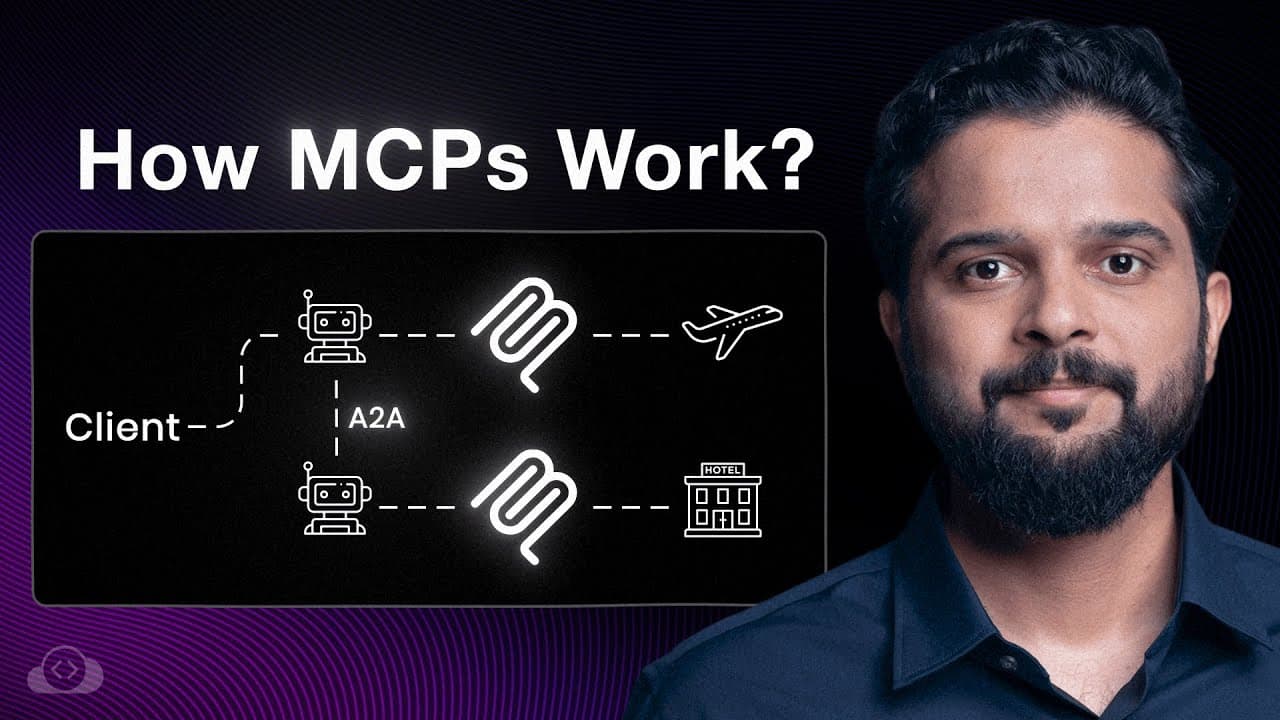
Model Context Protocol (MCP) helps AI agents identify external capabilities, structure requests, and use the appropriate APIs. Unlike an LLM that only generates content, an agent combines an LLM with tools and memory, repeatedly gathering information and taking actions until it completes a task such as comparing and booking a flight. Read on to understand MCP through the beginner-friendly AI flight booking demo and hands-on lab.
Transcript
So, everyone is talking about MCPs, AI agents, and agentto agent protocol. If you feel left out, this is the only video you need to watch to catch up. In this video, we'll talk about AI agents, MCPS, and agentto agent model in a super simplified manner with visualizations that will make it easy for anyone to understand. No background knowledge in A... Read More
Key Insights
- An LLM is a content-generating component that can return text, pictures, or videos, but it cannot natively interact with external services or complete actions such as booking a flight. An application needs additional mechanisms to turn a generated decision into a real operation.
- An AI agent is a system that combines an LLM with third-party tools and memory. It can move repeatedly among gathering information, consulting stored preferences, requesting model decisions, and performing actions until it has completed the assigned task.
- Agent mode is different from a conventional chatbot because it can execute a sequence of operations for one broad task. A software-development agent can inspect frontend and backend code, examine Git history through a terminal, identify the commit that caused a change, and propose a repair.
- An API is an interface that one application provides to another application. Unlike a user interface designed for people, an API can return structured flight information or accept a booking request, allowing another application to serve customers without sending them to the airline website.
- A tool is code that connects an agent to a third-party platform through its API. The agent can first call a flight-search operation, send the retrieved details to the LLM, and then use a booking operation after the LLM has selected an airline.
- Airline APIs can differ in endpoint names, input requirements, and response structures. One provider might describe locations as origin and destination, while another uses from and to, creating integration work when an application must communicate with many independent services.
- MCP is a guide that provides an AI agent with the context required to select and use appropriate APIs. It can describe a provider's capabilities, such as searching and booking flights, along with the expected input and output structures for those operations.
- AI agents can be accessed as prebuilt remote services, assembled through a drag-and-drop platform, or created from scratch with agent-building platforms. The examples mentioned include video script generation, web design grading, AI video automation, email organization, and software-development assistance.
Install to Summarize YouTube Videos and Get Transcripts
Explore YouTube Video Summarizer or Get YouTube Transcript Extractor
Questions & Answers
Q: How does Model Context Protocol (MCP) help AI agents use external tools?
MCP supplies the context an agent needs to choose and use appropriate APIs. For an airline platform, it can describe capabilities such as flight search and booking, along with the expected input and output structures. This helps the agent invoke the correct operation despite differences between providers.
Q: What is the difference between an LLM and an AI agent?
An LLM generates responses such as text, pictures, or videos, but it cannot natively perform external actions. An AI agent combines an LLM with tools, memory, and repeated operations. It can gather information, make decisions, and continue acting until it completes an assigned task.
Q: How can an AI agent book a flight for a user?
The agent retrieves options from airline platforms and considers stored preferences such as price level, seat choice, or meal choice. It passes the information to an LLM to compare the options and make a decision. The agent then calls a booking operation and returns the flight details and booking reference number.
Q: Why can an LLM not book a flight by itself?
An LLM can interpret a request and generate instructions, but it cannot natively interact with airline services or execute a booking. The task requires external tools to retrieve flights and submit the selected booking. An AI agent coordinates those tools with memory and the LLM.
Q: What is an API, and how is it different from a user interface?
A user interface is a website or mobile application designed for a person to use. An API is an interface that one application provides to another application. An airline API can return structured flight information or accept a booking request without requiring the customer to visit the airline's website.
Q: How do tools connect AI agents to third-party services?
A tool is code that communicates with a third-party platform through its API. A flight-search tool can retrieve structured options and provide them to the agent and LLM. After a flight is selected, another tool call can submit the booking and retrieve its reference number.
Q: Why is integrating multiple airline APIs difficult?
Airline providers can use different capability names, input requirements, and response structures. Equivalent locations might be labeled origin and destination by one provider or from and to by another. Those differences create integration work when an application must communicate with multiple independent services.
Q: How can beginners start building or using AI agents and MCP?
Beginners can invoke prebuilt remote agents, assemble agents with a drag-and-drop platform, or build them from scratch using agent-building platforms. The examples include video script generation, web design grading, AI video automation, email organization, and software-development assistance. The flight-booking demonstration also covers MCP setup, client configuration, testing, and a hands-on lab.
Summary & Key Takeaways
-
Large language models generate responses but cannot independently complete external actions. AI agents address this limitation by combining an LLM with tools, memory, and repeated operations. A flight-booking agent, for example, can retrieve options from airline platforms, consider stored preferences, choose a suitable flight, complete the booking, and return its reference number.
-
Tools are pieces of code that let agents communicate with third-party platforms through APIs. An agent can use tools to retrieve structured flight information, pass those details to an LLM for a decision, and call another API to book. However, providers expose different capability names, input structures, and output formats.
-
MCP supplies agents with context describing a platform's available capabilities and the structures required to use them. In the flight example, an MCP can describe search and booking operations, helping the agent choose and call appropriate APIs. The accompanying demonstration covers MCP setup, client configuration, testing, and a hands-on flight-booking lab.
Read in Other Languages (beta)
Share This Summary 📚
Summarize YouTube Videos and Get Video Transcripts with 1-Click
Try YouTube Summary with ChatGPT & Claude or YouTube Transcript Generator
Explore More Summaries from KodeKloud 📚
Summarize YouTube Videos and Get Video Transcripts with 1-Click
Try YouTube Summary with ChatGPT & Claude or YouTube Transcript Generator