How to design a scalable system for a photo app
TL;DR
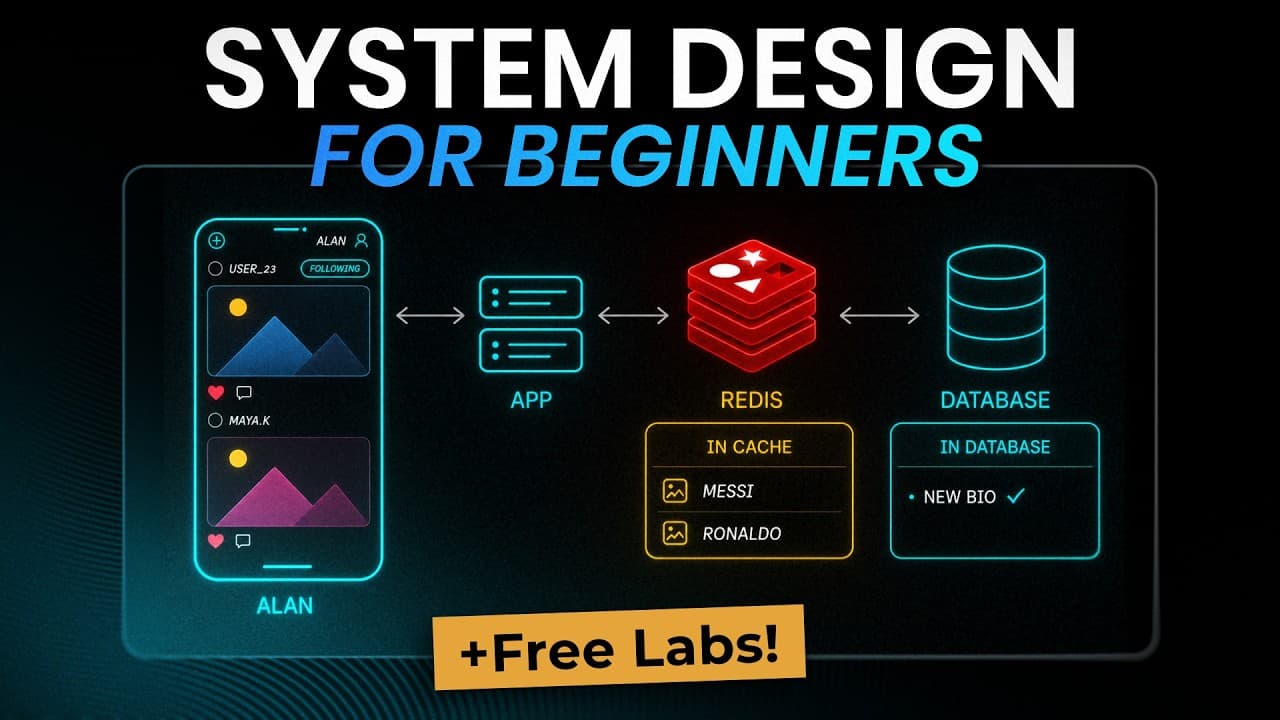
The video teaches building a real photo sharing app from a single server and scaling it step by step. It covers why you need load balancers, caching, replication, and sharding, and explains how functional and non functional requirements drive design decisions. The approach is to add components only as needed and reason about trade offs.
Transcript
This video is designed for absolute beginners who want to understand what system design is and how it actually works. And instead of covering topics in isolation, we'll attempt to design one real application together and improve the design step by step. Every concept, load balancers, caching, indexing, replication, sharding shows up exactly when ou... Read More
Key Insights
- System design focuses on choosing where components live and understanding costs, not rewriting code. The key is placing the right pieces in the right places to solve a software problem.
- Failing under high traffic reveals specific problems like CPU overload, database bottlenecks, or single points of failure, each with a standard fix such as adding servers, caches, or replicas.
- Load balancers act as traffic officers, directing requests to healthy servers and enabling horizontal scaling, which helps manage increased user loads effectively.
- Caching reduces repeated database queries by storing popular results in fast memory, improving response times for frequently accessed data.
- Replication creates copies of data across machines to avoid data loss from a single machine failure and supports higher availability.
- Sharding distributes data across multiple databases or storage nodes to handle very large datasets and traffic by dividing workload.
- High level design (HLD) looks at the big picture, including data flow and component roles, while low level design (LLD) zooms into specific features like a like button and its data operations.
- Functional requirements describe what the app must do, while non functional requirements describe quality attributes such as speed, durability, and scalability, guiding architectural trade offs.
Install to Summarize YouTube Videos and Get Transcripts
Explore YouTube Video Summarizer or Get YouTube Transcript Extractor
Questions & Answers
Q: A real search query question about the video (e.g. 'How to...', 'What is...', 'Why does...'). Question 1
The answer explains that system design is about placing components to meet functional goals while satisfying non functional requirements such as speed and durability. It emphasizes the iterative nature of design where new components are added only as needed to address observed failures and evolving requirements, not by rewriting the application logic.
Q: Question 2
The answer discusses why load balancers are used, describing how they distribute traffic and perform health checks to keep servers alive. It explains that the load balancer is the first building block added when traffic grows and helps prevent a single server from becoming a bottleneck.
Q: Question 3
The answer covers the role of caching, highlighting that caches store popular answers to avoid repeated heavy database queries. It notes that caches speed up responses but require careful invalidation and freshness handling to avoid serving stale data.
Q: Question 4
The answer describes replication as a strategy to protect data and improve availability. It explains that replicas allow the system to continue operating if the primary node fails and that data might be kept in external storage to ensure durability.
Q: Question 5
The answer explains what sharding is and why it helps scale by distributing workload across multiple database nodes. It highlights the challenge of keeping data consistent across shards and the need for appropriate routing logic.
Q: Question 6
The answer contrasts functional and non functional requirements, showing how the same feature set can lead to different architectures depending on required performance, availability, and cost. It emphasizes prioritizing requirements before choosing components.
Q: Question 7
The answer outlines the difference between high level and low level design, showing how to stay at a high level during initial design and zoom into details like the like feature when needed, without losing sight of the overall architecture.
Q: Question 8
The answer discusses why non functional requirements often conflict, such as speed versus cost, and stresses the need to make deliberate trade offs. It reiterates that the learning goal is to reason about system behavior under failure and scale, not to memorize diagrams.
Summary & Key Takeaways
-
A beginner level walkthrough shows starting with a single server and gradually adding components to handle growth, illustrating practical constraints and decisions. The example app is a photo sharing site where features and data storage need careful placement across machines.
-
The course emphasizes non functional requirements such as speed and durability, and explains how each design choice affects cost, reliability, and scalability. It teaches thinking in terms of components rather than code changes alone.
-
Free labs accompany the course to practice configuring load balancers, indexing, caching, and replicas, reinforcing hands on understanding of how failures expose weaknesses and how fixes introduce new challenges.
Read in Other Languages (beta)
Share This Summary 📚
Summarize YouTube Videos and Get Video Transcripts with 1-Click
Try YouTube Summary with ChatGPT & Claude or YouTube Transcript Generator
Explore More Summaries from KodeKloud 📚


Summarize YouTube Videos and Get Video Transcripts with 1-Click
Try YouTube Summary with ChatGPT & Claude or YouTube Transcript Generator