How to enable autonomous networking with agentic AI
TL;DR
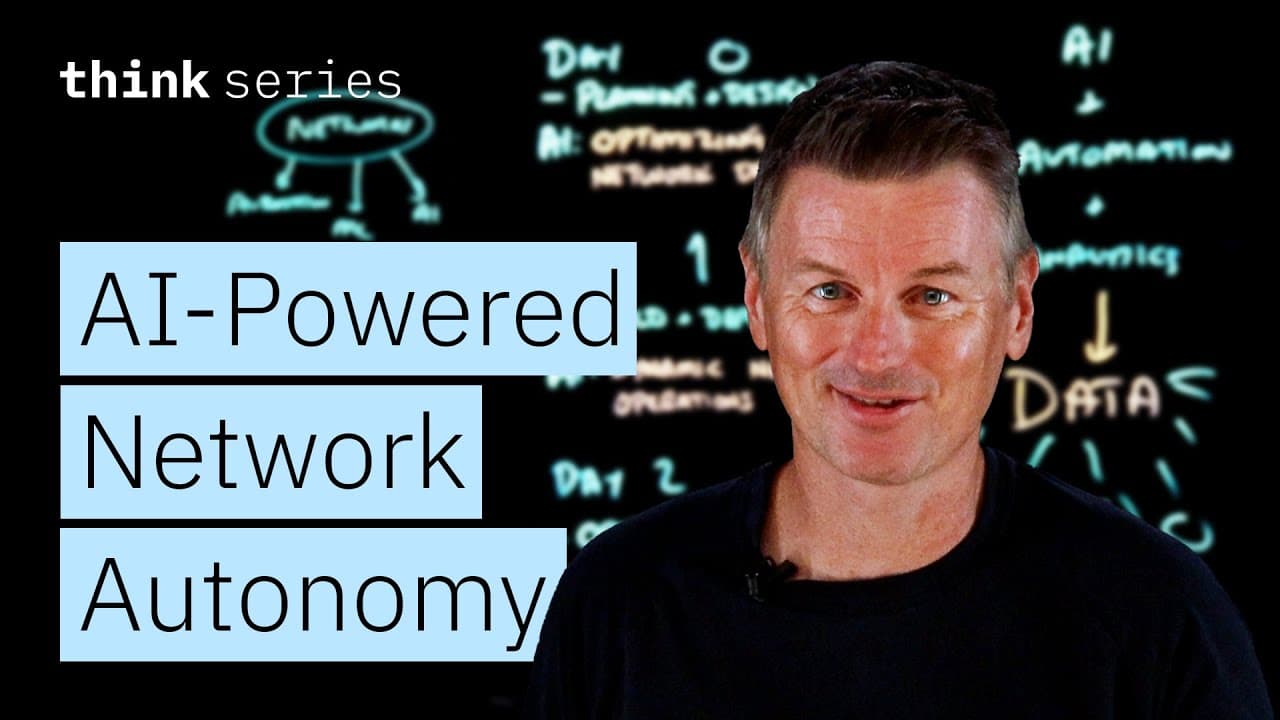
Agentic AI enables networks to reason about problems and act on them using domain tuned models and existing automation tools. Day zero planning, day one deployment, and day two operations combine AI with analytics to reduce false positives, improve remediation, and approach self healing networking. The result is a feedback loop where operational data trains better designs and smarter services.
Transcript
Many organizations want to get to autonomous networks, essentially networks that will take care of themselves. Now, if we look at the networks of today, they haven't really reached that level yet. They do typically have some level of automation and some level of machine learning and some amount of AI, but there's still a ways to go to reach autonom... Read More
Key Insights
- Signals in networks are overwhelmed by noise and many alerts are ignored or are false positives
- Cross domain data silos make it difficult to access telemetry data necessary for real time analysis
- AI for networking is a combined approach of AI, automation, and analytics rather than a magic fix
- Day zero AI focuses on planning and design to optimize capital expenditure and right size performance
- Day one AI accelerates deployment through validation of configurations and real time path optimization
- Day two AI handles operations with anomaly detection and autonomous remediation
- Agentic AI can reason about problems, not just flag them, and uses domain tuned models
- Remediation by agents uses existing automation tools and requires guardrails to bound the model’s actions
Install to Summarize YouTube Videos and Get Transcripts
Explore YouTube Video Summarizer or Get YouTube Transcript Extractor
Questions & Answers
Q: What is agentic AI in the context of networking and why is it important
Agentic AI in networking refers to an AI system that can reason about problems across siloed domains and then act to fix issues using existing automation tools. It uses domain tuned models to find root causes rather than merely flagging alerts. This approach addresses false positives and enables autonomous remediation while maintaining guardrails to ensure safe operation.
Q: How do day zero, day one, and day two differ in AI for networking
Day zero focuses on planning and design to optimize CapEx and create efficient architectures. Day one covers build and deployment, validating configurations and optimizing service paths in real time. Day two centers on operations, providing high fidelity anomaly detection and self improving behavior as feedback guides future design and deployment decisions.
Q: What problem does AI for networking aim to solve
The main problem is the flood of data and alerts across silos, making it hard to identify signals that matter. AI for networking aims to reduce noise, provide cross domain visibility, and enable networks to learn from operational data to become more autonomous and self healing over time.
Q: How does agentic AI achieve autonomous remediation
Agentic AI identifies the root cause through reasoning and then acts to remediate using existing automation tools. It operates within guardrails to ensure actions are safe and aligned with network policies, enabling faster resolution of issues without human intervention for routine problems.
Q: Why are domain tuned models important in this context
Domain tuned models are trained on specific network data, which makes them more accurate at identifying and diagnosing issues within that environment. They provide the contextual understanding needed to distinguish real problems from noise and guide correct remediation actions.
Q: What role do guardrails play in agentic AI
Guardrails bound the model’s reasoning and actions, ensuring that the AI’s decisions stay within safe, predefined policies. This is crucial because it prevents unintended changes or aggressive remediation, while still enabling autonomous responses to genuine issues.
Q: How does the AI feedback loop improve network design
Operational data and patterns from day two outages feed back into day zero planning, allowing capacity models to get smarter and designs to be better sized for actual usage. This continuous loop makes networks more self sufficient over time as the AI learns from real world behavior.
Q: Can humans still influence the automated network operations
Yes, humans can set the goals and priorities, such as traffic prioritization or latency optimization, while the agentic AI handles the ongoing detection and remediation within those guidelines. Humans remain in the loop for strategic decisions and oversight, ensuring alignment with business objectives.
Summary & Key Takeaways
-
Summary point 1 describes the problem of signal versus noise and data silos that hinder real time visibility across domains
-
Summary point 2 explains day zero planning and how AI optimizes CapEx decisions for more efficient designs
-
Summary point 3 outlines day two operations where agentic AI provides high fidelity anomaly detection and autonomous remediation within guardrails
Read in Other Languages (beta)
Share This Summary 📚
Summarize YouTube Videos and Get Video Transcripts with 1-Click
Try YouTube Summary with ChatGPT & Claude or YouTube Transcript Generator
Explore More Summaries from IBM Technology 📚



Summarize YouTube Videos and Get Video Transcripts with 1-Click
Try YouTube Summary with ChatGPT & Claude or YouTube Transcript Generator