Ninja Nerd Embryology: How Does the Placenta Develop?
TL;DR
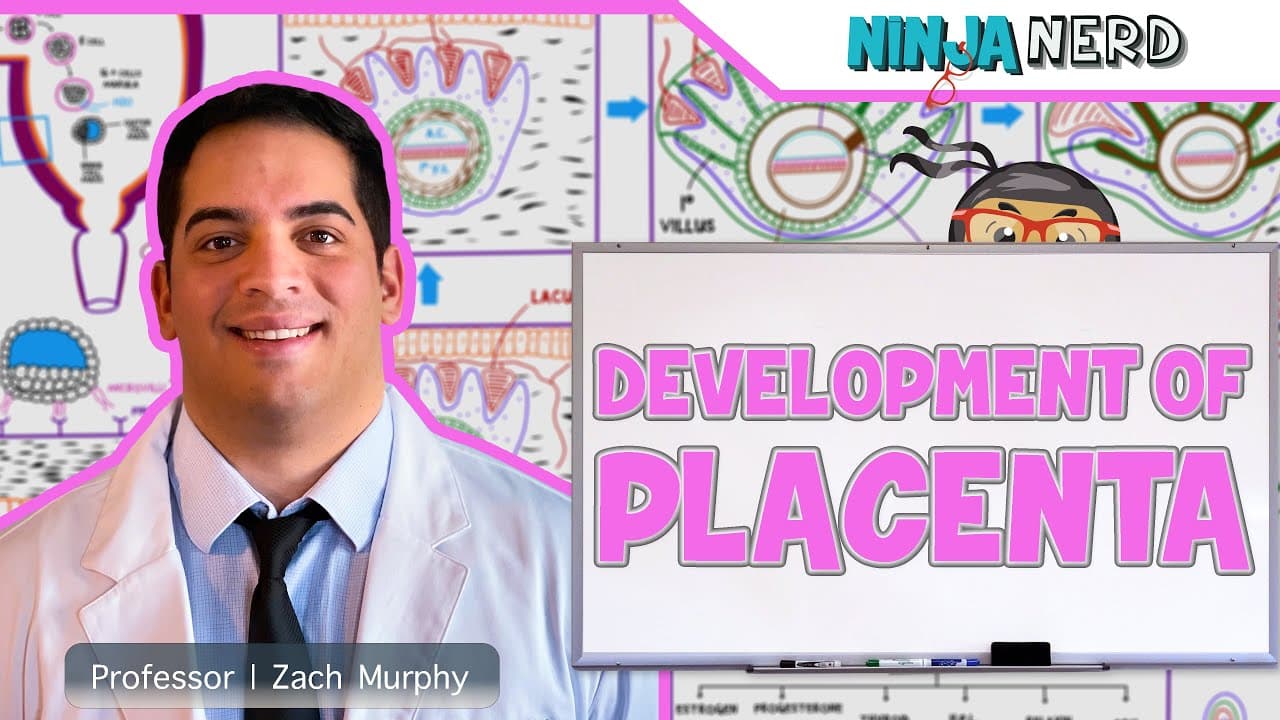
Ninja Nerd explains placenta development from blastocyst implantation through formation of the chorionic villi and the fetomaternal interface. The outer trophoblast forms placental tissue, while the inner embryoblast forms the fetus. Primary, secondary, and tertiary chorionic villi support exchange while maternal and fetal blood remain separate. Read on for the roles of decidualization, trophoblast differentiation, and placental functions.
Transcript
I ninja nerds in this video we are going to talk about the development of the placenta we're gonna get into a pretty decent amount of detail on that and then we're also gonna talk about the hormonal functions of the placenta and we'll throw throughout the video a couple clinical correlations that are important with this also before we get started c... Read More
Key Insights
- The blastocyst is formed when water enters the morula and creates a fluid-filled blastocoel, separating its cells into an outer cell mass and an inner cell mass. These populations become the trophoblast and embryoblast, respectively, and follow distinct developmental paths.
- The trophoblast is the outer cell mass that contributes to formation of the placenta, while the embryoblast is the inner cell mass that contributes to ectoderm, endoderm, and mesoderm. Those embryonic layers subsequently form the structural components of the fetus.
- Decidualization is the transformation of the endometrial lining into enlarged, supportive cells containing abundant glycogen and lipids. The blastocyst normally attaches to and invades the functional decidual region rather than penetrating beyond the intended layers of the uterine lining.
- Initial blastocyst attachment is a loose interaction between microvilli on trophoblastic cells and pinopodes projecting from the endometrial lining. This preliminary connection helps secure the blastocyst within the uterine cavity before stronger molecular attachments develop.
- Stronger implantation attachment is supported by integrins expressed on trophoblastic cells interacting with selectins and collagen associated with the endometrial lining. Adequate attachment is also linked to the release of specific chemokines by trophoblastic cells.
- The trophoblast differentiates into cytotrophoblast and syncytiotrophoblast layers, both of which contribute to implantation and invasion of the maternal endometrium. This differentiation helps establish the fetal component of the developing interface between embryonic and maternal tissues.
- Chorionic villi develop through primary, secondary, and tertiary stages and become the structural and functional units of the placenta. The extraembryonic mesoderm and chorionic plate participate in their formation, while umbilical vessels connect them with the embryonic circulatory system.
- The mature fetomaternal interface supports gas exchange, nutrient delivery, waste removal, hormone production, and immune protection. Maternal and fetal circulations remain separate, but their close arrangement across the placental barrier permits the placenta to support fetal growth and survival.
Install to Summarize YouTube Videos and Get Transcripts
Explore YouTube Video Summarizer or Get YouTube Transcript Extractor
Questions & Answers
Q: How does Ninja Nerd explain placenta development?
Ninja Nerd begins with cleavage of the zygote, then explains blastocyst implantation, trophoblast differentiation, formation of the extraembryonic coelom and chorionic plate, and development of the chorionic villi. The explanation concludes with placental coverings, functions, hormonal activity, and clinical correlations.
Q: How does the placenta begin to develop after fertilization?
The zygote undergoes cleavage through the two-cell, four-cell, eight-cell, and morula stages while surrounded by the zona pellucida. Water then enters the morula and forms the blastocoel, creating a blastocyst whose outer trophoblast contributes to the placenta.
Q: What is the difference between the trophoblast and embryoblast?
The trophoblast is the blastocyst's outer cell mass and contributes to placental formation. The embryoblast is the inner cell mass and contributes to the ectoderm, endoderm, and mesoderm that form the fetus.
Q: How does the blastocyst attach to the endometrium?
Trophoblastic microvilli first interact with pinopodes on the endometrial lining to form a loose connection. Integrins on trophoblastic cells then interact with selectins or collagen associated with the endometrium to create a tighter attachment.
Q: What is decidualization, and why does it support implantation?
Decidualization transforms cells of the endometrial lining into larger cells containing abundant glycogen and lipids. These decidual cells provide a supportive environment where the blastocyst normally attaches to and invades the functional decidual region.
Q: How does the trophoblast change after implantation?
After implantation, the trophoblast differentiates into cytotrophoblast and syncytiotrophoblast layers. Both layers contribute to implantation and invasion of the maternal endometrium, helping establish the fetal side of the developing interface.
Q: How do chorionic villi become functional units of the placenta?
Chorionic villi progress through primary, secondary, and tertiary stages. The trophoblast, extraembryonic mesoderm, and chorionic plate contribute to their formation, while umbilical vessels connect the villous system to the embryonic circulation.
Q: What functions does the placenta perform?
The placenta supports gas exchange, nutrient delivery, waste removal, hormone production, and immune protection. Its chorionic villi form exchange units between fetal and maternal tissues while maternal and fetal blood remain separate.
Summary & Key Takeaways
-
After fertilization in the fallopian tube, the zygote undergoes cleavage through two-cell, four-cell, eight-cell, and morula stages while surrounded by the zona pellucida. Water then enters the morula and creates the blastocoel, producing a blastocyst with an outer trophoblast and an inner embryoblast that have different developmental roles.
-
The trophoblast initiates placental formation by attaching the blastocyst to the decidualized endometrium. Trophoblastic microvilli first interact with endometrial pinopodes to create a loose connection. Integrins on trophoblastic cells and selectins or collagen associated with the endometrial lining then contribute to a tighter attachment that supports implantation and invasion.
-
Following implantation, the trophoblast differentiates into cytotrophoblast and syncytiotrophoblast layers. Extraembryonic mesoderm contributes to the chorionic plate, while primary, secondary, and tertiary chorionic villi become functional placental units. Their interaction with the decidua basalis creates a fetomaternal interface for exchange, protection, hormonal activity, and fetal circulatory connections.
Read in Other Languages (beta)
Share This Summary 📚
Summarize YouTube Videos and Get Video Transcripts with 1-Click
Try YouTube Summary with ChatGPT & Claude or YouTube Transcript Generator
Explore More Summaries from Ninja Nerd 📚






Summarize YouTube Videos and Get Video Transcripts with 1-Click
Try YouTube Summary with ChatGPT & Claude or YouTube Transcript Generator