How Is Tomer Cohen, LinkedIn CPO, Using AI to Disrupt Traditional Product Management?
TL;DR
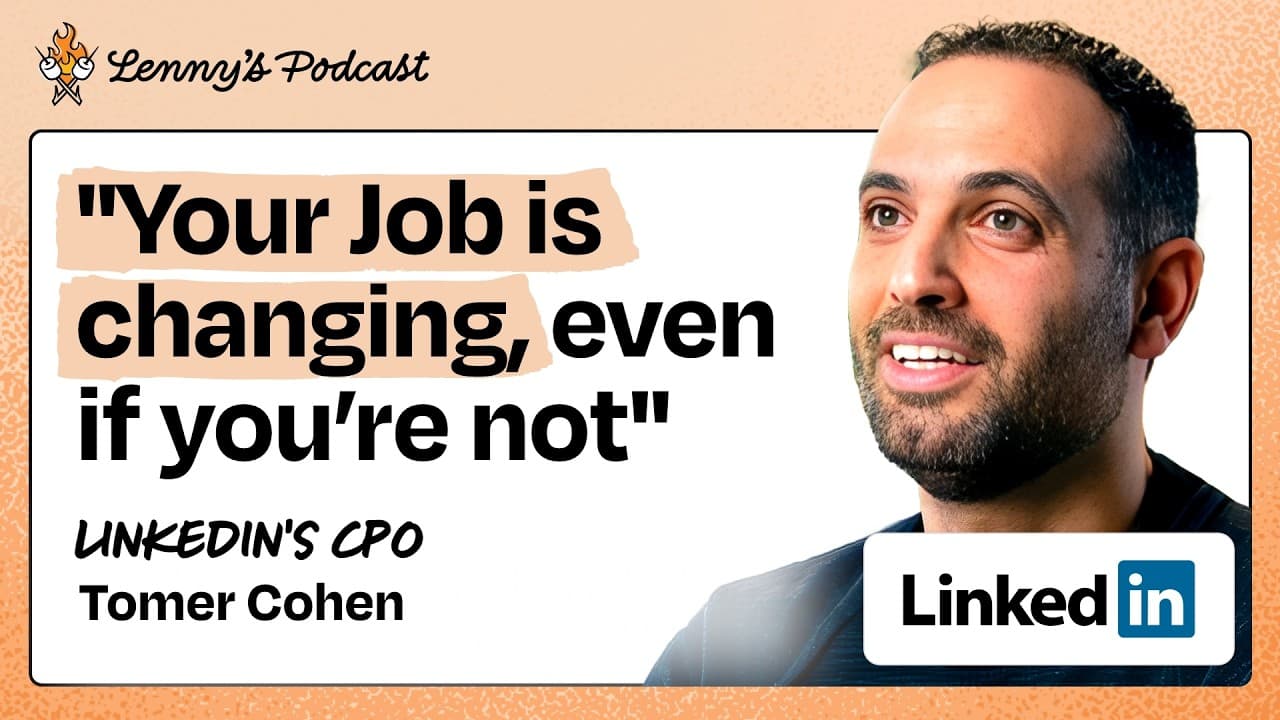
Tomer Cohen, LinkedIn CPO, is piloting a Full Stack Builder model that enables people from any function to take products from idea to launch. LinkedIn replaced its Associate Product Manager program, created a Full Stack Builder career path, and built internal tools and agents for human plus AI teams. Read on to see why culture, incentives, and change management are critical to making this model work.
Transcript
When we look at the skills required to do your job, by 2030 it will change by 70%. So whether or not you're looking to change your job, your job is changing. In order to stay competitive, you actually have to go back to some first principles, go back to the drawing board and reimagine what it means to be building. You're experimenting with a very d... Read More
Key Insights
- The skills required to perform jobs are expected to change by 70% by 2030, according to LinkedIn’s view of workforce data. Employees therefore face significant changes in their existing work even when they are not planning to change jobs.
- Traditional product development is slowed by accumulated process complexity. Research alone can involve 10 to 15 information sources, while design, privacy, security, and other reviews add valid but numerous substeps before a feature can reach customers.
- Organizational complexity follows process complexity because every specialized substep needs an owner. Engineering, product, and design divide further into specialties such as interaction design, animation design, content design, and research, creating additional coordination across teams and functions.
- The Full Stack Builder model enables a person from any function to take an idea to market. It attempts to collapse the product development stack, restore craftsmanship, and reduce dependence on rigid functional boundaries without suggesting that existing specialties lack value.
- LinkedIn replaced its traditional Associate Product Manager program with an Associate Full Stack Builder program. The new approach teaches coding, design, and product management skills together, reflecting the expectation that future builders will work across responsibilities that were previously separated.
- The Full Stack Builder program depends on three pillars: platform, agents, and culture. Culture matters most because access to technology is insufficient without incentives, motivation, practical examples, recognition, and organizational systems that encourage people to change how they work.
- Specialized agents can critique product ideas and identify vulnerabilities, but enterprise use requires customization. The discussion states that off-the-shelf AI tools do not work on enterprise code without adaptation, making internal tools and agents important components of LinkedIn’s model.
- Top performers adopt AI tools fastest because strong talent continually tries to improve its craft. This challenges the assumption that AI primarily levels performance by making less capable workers stronger, since highly capable builders can also use it to extend their advantage.
- Related book: The Beginning of Infinity
- Related book: Why Nations Fail
- Export your Kindle highlights to Glasp: How to Download Highlights and Notes from Kindle
Install to Summarize YouTube Videos and Get Transcripts
Explore YouTube Video Summarizer or Get YouTube Transcript Extractor
Questions & Answers
Q: What is Tomer Cohen, LinkedIn CPO, changing about product development?
Tomer Cohen is piloting LinkedIn’s Full Stack Builder model, which enables builders to take an idea to market regardless of their function, role in the stack, or team. The model combines human judgment with AI tools, agents, and processes so product teams can move faster and adjust to change quickly.
Q: What is LinkedIn’s Full Stack Builder model?
The Full Stack Builder model empowers people from any function to move products from idea to launch. It creates a fluid interaction between humans and machines while combining responsibilities that traditionally sit across product, design, and coding.
Q: Why is LinkedIn rethinking traditional product management?
LinkedIn expects the skills required to do a job to change by 70% by 2030. Cohen argues that staying competitive requires returning to first principles and reimagining what it means to build products.
Q: What happened to LinkedIn’s Associate Product Manager program?
LinkedIn scrapped its traditional Associate Product Manager program and replaced it with an Associate Full Stack Builder program. The new program reflects a model in which builders develop product, design, and coding capabilities together.
Q: Can anyone become a Full Stack Builder at LinkedIn?
LinkedIn introduced a Full Stack Builder career path that people from any function can pursue. Its goal is to let strong builders take ideas to market regardless of their original role or team.
Q: How do AI agents support LinkedIn’s product teams?
LinkedIn built internal tools and agents to support human plus AI product teams. These systems help teams move quickly, respond to change, and accomplish more with fewer traditional handoffs.
Q: Why is change management critical for AI adoption?
Providing AI tools alone does not make employees adopt them. Companies also need incentive programs, motivation, practical examples, and processes that show people how to use the tools in their work.
Q: Does AI make top performers even more effective?
The discussion suggests that top talent continually looks for ways to improve its craft. Because these builders actively seek better tools and methods, AI can make already strong performers even more effective rather than only helping weaker performers improve.
Summary & Key Takeaways
-
Product development becomes slow when reasonable safeguards, information sources, reviews, code bases, and specialties accumulate into a complicated system. LinkedIn is reconsidering traditional functional boundaries because even a small feature can require multiple teams and sprints, while the iteration that follows a launch is where success actually emerges.
-
LinkedIn’s Full Stack Builder model empowers people from any function to move an idea from conception to market. The company replaced its traditional Associate Product Manager program with an Associate Full Stack Builder program, introduced a formal Full Stack Builder career path, and combined product, design, and coding skills in one development model.
-
Making the model work requires a platform, customized agents, and a supportive culture, with culture described as the most important pillar. Adoption depends on change management, including incentives, motivation, examples, recognition, exclusivity, and updated performance reviews. LinkedIn’s approach treats product creation as a fluid collaboration between humans and machines.
Read in Other Languages (beta)
Share This Summary 📚
Summarize YouTube Videos and Get Video Transcripts with 1-Click
Try YouTube Summary with ChatGPT & Claude or YouTube Transcript Generator
Explore More Summaries from Lenny's Podcast 📚

Summarize YouTube Videos and Get Video Transcripts with 1-Click
Try YouTube Summary with ChatGPT & Claude or YouTube Transcript Generator