How to Build Ad Creative for Meta Andromeda

TL;DR
Treat each successful creative idea as a concept, then produce meaningful iterations within that concept while continuing to test distinct concepts. Meta Andromeda uses creative signals, alongside pixel, site, conversions API, and other data, to match ads with relevant audiences, so creative diversification matters, but abandoning iterations forces costly dependence on an endless supply of unproven ideas.
Transcript
The latest meta ads Andromeda update has completely transformed advertising. We've seen return on ad spends drop. We've seen CPAs rise and there has been an absolute outburst in new strategies completely change structures and new ways to run ads. Now, the scary thing I'm seeing in the market today is that there is so much advice out there with abso... Read More
Key Insights
- Meta Andromeda is a retrieval system designed to process greater creative volume and diversity, allowing more complex AI models to personalize which eligible ad is shown to each person as advertisers upload increasingly large libraries of creative.
- The December 2, 2024 Andromeda release did not suddenly erase entire advertising accounts, according to the transcript, because Advantage Plus had already used the system for months and the newer change primarily affected manual or non-Advantage Plus audiences.
- Creative diversification is the practice of producing ads with different themes, messages, and visuals for diverse audience segments. Meta's April 2025 best-practices paper presents this variety as a way to give its AI more eligible ads for scaled testing and optimization.
- Creative is increasingly the targeting because Meta uses an ad's data, engagement rates, and associated metrics to match that ad with a relevant person. Different concepts can therefore find different audiences without advertisers manually grouping every creative under one predefined audience.
- The ad-to-audience relationship has shifted from one audience containing many ads toward individual ads finding appropriate audiences. Pixel information, site activity, conversions API data, and connected third-party sources still contribute to determining who Meta targets.
- A strategy based only on entirely new concepts requires an effectively endless supply of ideas, extensive creative resources, and enough advertising spend to test them. Because producing a winning ad is difficult, repeatedly pursuing only large conceptual swings can create frequent failures and wasted spending.
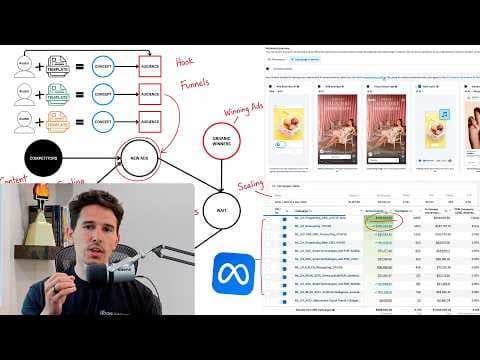
- A concept is a repeatable creative approach, such as model photography with large bold text, a clean product display, a product shown in a natural setting, or a raw UGC-style demonstration. Advertisers should evaluate and develop these broader patterns instead of treating every ad as isolated.
- Iterations remain valuable when they make meaningful changes within proven concepts. The transcript cites Yeti, Athletic Greens, and major agency clients as continuing to iterate, while noting that Yeti launched 318 new ads in 14 days across several distinct creative approaches.
Install to Summarize YouTube Videos and Get Transcripts
Explore YouTube Video Summarizer or Get YouTube Transcript Extractor
Questions & Answers
Q: What changed with Meta Andromeda advertising?
Meta Andromeda changed how the advertising system retrieves and matches creative to people. Instead of thinking primarily about an audience containing a group of ads, advertisers can view each ad as finding an appropriate audience through its creative signals and performance data. Pixel information, site information, conversions API data, and connected third-party sources still influence who Meta targets.
Q: Does Meta Andromeda make ad iterations obsolete?
No, iterations are not obsolete under Meta Andromeda. The recommended approach in the transcript is to test distinct concepts, identify high-performing ones, and then create substantial iterations within those concepts. The warning is that iterations must be meaningful. Tiny wording changes, such as adjusting capitalization in the same phrase, are presented as insufficient to create a useful difference.
Q: What does creative diversification mean for Meta ads?
Creative diversification means developing a wide range of advertisements with different themes, messages, and visuals so they can appeal to diverse audience segments. Meta's April 2025 best-practices paper says greater volume and diversity create more eligible ads for personalization. Andromeda processes that larger pool so more complex AI models can determine which creative is relevant to a particular person.
Q: Why is creative considered the new targeting on Meta?
Creative is considered the new targeting because Meta uses the information and response patterns associated with each ad to match it with relevant people. Two ads with very different concepts can be delivered to different audiences based on their likely reactions. However, the creative is not the only input, since pixel, website, conversions API, and third-party data also affect targeting.
Q: How should advertisers structure creative for Andromeda?
Advertisers should structure creative around concepts rather than viewing every advertisement as a separate, unrelated unit. They can test several distinct concepts, such as a clean product display, a product shown in use, or a natural UGC-style video. Once a concept proves successful, they should produce meaningful variations that expand its reach while preserving the core approach that performed.
Q: Why can testing only new ad concepts waste money?
Testing only entirely new concepts can waste money because each concept requires creative effort and advertising spend despite having no established performance. Winning ads are difficult to produce, so relying exclusively on new conceptual swings increases the likelihood of repeated failures. It also reduces the number of lower-risk attempts advertisers can make by iterating on creative approaches that have already demonstrated potential.
Q: What does Yeti's Meta ad strategy demonstrate?
Yeti's advertising illustrates how concept diversity and iteration can operate together. The transcript identifies three approaches: products on simple colored or white backgrounds, products shown in natural settings, and raw UGC-style videos showing products in use. It also reports that Yeti launched 318 new ads in 14 days, indicating substantial creative volume rather than fewer advertisements.
Q: Did the latest Andromeda change wipe out existing ad accounts?
The transcript argues that the newer Andromeda change did not wipe out entire advertising accounts. It states that the first update was released on December 2, 2024 and had already been used by Advantage Plus for months. Under that account, the more recent effects mainly concerned manual or non-Advantage Plus audiences, rather than representing a sudden replacement of every existing account signal.
Summary & Key Takeaways
-
Meta Andromeda was introduced to handle growing creative volume and diversity with more complex personalization models. The update had already supported Advantage Plus for months, according to the transcript, while the newer change primarily affected manual or non-Advantage Plus audiences rather than suddenly wiping out the value of entire advertising accounts.
-
Creative increasingly functions as targeting because Meta evaluates each ad's data, engagement rates, and related metrics to find relevant people. Distinct themes, messages, visuals, formats, products, and settings can attract different audience segments, while pixel data, site information, conversions API data, and connected third-party sources also influence delivery decisions.
-
Advertisers should organize creative around concepts rather than isolated ads. They can test genuinely different concepts, identify the ones that perform, and build substantial iterations around those winners. Yeti illustrates this approach through product displays, products in natural settings, and raw UGC-style videos, supported by numerous variations within successful concepts.
Read in Other Languages (beta)
Share This Summary 📚
Summarize YouTube Videos and Get Video Transcripts with 1-Click
Try YouTube Summary with ChatGPT & Claude or YouTube Transcript Generator
Explore More Summaries from Sam Piliero 📚


Summarize YouTube Videos and Get Video Transcripts with 1-Click
Try YouTube Summary with ChatGPT & Claude or YouTube Transcript Generator