How to apply the 70/20/10 rule to Facebook ads

TL;DR
The 70/20/10 framework guides how you allocate time for ad creation. Spend about 70 percent on the main winning content, 20 percent on adjacent ideas, and 10 percent on wild card tests. Then maximize a proven ad by creating hundreds of variants to extend its life while others prove themselves.
Transcript
Alex Herozi broke the internet recently with his latest launch of $100 million money models. He generated over $100 million from a single book launch. And many of you know Alex is growing a portfolio of businesses that are generating over $200 million annually. And I'm 100% convinced that none of this would be possible if him and his team didn't ma... Read More
Key Insights
- The 70/20/10 rule guides time allocation for ad creation, prioritizing the most impactful content first.
- A winning ad should be used as a base to generate hundreds of variations, extending its performance and lifespan.
- Adjacent ideas are variations that stay close to the main concept but explore different angles and hooks.
- The 10 percent wild card uses high-risk, high-reward ideas to discover new successful formats.
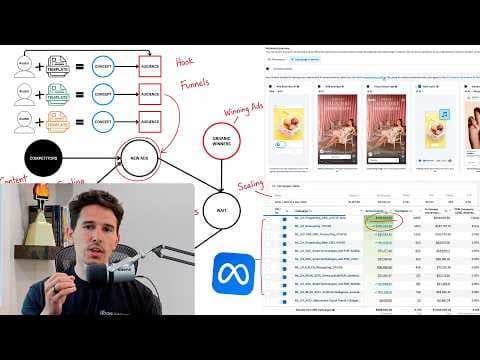
- Old school Facebook relied on targeting after the concept; new Facebook emphasizes multiple concepts with performance varied across audiences.
- Having multiple ad concepts allows Facebook to optimize delivery across diverse audiences for better scale.
- Proof from customers often matters more than the advertiser’s claims when driving conversions and trust.
- Testing offers and framing, such as value versus discount, can significantly impact perceived value and response rates.
Install to Summarize YouTube Videos and Get Transcripts
Explore YouTube Video Summarizer or Get YouTube Transcript Extractor
Questions & Answers
Q: What is the 70/20/10 rule in Facebook ads and how should it be applied?
The 70/20/10 rule is a time and resource allocation framework for ad creation. You should spend 70 percent of your effort on the main, proven content that already performs well, 20 percent on adjacent ideas that extend that concept, and 10 percent on wild card tests to discover fresh approaches. This structure helps focus energy on what works while still exploring new angles, increasing the odds of finding scalable winners.
Q: How do you maximize a winning ad according to the speaker?
To maximize a winning ad, you should create hundreds of iterations of that same ad. This includes changing visuals, headlines, fonts, and copy while keeping the core concept intact. The goal is to extend the ad’s lifespan by producing variations that appeal to different viewers, thereby sustaining performance rather than letting it fade quickly.
Q: What is meant by ‘adjacent ideas’ in the context of ad creation?
Adjacent ideas refer to variations of the main winning ad that explore related angles or tweaks without straying far from the core concept. These variations help test which small changes can improve engagement and ROAS, expanding the effective reach of the original winning idea.
Q: How has the targeting dynamic changed from old to new Facebook according to the speaker?
In old Facebook, you would set a target audience first and then craft ads for that audience. In new Facebook, the platform uses the ad concept as the primary driver for delivery, and Facebook determines audiences based on the creative. This means you should develop multiple strong concepts so that Facebook can optimize across different audiences.
Q: Why is having multiple ad concepts beneficial for scale?
Multiple ad concepts prevent overreliance on a single ad. Each concept can perform at different levels and spend differently, enabling Facebook to optimize for diverse audiences. This approach improves overall ROAS and reduces the risk of a single ad stalling under fatigue, enabling steadier, scalable growth.
Q: What practical tip is given for improving ad performance in the first seconds?
A practical tip is to capture the best-performing first 3 to 5 seconds of your top-winning ads and slice that segment into other ads. This method provides a strong opening that can boost engagement and allows you to generate many variants quickly, accelerating the discovery of effective hooks.
Q: How should offers be framed to improve conversion without increasing discounting?
Offers should be framed in terms of value rather than just percentage discounts. For example, stating a larger dollar amount off instead of a percentage can be more compelling. This framing reduces cognitive load for the consumer and can improve perceived value, leading to higher conversion rates.
Q: What role does customer proof play in the ad strategy described?
Customer proof plays a crucial role, as most effective ads rely on demonstrations of results or testimonials rather than self-promotion. Letting proof talk for you builds trust and credibility, which helps ads resonate with potential buyers and improves conversion by showing real-world impact.
Summary & Key Takeaways
-
The video explains the 70/20/10 rule for allocating creative effort and time across a single winning ad, adjacent ideas, and random tests. It emphasizes starting with proven content and iterating with many variations to extend performance. It also discusses adapting concepts to the platform’s evolving targeting dynamics.
-
A key point is to exhaust the potential of strong ads by producing many iterations, rather than letting a winning ad fade. Diversifying ad concepts and using first 3-5 seconds as a template helps scale and maintain ROAS.
-
The content covers practical tips for presenting offers, testing different wording, and framing numbers to boost perceived value. It also highlights the importance of proof from customers over self-promotion and the shift from old to new Facebook targeting.
Read in Other Languages (beta)
Share This Summary 📚
Summarize YouTube Videos and Get Video Transcripts with 1-Click
Try YouTube Summary with ChatGPT & Claude or YouTube Transcript Generator
Explore More Summaries from Sam Piliero 📚



Summarize YouTube Videos and Get Video Transcripts with 1-Click
Try YouTube Summary with ChatGPT & Claude or YouTube Transcript Generator