How Does Linear Algebra Support Machine Learning?
TL;DR
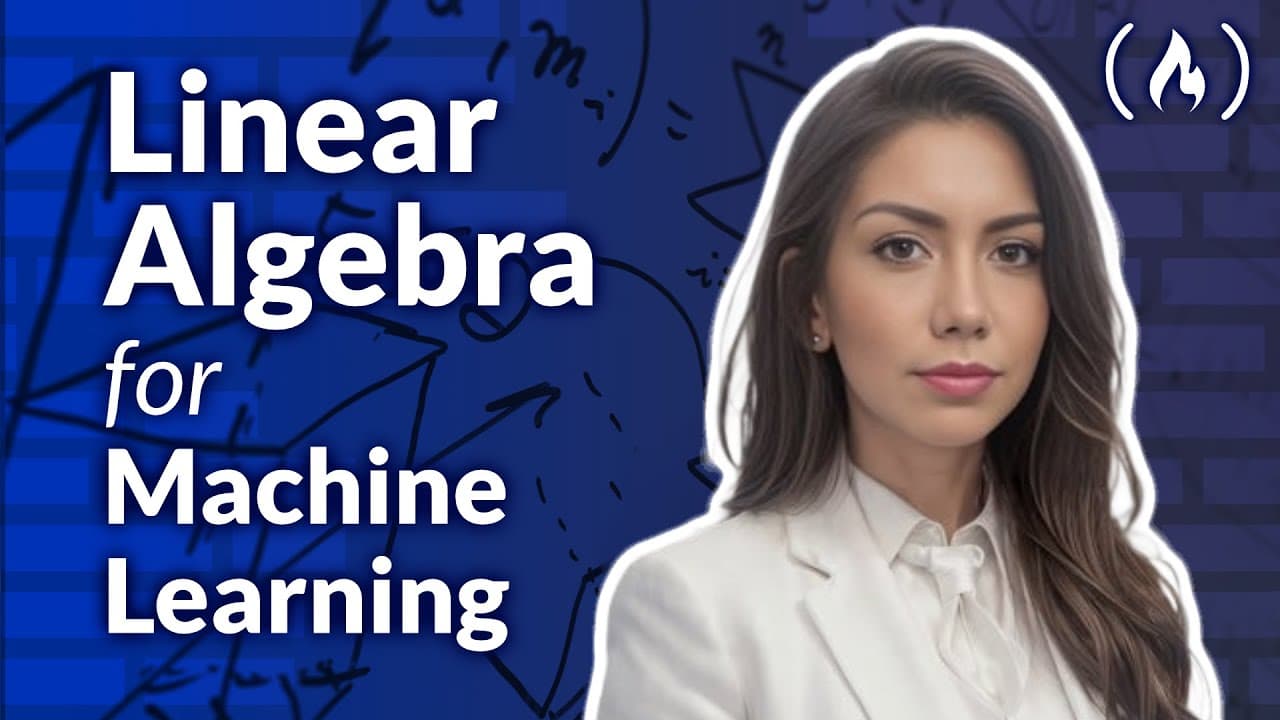
Linear algebra provides the mathematical foundation needed to build, optimize, and analyze machine learning models, from linear regression to neural network architectures. Begin with real numbers, coordinate systems, trigonometry, geometry, norms, and distance measures, then progress through vectors, scalar multiplication, linear combinations, span, linear independence, linear systems, and matrices.
Transcript
this in-depth course provides a comprehensive exploration of all critical linear algebra Concepts necessary for machine learning you'll learn the mathematical foundations to excel in AI tdiv from lunar Tech developed this course she has created many popular machine learning courses machine learning is at the Forefront of the Innovation powering the... Read More
Key Insights
- Linear algebra is a mathematical foundation for understanding machine learning models, including basic linear regression, neural network architectures, optimization algorithms, and gradient descent. The course presents these ideas for learners who want to move beyond merely using libraries and understand underlying technical mechanics.
- Real numbers form the basic numerical setting introduced in the course. The notation R represents all real numbers, including positive integers, negative numbers, and floating-point values, while R2, R3, and RN represent Euclidean spaces with increasing numbers of dimensions.
- The Cartesian coordinate system is essential for visualizing points, lines, and vectors. A point in a two-dimensional plane is described with an x-coordinate and a y-coordinate, while related ideas extend the representation of vectors into three-dimensional and higher-dimensional spaces.
- Norms and distance measures describe geometric properties needed for vector analysis. The course connects norms with vector magnitude and uses Euclidean distance to discuss the length between points represented in two-dimensional or three-dimensional coordinate spaces.
- Trigonometry and geometry provide prerequisites for studying vectors. The required concepts include sine, cosine, tangent, reciprocal functions, angles, triangles, right angles, the Pythagorean theorem, and relationships among triangle sides, all of which support later linear algebra topics.
- Vectors can represent practical data rather than only geometric arrows. The course uses word-count vectors and customer-purchase representations as applications, then expands the discussion to sparse vectors and vectors with high numbers of dimensions.
- Linear combinations and span describe how vectors can be scaled and combined. After introducing scalar multiplication and unit vectors, the course develops span and linear independence as advanced concepts needed to reason about relationships within collections of vectors.
- Matrices provide notation and structure for linear systems. The curriculum moves from coefficient labeling and systems of equations to matrix definitions, notation, and special matrix types, establishing concepts used to build, analyze, and optimize machine learning methods.
- More videos from this channel:
- More from this channel: freeCodeCamp.org
Install to Summarize YouTube Videos and Get Transcripts
Explore YouTube Video Summarizer or Get YouTube Transcript Extractor
Questions & Answers
Q: Why is linear algebra important for machine learning?
Linear algebra supplies mathematical concepts used to build, optimize, and analyze machine learning models. It supports understanding of methods ranging from linear regression to neural network architectures, including optimization algorithms and gradient descent. Studying it helps practitioners move beyond simply calling software libraries so they can recognize the technical mechanics behind machine learning, deep learning, artificial intelligence, data science, and analytics.
Q: What should I know before studying linear algebra for machine learning?
The stated prerequisites include familiarity with real numbers, variables, equations, vector spaces, norms, distance measures, Cartesian coordinates, basic algebra, geometry, and trigonometry. Learners should understand sine, cosine, tangent, angles, triangles, right angles, the Pythagorean theorem, and basic graphing with x and y axes. The course also refreshes these ideas when they become relevant to later material.
Q: What does R, R2, R3, and RN mean in linear algebra?
R represents the set of all real numbers, including positive integers, negative numbers, and floating-point values. R2 describes a two-dimensional Euclidean plane in which each point can be assigned an x-coordinate and a y-coordinate. R3 refers to three-dimensional space, while RN generalizes the same idea to a Euclidean space containing an arbitrary number of dimensions.
Q: How does the Cartesian coordinate system support vector learning?
The Cartesian coordinate system provides a visual framework for plotting points, lines, functions, and vectors. In a two-dimensional plane, positions are described by corresponding x and y coordinates. This framework helps learners understand vector direction, angles, magnitude, and distance, and it provides a starting point for extending vector representations from two dimensions into three-dimensional and higher-dimensional spaces.
Q: What are norms and Euclidean distance used for?
Norms are introduced as a way to discuss the magnitude or length associated with vectors. Distance measures describe the length between two points when those points are plotted in a coordinate space. The course connects these ideas with trigonometry, geometry, Cartesian coordinates, and the Pythagorean theorem before presenting the Euclidean distance between two points as a dedicated topic.
Q: How can vectors represent machine learning data?
Vectors can encode practical observations as ordered numerical representations. The course gives word-count vectors and customer-purchase representations as concrete applications, then discusses sparse vectors and vectors in high-dimensional spaces. These examples show how information can be organized numerically before learners study operations such as scalar multiplication, linear combinations, span, and linear independence.
Q: What vector operations and concepts does the course cover?
The vector curriculum begins with definitions of scalars and vectors, followed by zero vectors, unit vectors, sparsity, and high-dimensional vectors. It then introduces scalar multiplication with examples and develops linear combinations and unit-vector relationships. More advanced sections examine the span of vectors and linear independence, preparing learners to reason about collections of vectors and their mathematical relationships.
Q: When are matrices introduced in the linear algebra course?
Matrices are introduced after the sections on vectors, scalar multiplication, linear combinations, span, and linear independence. The transition begins with linear systems and coefficient labeling, followed by matrix definitions and notation. The curriculum then moves into special matrix types, placing matrices within a progression that starts with foundational geometry and advances toward structures relevant to machine learning models.
Summary & Key Takeaways
-
The course begins by connecting linear algebra to machine learning, deep learning, artificial intelligence, data science, analytics, cryptology, cybersecurity, and other applied disciplines. Its central goal is to help practitioners understand the mathematics and technical mechanics behind algorithms instead of relying exclusively on software libraries or memorized procedures.
-
The prerequisite review covers real numbers, variables, equations, Cartesian coordinates, trigonometric functions, angles, triangles, the Pythagorean theorem, orthogonality, perpendicularity, norms, and distance. These concepts prepare learners to interpret vector direction, magnitude, geometric relationships, multidimensional spaces, and later applications such as dimensionality reduction.
-
The curriculum progresses from scalars, vectors, zero vectors, unit vectors, sparsity, and high-dimensional representations to scalar multiplication, linear combinations, span, and linear independence. It then introduces linear systems, coefficient labeling, matrices, notation, and special matrix types, while using examples such as word counts and customer purchases.
Read in Other Languages (beta)
Share This Summary 📚
Summarize YouTube Videos and Get Video Transcripts with 1-Click
Try YouTube Summary with ChatGPT & Claude or YouTube Transcript Generator
Explore More Summaries from freeCodeCamp.org 📚





Summarize YouTube Videos and Get Video Transcripts with 1-Click
Try YouTube Summary with ChatGPT & Claude or YouTube Transcript Generator