How to Design Believable Game Cities With Urban Planning
TL;DR
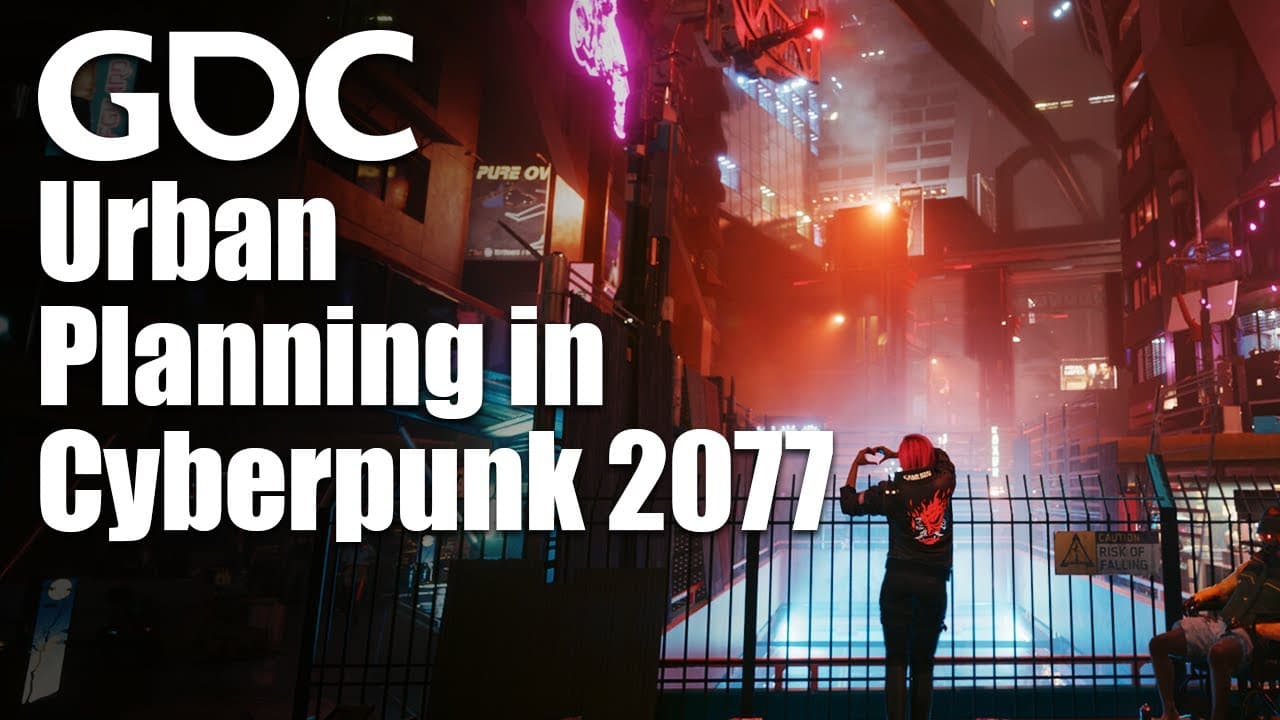
Game cities should be believable rather than realistic, built as a readable structure instead of buildings scattered on a surface. Every city breaks down into three core spaces: street, square, and backyard, and the three basic design parameters are size, proportions, and level of detail. All three tie directly to gameplay, specifically the player's type and speed of movement.
Transcript
Uh And today I'm going to speak about urban planning in games. But before uh a few words about myself, um it's two years that I've been working at City Project Grab and uh 10 years that I'm in Game Dev uh in general w work mostly on environments. Uh Also, I have a master's degree in urban planning, although I never work as architect or urban planni... Read More
Key Insights
- Believability, not realism, is the goal of urban planning in games. The parallel is character anatomy: artists do not copy exact human proportions but must understand anatomy before they simplify, exaggerate, or add horns and wings. Cities require the same understanding-then-adjustment process.
- Real cities cannot be copy-pasted into games because they were made for comfortable living while game cities must be made for fun playing. A 15 minute walk to a grocery store reads as convenient in real life and as boring gameplay, so real proportions fail even when recreating an existing city.
- The most common mistake among artists and designers is perceiving a city as a bunch of buildings randomly scattered on a surface. Two cube schemes with nearly identical silhouettes demonstrate the difference: one immediately reads as a city, the other reads as chaos lacking structure.
- A city is always a structure, and that structure is what makes space readable. In street view, roughly ten cubes placed in order already communicate a street with buildings despite zero detail, while a random arrangement cannot be identified as a street, a backyard, or anything else.
- Using urban planning from the very beginning simplifies production because it yields a distinctive and recognizable space at the first step. A city can be imitated through composition and level design alone, but structural planning gets there without relying on lucky arrangement.
- Two general types of urban planning exist. City block is a dense row of buildings along the street, typical of cities built before the 20th century such as San Francisco. Super block is separately standing buildings around an infrastructure unit surrounded by big roads, invented by modernist and brutalist architects and popular after the Second World War.
- Street, square, and backyard are the three basic types of city space and are present in every city while taking the biggest surface. Parks, green areas, markets, parking, and construction sites can appear optionally, so these three are the core of a city but not the complete list of city space.
- Size, proportions, and level of detail are the three basic parameters of city creation, and all three connect to gameplay through the type and speed of player movement. A car-based city needs to be bigger than a walking city, and size decisions also cover the city's borders and shape.
Install to Summarize YouTube Videos and Get Transcripts
Explore YouTube Video Summarizer or Get YouTube Transcript Extractor
Questions & Answers
Q: Why is urban planning important for game environments?
Urban settings are very common across games, whether the city is real, fictional, sci-fi, fantasy, or futuristic, and they appear in big open world projects as well as smaller games with linear gameplay. Even a team creating just one or a few streets rather than an entire city still has to understand what a street is and which elements make it recognizable as a street. Applying urban planning from the very beginning lets a team create distinctive and recognizable space from the first step of production, which simplifies the work rather than complicating it.
Q: What is the difference between realistic and believable city design in games?
The goal in games is believability, not realism. The talk compares this to anatomy for game characters: character artists do not necessarily follow real human proportions, but they still have to understand human anatomy, following certain rules and then simplifying some parts, exaggerating others, or adding extra elements like horns or wings. City building works the same way. Designers must first understand the urban environment as a structure, then adjust it to the specific needs of the game rather than reproducing reality exactly.
Q: Why can you not copy a real city from Google Maps into a game?
Real proportions for cities do not work for game needs, even when the project is recreating an actual existing city. The example given is a grocery store a 15 minute walk from home. In real life that distance feels super close and super convenient, but in a game, walking for 15 minutes to reach something would feel super boring and simply would not work. Real cities were made for comfortable living while game cities should be made for fun playing, and those are completely different tasks.
Q: What is the most common mistake when designing cities for games?
The most common mistake among many artists and designers is perceiving a city as a bunch of buildings randomly scattered on the surface. At first glance a city might seem like that, but it is not. The talk demonstrates this with two cube schemes whose silhouettes are almost identical and very hard to tell apart, yet one reads instantly as a city because viewers have seen that structure many times, while the other is simply chaos. A nice composition can be made from random cubes, but it still lacks structure, and a city is always a structure.
Q: What are the three basic types of city space?
The three basic types are street, square, and backyard. In real cities there can be more types, but these three take up the biggest surface and are present in every city. Other city spaces such as parks, any type of green areas, markets, parking, and construction sites can be present optionally in a game city, and that list is effectively endless. So these three are the core of the city but not the ultimate list of city space. Their shapes can vary: streets can be straight, curved, or angled, and squares can sit at the middle of an intersection or along the side of a street.
Q: What is the difference between city block and super block urban planning?
City block urban planning is a dense row of buildings along the street. It can be found everywhere around the world, in Europe and America, and it broadly describes any city built before the 20th century, with San Francisco given as a great example. Super block urban planning is separately standing buildings, usually arranged around some infrastructure unit and surrounded by big roads, often with many trees and similar elements. It was invented by modernist and brutalist architects in the first part of the 20th century and became really popular after the Second World War, and it also appears everywhere including Europe, America, Asia, and Africa.
Q: How do you know if a game city is readable?
The test is instant recognition. If a person were teleported into a random city they had never visited, with no idea where they are, they would immediately recognize the space around them: standing in a street reads as a street, standing in a square reads as a square, and the same goes for a backyard, with no chance of confusing one for another. Games should work the same way. If a player is spawned randomly somewhere in the city, they should immediately understand where they are. Night City examples show this: a street with clear direction, road, sidewalks, and buildings on the left and right; Corpo Plaza reading unambiguously as a square; and a backyard that would never be mistaken for either.
Q: How does gameplay affect the size of a game city?
The three basic parameters of a city, size, proportions, and level of detail, are all very much connected with gameplay, and more precisely with the type of movement and particularly the speed of movement. If the player is mostly driving a car in the city, their speed is quite high, so the city apparently needs to be bigger than one built for mostly walking. Size itself is the simplest parameter, literally measured in square meters, square kilometers, or square feet. This stage is also when the borders and shape of the city should be considered, for instance whether it sits on a shoreline, is surrounded by mountains, lies in a valley, or forms a peninsula.
Summary & Key Takeaways
-
Urban settings appear in games of every scale, from big open worlds to smaller linear projects, so even a team building one or two streets needs to understand which elements make a street read as a street. The speaker, who has 10 years in game development and two years at CD Projekt Red plus a master's degree in urban planning, frames this as a non-trivial question.
-
The goal in game urban planning is believability, not realism. The comparison offered is character anatomy: character artists do not follow exact human proportions, but they understand anatomy first and then simplify, exaggerate, or add horns and wings. Cities work the same way. Copying a real city from Google Maps fails because real proportions serve comfortable living, while game cities must serve fun playing.
-
A common mistake is treating a city as buildings randomly scattered on a surface. Two simple cube schemes with nearly identical silhouettes prove the point: one reads instantly as a city, the other reads as chaos. From street view, ten cubes placed in order already read as a street, while the random arrangement cannot even be identified as a backyard.
-
Two general types of urban planning exist: city block, a dense row of buildings along the street found in cities built before the 20th century such as San Francisco, and super block, separately standing buildings around an infrastructure unit surrounded by big roads, invented by modernist and brutalist architects and popular after the Second World War. The talk focuses on city block, though the principles extrapolate.
-
Three basic types of city space, street, square, and backyard, take up the biggest surface and are present in every city. Parks, green areas, markets, parking, and construction sites are optional additions. Night City examples illustrate each: a street with direction, road, sidewalks, and buildings on both sides; Corpo Plaza as a clearly readable square; and a distinctly separate backyard.
-
The test of good urban planning is instant recognition. Teleported into an unfamiliar city, a person immediately knows whether they are standing in a street, a square, or a backyard, with no chance of confusing one for another. Games should work identically: a player spawned randomly in the city should understand the space instantly.
-
Three basic parameters govern city creation: size, proportions, and level of detail. All three connect to gameplay, and more precisely to the type and speed of player movement. Size is the simplest, measured in square meters, kilometers, or feet, and is also the stage for deciding the city's borders and shape, whether shoreline, valley, mountain-ringed, or peninsula.
-
Speed of movement drives scale directly. A city where the player mostly drives a car needs to be bigger than one built for walking. The 15 minute walk to a grocery store that a real resident calls convenient becomes boring as a game traversal, which is why real-world proportions cannot transfer unchanged.
Read in Other Languages (beta)
Share This Summary 📚
Summarize YouTube Videos and Get Video Transcripts with 1-Click
Try YouTube Summary with ChatGPT & Claude or YouTube Transcript Generator
Explore More Summaries from GDC Festival of Gaming 📚

Summarize YouTube Videos and Get Video Transcripts with 1-Click
Try YouTube Summary with ChatGPT & Claude or YouTube Transcript Generator