How to Build a Small Open World Game as a Solo Dev
TL;DR
A Short Hike began as a Christmas break escape from a stalled year-long RPG project, then became a funded game shipped in three months. Adam Robinson-Yu kept the core scope tight enough to finish inside the deadline and treated extra features as stretch goals, so the release date stayed fixed while the content scaled to actual progress.
Transcript
my name is Adam Robinson you and I made this little game called the short hike and I also want to quickly thank people who helped me work on the game thank you to Dawn Andrew mark and David and also everyone you tested it just to thanks a lot for your contributions so I guess for those of you who aren't familiar with the game I'm going to show the ... Read More
Key Insights
- Small projects carry less risk for developers starting out, because a game that does not become a huge success can still be worth the time invested, goals feel more achievable, and faster releases teach more lessons while potentially bringing in revenue sooner.
- Sunk cost fallacy is a real obstacle in game development, since a year of work plus a growing following made abandoning the RPG feel like throwing away momentum, and uncertainty makes it hard to tell whether a project is off track or just in a rut.
- The pixelated look was chosen partly to expand scope, since the big crunchy pixels let the developer get away with simpler models, produce more of them faster, and rely on the player's imagination to fill in details.
- The pixel effect works by rendering the world to a tiny render texture in Unity, then having a second camera look at that texture and blow it up with point filtering, a technique learned from a plug-in called GB Camera for Unity.
- Color palettes were established by searching for fall nature photos of the Canadian Shield and sampling colors directly from them, which set both the palette and the mood the developer wanted the game to convey.
- A custom mostly unlit shader gave precise control over shadows on every object, keeping textures and shadows flat and consistent so the pixelated look would not become noisy and apparent.
- Flat coloring made UV mapping fast, because UVs could be unwrapped to fit onto a color palette texture, saving texturing time and making it easy to experiment with alternative palettes by swapping that one texture.
- Flexible scope kept the three-month deadline achievable: the core game was tight enough to finish comfortably, and desired features were treated as stretch goals that would scale the project to the rate work was actually getting done.
Install to Summarize YouTube Videos and Get Transcripts
Explore YouTube Video Summarizer or Get YouTube Transcript Extractor
Questions & Answers
Q: What is A Short Hike about?
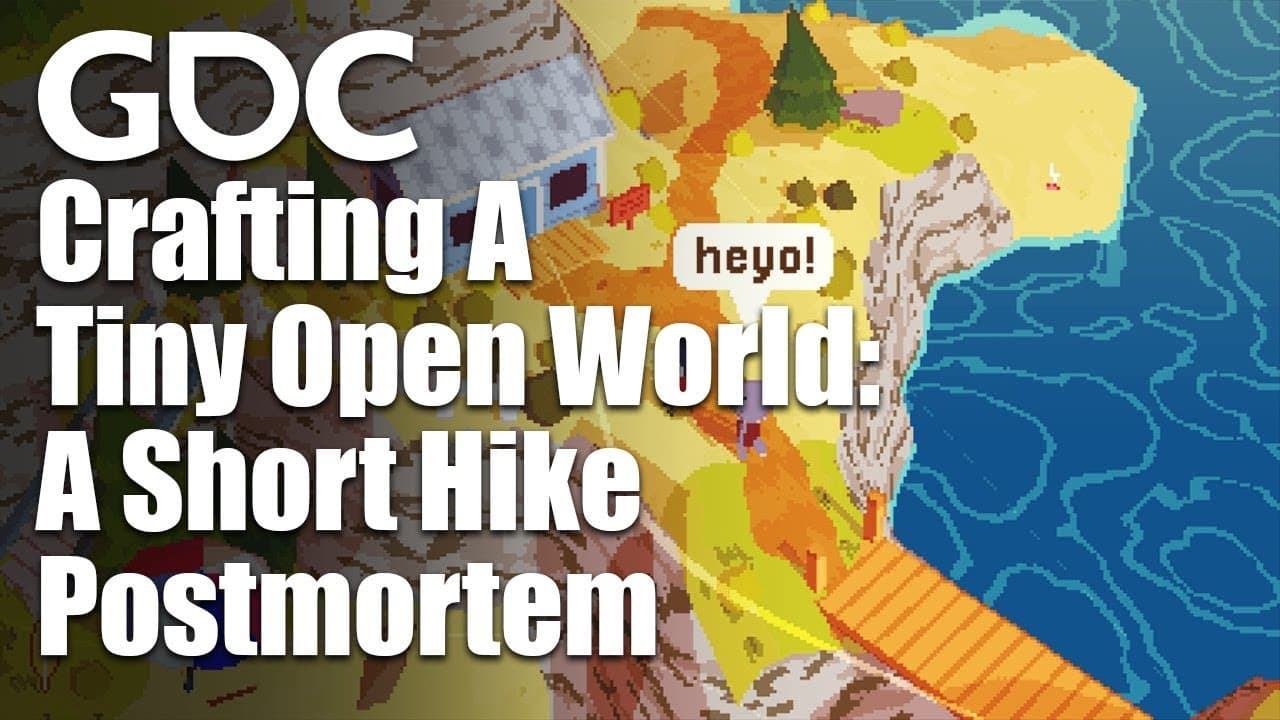
A Short Hike is a small video game about hiking. The player controls Claire, a bird who is visiting an island from the city and cannot find any cellphone reception there. She hears that the only place to find reception is at the very top of the mountain, so the game is structured around the journey up. Along the way the player explores the island, collects items, befriends other hikers, and gets lost in the wilderness. The world is open but deliberately small in scale.
Q: How did A Short Hike get started?
In December 2018 the developer decided to give himself a break as a kind of Christmas present, setting aside a large RPG he had been working on for over a year. He started throwing assets together in Unity and building a tiny world he could escape into, putting in whatever he felt would be fun. After sharing some of this work on Twitter, he got the opportunity to fund a tiny project based on that prototype, which became A Short Hike.
Q: Why did the developer abandon his RPG project?
After leaving a software engineering job in 2017 and moving back to Toronto to make indie games full time, he spent over a year on an ambitious RPG with many characters, locations, and battle mechanics. He never had a clear vision for it, remained uncertain about many elements, and estimated it would take several more years. The pressure of treating it as his one shot made him stressed and anxious, and he never felt he was getting enough done. Two short games he played in 2018 showed him that short, sweet games could still succeed.
Q: Why should solo developers work on small projects?
Small projects carry less risk, because if they do not pan out the loss is smaller, and the game does not have to be a huge success to justify the time invested. Smaller goals feel more achievable, which helps with the anxiety that came from a multi-year project with an unclear vision. Faster release cycles also mean more games shipped, which teaches a lot and can start bringing in revenue. The developer said in hindsight that choosing the small project was a good decision for him.
Q: How was the pixelated art style of A Short Hike made?
The world is rendered to a tiny render texture inside Unity, and then a second camera looks at that texture and blows it up using point filtering, which produces the big crunchy pixels. The developer learned this technique from a plug-in called GB Camera for Unity. He chose the look partly because he considered himself limited in drawing and modeling but stronger in programming, VFX, and post-processing, and because simpler models could be produced faster at that resolution.
Q: How do you pick a color palette for a game?
The developer had trouble picking colors that conveyed the atmosphere he wanted, so he searched for fall nature photos of the Canadian Shield and sampled colors directly from those references. This established both the palette and the mood. To keep those colors reading true in game under different lighting, he wrote a custom mostly unlit shader with precise control over shadows, applying a stair shape to the lighting ramp and shifting colors toward white so they stayed close to the original palette color.
Q: What post-processing effects were used in A Short Hike?
Three main layers were added on top of the raw render. Fog came first, to stop noisy distant objects from distracting from the foreground and keep the player focused. An edge detection effect then picked out the silhouettes of background objects, creating a dramatic look the developer stumbled on by accident while experimenting with available filters. A color correction pass came last, adding extra blue to the shadows to make the scene feel more alive. Many such effects are available for free in Unity standard asset packs.
Q: How did the developer finish the game in three months?
After getting funding, he committed to a three-month release and wrote a design document with three discrete milestones a month apart: alpha, beta, and release candidate. The key was flexible scope. The core game was kept tight enough that he knew he could finish it well within the deadline, while desired extras were treated as stretch goals that would scale the project to the actual rate of work. Many stretch goals missed the original Humble release and were added later for the Steam and Itch release. He also used a simplified scrum process, re-estimating tasks weekly and each morning.
Summary & Key Takeaways
-
A Short Hike is a small open world game about hiking, where the player controls Claire, a bird visiting an island from the city. She cannot get cellphone reception anywhere except the very top of the mountain, so the journey upward becomes a frame for exploring the island, collecting items, and befriending other hikers.
-
The project started in December 2018 as a break from an ambitious RPG that had consumed over a year without a clear vision. After sharing prototype work on Twitter, the developer received funding for the tiny project and had to overcome sunk cost fallacy to set the RPG aside, encouraged by two short games he had played that year.
-
The art style came from rendering the world to a tiny render texture, then blowing it up with point filtering through a second Unity camera. Colors were sampled from fall nature photos of the Canadian Shield, a custom mostly unlit shader flattened shadows, and post-processing added fog, edge detection, and color correction.
Read in Other Languages (beta)
Share This Summary 📚
Summarize YouTube Videos and Get Video Transcripts with 1-Click
Try YouTube Summary with ChatGPT & Claude or YouTube Transcript Generator
Explore More Summaries from GDC Festival of Gaming 📚
Summarize YouTube Videos and Get Video Transcripts with 1-Click
Try YouTube Summary with ChatGPT & Claude or YouTube Transcript Generator