What Are Quaternions and Dual Quaternions in 3D?
TL;DR
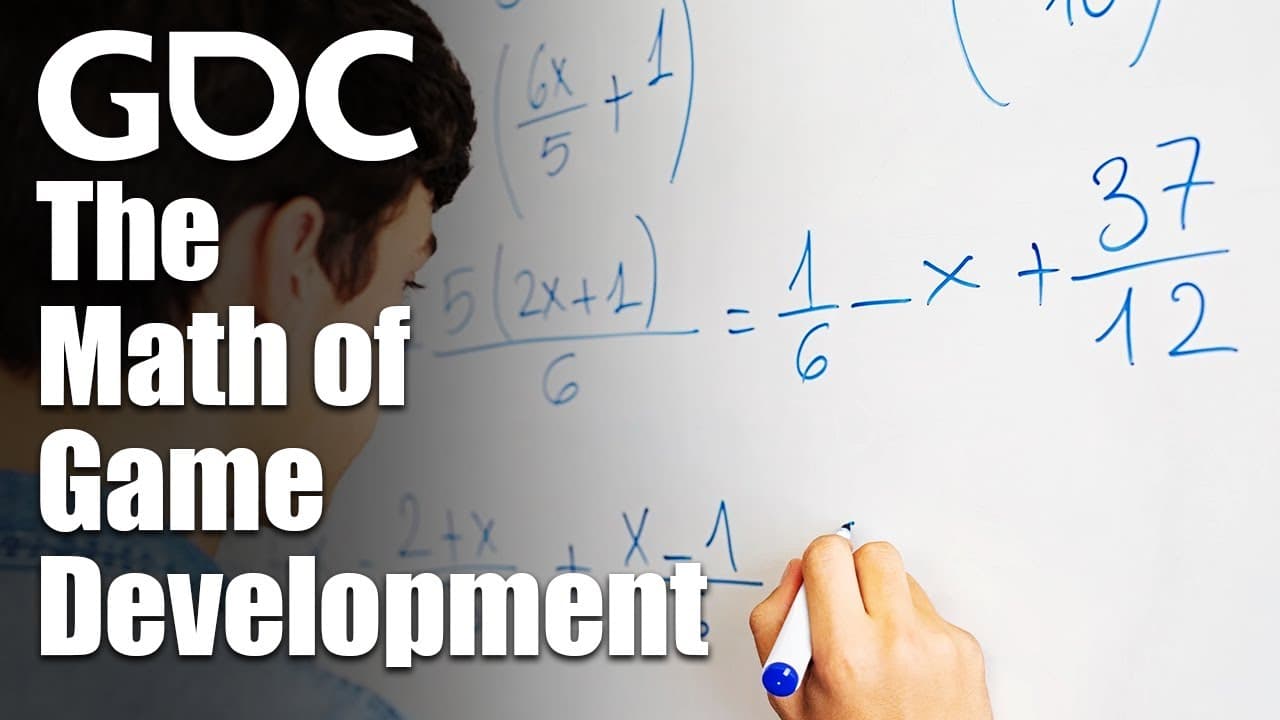
Quaternions are mathematical constructs used to represent 3D rotations as a mix of axis lines through the origin, while dual quaternions extend this capability to include translations. They prevent issues like the 'candy wrapper effect' found in traditional 4x4 matrix animations, thus providing smoother and more natural animation transitions.
Transcript
you are at the right session this is a visual guide to querian and dual querian a querian is something like this it's a rotation in three dimensional space and a dual querian is a slightly broader class of object that we'll be talking about in the second half of the talk which can do 3D translations and rotation and translations first a little bit ... Read More
Key Insights
- ⚾ Quaternions combine axis-based rotation with identity components, enhancing 3D rotation handling.
- 🔂 Dual quaternions unify rotation and translation into a single representation, improving animation workflows.
- 🥺 The "candy wrapper effect" can lead to unnatural deformations during animations, which dual quaternions effectively prevent.
- 👻 Quaternion multiplication allows for complex rotation combinations simply, a benefit not found with traditional representations.
- ❓ Lerp offers a straightforward approach to transition between orientations, although further refinement can enhance visual smoothness.
- 🛟 Converting from quaternions to Euler angles is precise, thus preserving the data integrity needed for accurate rotations.
- ✋ Compared to 4x4 matrices, dual quaternions require fewer computational resources while achieving high-quality animations.
Install to Summarize YouTube Videos and Get Transcripts
Explore YouTube Video Summarizer or Get YouTube Transcript Extractor
Questions & Answers
Q: What is a quaternion, and how is it different from traditional rotation representations?
A quaternion is a mathematical representation that facilitates 3D rotations by encapsulating them in four components: three representing the axis of rotation and one representing the degree of rotation. This is different from traditional rotation representations, such as Euler angles, which can suffer from issues like gimbal lock. Quaternions provide a more robust way to perform smooth rotations in 3D space.
Q: How do dual quaternions enhance translation in 3D graphics?
Dual quaternions extend the concept of quaternions by allowing for both rotation and translation. They consist of two quaternions, one representing the rotation and the other representing the translation. This feature makes dual quaternions especially useful in animation and modeling, as they can manage complex transformations in a single operation, avoiding the complications found in traditional matrix methods.
Q: What are the advantages of using dual quaternions over 4x4 matrices in animations?
Dual quaternions provide a more efficient way of managing rotations and translations without the "candy wrapper effect" seen in 4x4 matrix animations. They require fewer computations, have eight degrees of freedom compared to the 16 in 4x4 matrices, and inherently handle the preservation of volume, making them particularly advantageous for character animations where realistic transformations are critical.
Q: Can quaternions be converted to Euler angles without losing data?
Yes, the conversion from quaternions to Euler angles can be done accurately, as the sine and cosine functions used in quaternion representations retain sufficient precision in 32-bit floats. While minor numerical inaccuracies can occur due to the representation limitations of computers, these are generally negligible in practice.
Q: What is the "candy wrapper effect," and how do dual quaternions help mitigate it?
The candy wrapper effect refers to unnatural distortions that occur in 3D models when using traditional rotation methods, especially with 4x4 matrices. Dual quaternions provide a more natural interpolation of rotations and translations, allowing for smoother and more realistic animations without the visual artifacts that can arise with matrix-based approaches.
Q: How does quaternion multiplication work in the context of rotations?
Quaternion multiplication represents the composition of rotations. When you multiply two quaternions, the resulting quaternion represents the same rotation as first applying the first quaternion's rotation followed by the second. This is useful in practice, as it allows for the creation of complex rotational movements by simply multiplying the respective quaternions.
Q: What is linear interpolation (lerp) in relation to quaternions, and how is it applied?
Linear interpolation (lerp) for quaternions is a method used to transition smoothly between two orientations. By mixing quaternions in a linear fashion based on a parameter ‘T’, where T represents the transition weight, one can smoothly animate an object from one orientation to another over time. However, lerping directly can result in inconsistent speeds unless more sophisticated methods like slurp are used.
Q: What are the limitations of using dual quaternions?
While dual quaternions are powerful, they do have limitations. The primary one is that they can only represent rigid transformations; more complex deformations, such as shearing, cannot be handled as effectively. Additionally, they can sometimes require conversion to 4x4 matrices for particular operations, like camera projections, which can add complexity to the workflow.
Summary & Key Takeaways
-
The presentation covers the definitions and uses of quaternions, which represent 3D rotations as mixtures of axis lines through the origin, and their dual counterparts that also handle translations.
-
The speaker, a graphics researcher, emphasizes the practical implications of quaternions in animations and 3D modeling, highlighting their ability to prevent issues like the "candy wrapper effect" often seen with traditional 4x4 matrix animations.
-
Detailed explanations are provided about quaternion operations like multiplication and averaging, along with a discussion on the advantages of using dual quaternions for combining rotations and translations seamlessly.
Read in Other Languages (beta)
Share This Summary 📚
Summarize YouTube Videos and Get Video Transcripts with 1-Click
Try YouTube Summary with ChatGPT & Claude or YouTube Transcript Generator
Explore More Summaries from GDC 📚

Summarize YouTube Videos and Get Video Transcripts with 1-Click
Try YouTube Summary with ChatGPT & Claude or YouTube Transcript Generator