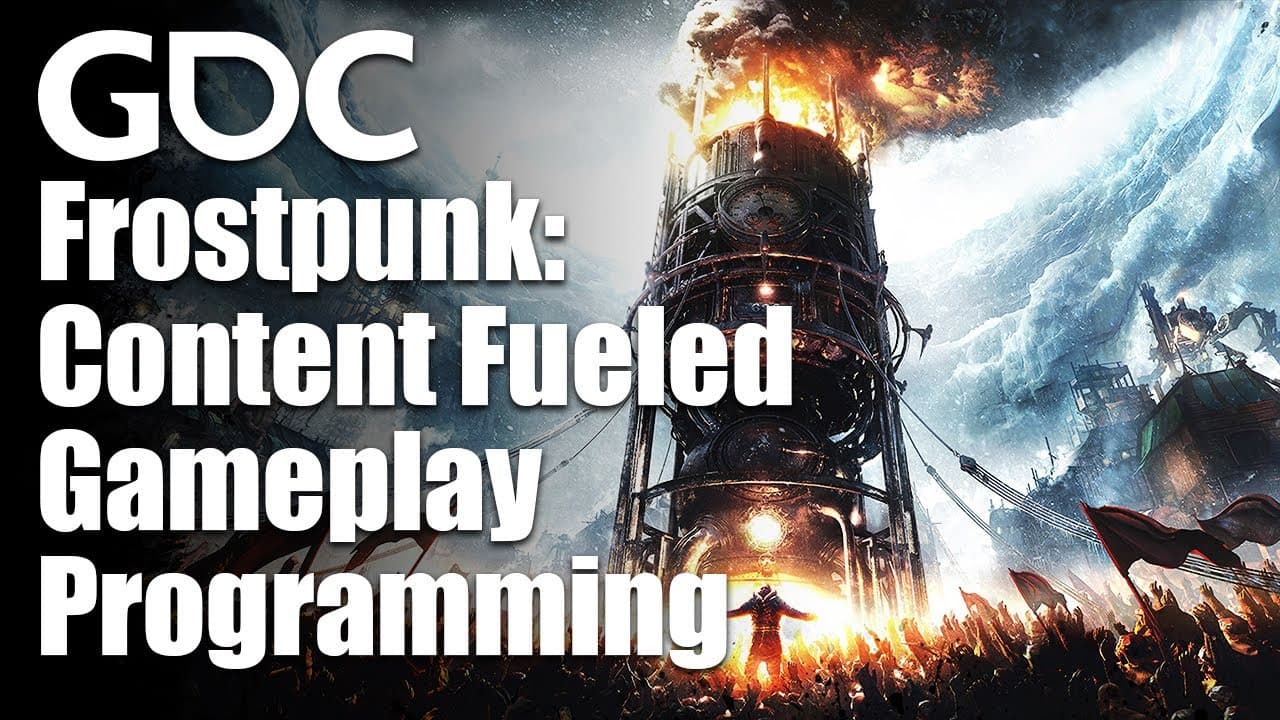
How to Program Data-Driven Gameplay in Frostpunk
TL;DR
Frostpunk's gameplay architecture relies on a data-driven approach using entity component systems (ECS). This method allows for flexible and rapid prototyping, enabling designers to experiment with minimal programmer involvement. The ECS structure supports scalable and efficient game state management, crucial for Frostpunk's complex societal simulation.
Transcript
good afternoon ladies and gentlemen first things first i would like to remind you to turn off your cell phones and to fill out the session evaluation email and let's start my name is alexander kau i am lead gameplay programmer at 11 bit studios and today i would like to present you the architecture that we used in frostpunk a few words about me i'v... Read More
Key Insights
- Frostpunk uses a data-driven architecture based on entity component systems (ECS), allowing for flexible and scalable gameplay programming.
- Entity component systems separate data and logic, enabling efficient updates and management of numerous game entities.
- Data-driven programming allows designers to create and iterate content rapidly without deep programming involvement.
- Game events in Frostpunk are managed by a scripting system that uses triggers, conditions, and effects to control narrative and gameplay flow.
- Appearance states in Frostpunk dynamically change building visuals based on game conditions, enhancing player immersion.
- The ECS architecture facilitates rapid prototyping and experimentation, crucial for developing Frostpunk's unique societal mechanics.
- Templates in Frostpunk define object configurations, enabling designers to create new entities with consistent properties.
- The lack of inheritance in ECS components requires new component types for additional functionality, maintaining a clean and navigable codebase.
Install to Summarize YouTube Videos and Get Transcripts
Explore YouTube Video Summarizer or Get YouTube Transcript Extractor
Questions & Answers
Q: How does Frostpunk's data-driven architecture work?
Frostpunk's data-driven architecture utilizes entity component systems (ECS) to separate logic and data, allowing for efficient updates and management of numerous game entities. This approach enables rapid prototyping and experimentation, crucial for developing the game's complex societal simulation. Designers can create and iterate content with minimal programmer involvement, using templates to define object configurations.
Q: What are entity component systems in game development?
Entity component systems (ECS) are a game development architecture that separates data (components) and logic (systems), allowing for efficient management and updates of game entities. ECS facilitates scalable and flexible programming, enabling rapid prototyping and experimentation. In Frostpunk, ECS supports the game's complex societal mechanics by allowing designers to iterate content rapidly without deep programming involvement.
Q: How are game events managed in Frostpunk?
Game events in Frostpunk are managed by a scripting system that uses triggers, conditions, and effects. Triggers register specific in-game incidents, conditions evaluate boolean expressions based on game state, and effects execute functions that alter the game state. This system controls narrative and gameplay flow, allowing designers to create and iterate events without heavy programmer involvement.
Q: What role do appearance states play in Frostpunk?
Appearance states in Frostpunk dynamically change building visuals based on game conditions, enhancing player immersion. These states affect various visual elements, such as meshes, textures, and animations, and are managed by appearance overlays that define what changes when specific conditions are met. This system allows the game to reflect the evolving societal and environmental conditions visually.
Q: Why is rapid prototyping important in Frostpunk's development?
Rapid prototyping is crucial in Frostpunk's development because it allows designers to experiment with gameplay mechanics and narrative elements quickly. The data-driven architecture and entity component systems (ECS) enable this flexibility by minimizing programmer involvement in content iteration. This approach supports the development of Frostpunk's complex societal simulation and unique gameplay experience.
Q: What are templates in Frostpunk's architecture?
Templates in Frostpunk's architecture define object configurations, specifying the fields and properties that designers can configure. They act like class definitions in programming, allowing for consistent entity creation with predefined attributes. This system enables designers to create new entities efficiently, supporting rapid content iteration and maintaining consistency across the game's complex mechanics.
Q: How does Frostpunk handle component functionality without inheritance?
Frostpunk's entity component system (ECS) does not use inheritance for components. Instead, new component types are created to add functionality, maintaining a clean and navigable codebase. This approach requires each system to handle one component type, simplifying code management and ensuring clarity, but necessitates additional components for new functionalities.
Q: What challenges did Frostpunk's development team face?
Frostpunk's development team faced challenges in creating a unique city builder focused on survival and societal simulation. They had to develop a data-driven architecture using entity component systems (ECS) to support rapid prototyping and content iteration. The team also needed to manage complex game events and appearance states, requiring innovative solutions for efficient and scalable programming.
Summary & Key Takeaways
-
Frostpunk's architecture is built on a data-driven approach using entity component systems (ECS), which separates logic and data to manage game state efficiently. This system allows for rapid prototyping and experimentation, essential for the game's complex societal simulation.
-
The game uses a scripting system to manage events through triggers, conditions, and effects, controlling narrative and gameplay elements. This approach enables designers to iterate on content without heavy programmer involvement, fostering creativity and flexibility.
-
Appearance states dynamically alter building visuals based on game conditions, enhancing immersion. The lack of inheritance in ECS components maintains a clean codebase but requires additional component types for new functionalities, supporting Frostpunk's unique gameplay mechanics.
Read in Other Languages (beta)
Share This Summary 📚
Summarize YouTube Videos and Get Video Transcripts with 1-Click
Try YouTube Summary with ChatGPT & Claude or YouTube Transcript Generator
Explore More Summaries from GDC Festival of Gaming 📚

Summarize YouTube Videos and Get Video Transcripts with 1-Click
Try YouTube Summary with ChatGPT & Claude or YouTube Transcript Generator