How Subsea Cables Power the Internet and AI
TL;DR
Subsea fiber cables carry the vast majority of international internet traffic and enable AI workloads by linking data centers worldwide. They use repeaters to amplify signals every 50 to 62 miles and connect to terrestrial landing stations, while tech giants invest billions to expand capacity and security concerns drive tighter regulations.
Transcript
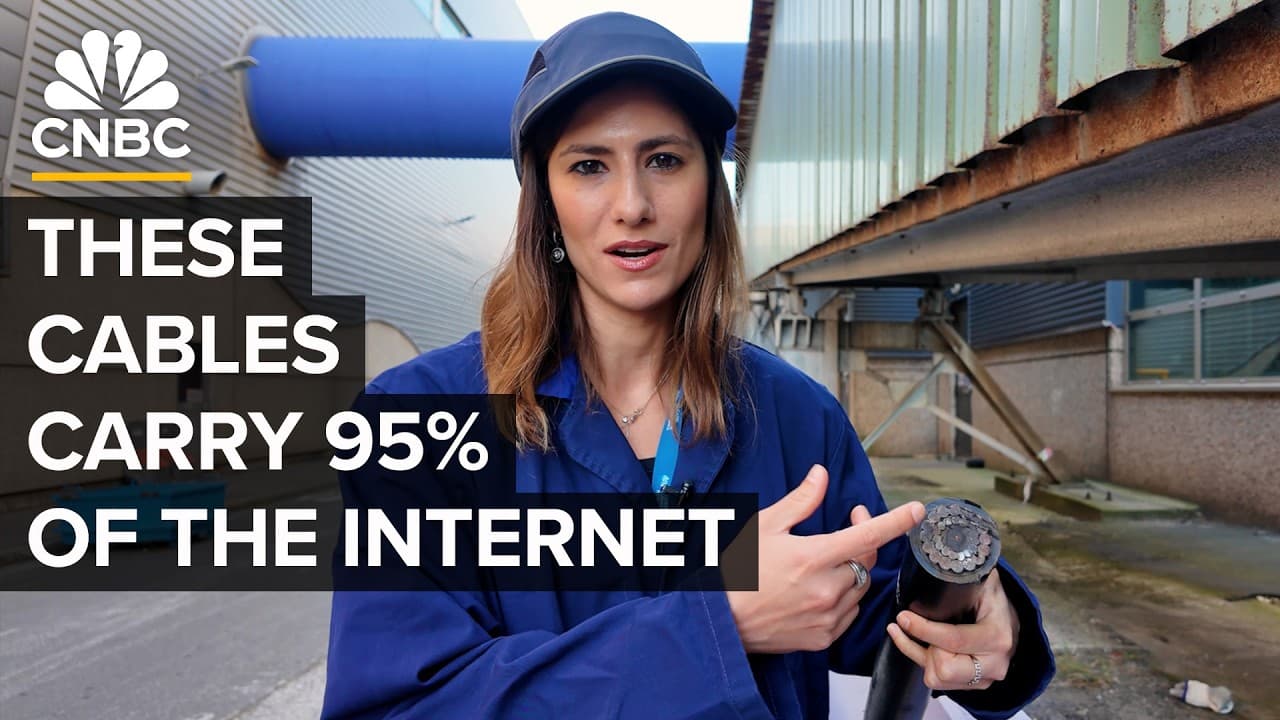
In this quiet seaside town in northern France, thousands of miles of cables are manufactured each year and then dropped into the ocean to become the superhighway of the internet. Over 95% of international internet traffic travels from continent to continent through cables on the ocean floor that, for the most part, are no larger than a garde... Read More
Key Insights
- Subsea cables are the backbone of global internet traffic and enable cross continental data exchange.
- The signaling in subsea cables relies on optical fibers, with repeaters amplifying the light signals roughly every 50 to 62 miles.
- Landing stations on land provide power feeding and telecom signal injection, completing the subsea link.
- There are only a few major manufacturers of subsea cables, with ASN being a leading producer.
- Tech giants like Google, Meta, Amazon, and Microsoft dominate a large portion of new subsea capacity, driving project scale.
- Investment in new subsea cables is accelerating, with billions planned for 2025 to 2027 to expand capacity.
- Cable design includes layers of armor to protect against water pressure and seabed hazards, with heavier armor near shallow, riskier zones.
- Security concerns are rising as sabotage and geopolitical tensions threaten critical subsea infrastructure.
- More videos from this channel:
- More from this channel: CNBC
Install to Summarize YouTube Videos and Get Transcripts
Explore YouTube Video Summarizer or Get YouTube Transcript Extractor
Questions & Answers
Q: How do subsea cables power the internet and AI workloads?
Subsea cables carry most international internet traffic by linking continents through a network of fiber optic lines. Data travels as light through dozens of fibers within a single cable, amplified by repeaters every roughly 50 to 62 miles to maintain signal quality. Land landing stations then route this traffic into terrestrial networks, enabling AI services and cloud platforms to operate globally.
Q: What makes subsea cables essential for cloud providers like Google and Meta?
Cloud providers rely on subsea cables to connect vast data centers across the world, delivering low latency and high capacity required for AI training and inference. Investments in new cables by these companies expand throughput and resilience, enabling faster access to cloud resources, better redundancy, and the ability to support growing data center networks.
Q: What are the main components of a subsea cable system?
A subsea cable comprises optical fibers protected by a metal tube, an armor layer, copper conductors for power to repeaters, and plastic sheathing. The cable is deployed with repeaters to amplify signals and is connected on land at landing stations which house power feeding equipment and signal transmitters and receivers.
Q: How do landing stations fit into the subsea cable infrastructure?
Landing stations act as the interface between the undersea cable and terrestrial networks. They provide power to submerged repeaters, enabling the optical signals to travel long distances, and they host transmitters and receivers that inject and extract telecom signals into the fiber network, linking oceanic cables to land based data centers and networks.
Q: Who are the major customers for subsea cables?
Major customers include traditional telecom operators and new entrants like Google, Meta, Amazon, and Microsoft. These web scale players now represent a significant share of capacity, driving the construction of long, multi continent cables and shaping the strategic direction of the subsea cable industry.
Q: What is the economic scale of subsea cables today?
Investment in subsea cables has grown from a few billion annually to around five to six billion per year as of recent periods, with billions more planned for future upgrades and new routes. The scale reflects the expectation of long term demand for global connectivity to support AI, cloud, and data center needs.
Q: What security risks do subsea cables face?
Subsea cables face security risks including sabotage and unauthorized interference. Governments monitor and regulate foreign involvement in cable construction and operation, as disruptions could undermine 95 percent plus of international traffic. Protective measures include secure landing stations, robust cable armoring, and international cooperation on threat detection.
Q: How do optical fibers transmit data in subsea cables and why is attenuation a concern?
Optical fibers transmit data as light pulses through dozens of glass strands bundled in a cable. As light travels, it loses power due to attenuation, which necessitates repeaters to reamplify the signal periodically. Proper fiber quality, protective layering, and repeaters keep the data highway functioning over thousands of miles across oceans.
Summary & Key Takeaways
-
Subsea cables form the backbone of global connectivity, carrying immense data flows and enabling AI services by connecting data centers across continents.
-
Manufacturing and deployment involve specialized fiber optics, armor, and repeaters to maintain signal integrity over long oceanic distances.
-
Investment in subsea cables is rising, with tech giants driving multi billion dollar projects to meet future cloud and AI demand, alongside heightened security considerations.
Read in Other Languages (beta)
Share This Summary 📚
Summarize YouTube Videos and Get Video Transcripts with 1-Click
Try YouTube Summary with ChatGPT & Claude or YouTube Transcript Generator
Explore More Summaries from CNBC 📚






Summarize YouTube Videos and Get Video Transcripts with 1-Click
Try YouTube Summary with ChatGPT & Claude or YouTube Transcript Generator