How Does the Brain Store and Rewrite Memories?
TL;DR
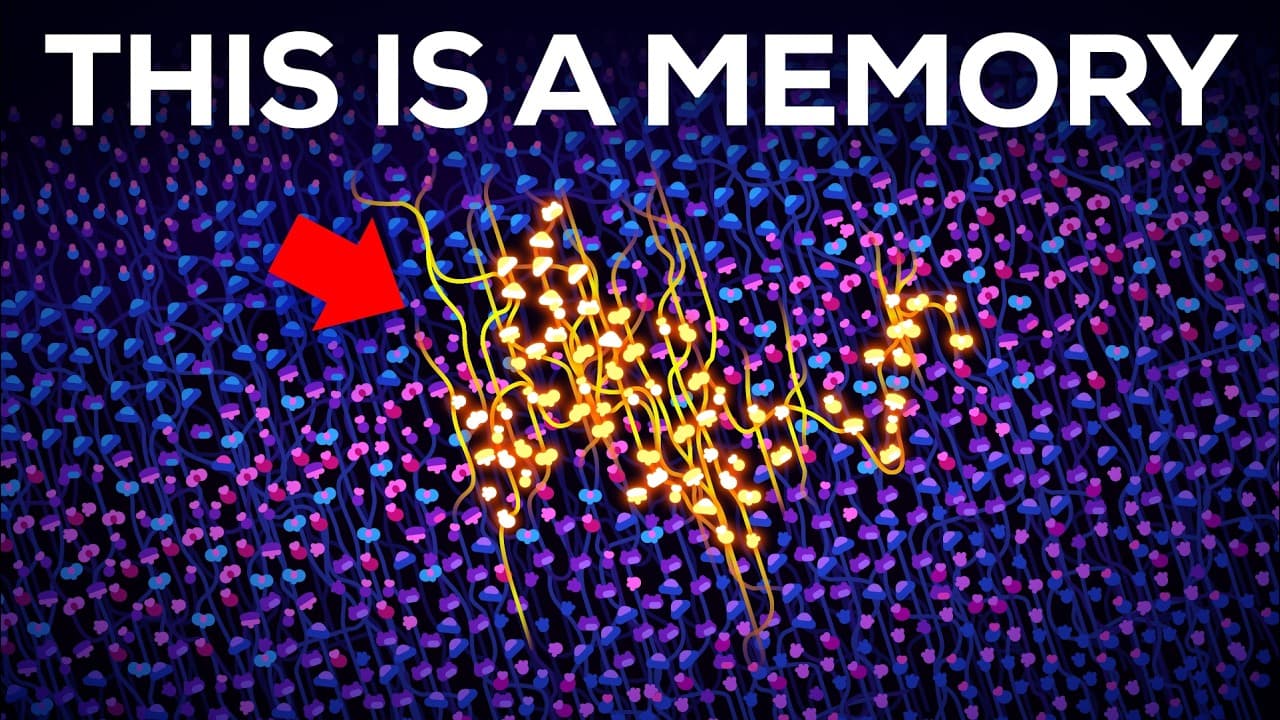
Memories are stored as strengthened patterns of connections among neurons distributed across multiple brain regions, while the hippocampus records a blueprint that helps reactivate each pattern. Novelty, repetition, emotion, and sleep can reinforce these assemblies, but recalling a memory makes it changeable again, so remembering is an act of reconstruction rather than an exact replay.
Transcript
Memories are biological magic that enable you to experience bygone moments – over and over. With them, your mind can encode, store and retrieve information about the world and yourself. But memories are not static like photos. Like dioramas made from wax, each time they’re under the spotlight of your attention they can melt and change a tiny ... Read More
Key Insights
- The human brain contains about 86 billion neurons, and a typical neuron connects with up to 10,000 others through synapses. Electrical signals become chemical messages across these tiny gaps and are then converted back into electrical activity, allowing neurons to communicate within an immense network.
- Memory formation depends on neurons strengthening their connections when they fire together. Repeated synchronized activity changes synapses, making the participating neurons more likely to activate one another again and turning temporary activity into a more stable physical pattern within the brain.
- A conscious experience is an assembly of synchronized neurons spanning multiple brain regions. Visual, auditory, language, bodily, and emotional systems process separate features, while deeper areas evaluate their importance and combine the winning signals into the coherent experience occupying attention.
- The hippocampus creates a rough blueprint of a newly active neural assembly and indexes it alongside associated memories. Activating part of that stored pattern can later trigger the wider assembly, allowing a past experience to be retrieved even though the original moment no longer exists.
- New memories are initially fragile and can disappear if their neural assemblies are not reinforced. The hippocampal blueprint alone does not guarantee permanence because unused synapses can weaken again, which is why most ordinary moments and minor details of daily life are eventually forgotten.
- Novelty, repetition, and emotion strengthen memories by driving stronger activation and structural change. Neurons can grow more synapses and become better coordinated, making the assembly more solid. Strong emotions signal that an experience may matter for survival, even when that interpretation is inaccurate.
- Sleep supports long-term memory by allowing the hippocampus to replay neural assemblies repeatedly. This replay strengthens the connections and makes stored experiences easier to retrieve, while inadequate sleep causes more forgetting and can undermine the effort spent studying new material.
- Memory retrieval is reconstruction rather than exact playback. A cue prompts the hippocampus to locate and activate a stored assembly, but attention makes parts of that pattern changeable again. Because the present context differs from the original one, recalling an experience can modify its stored form.
Install to Summarize YouTube Videos and Get Transcripts
Explore YouTube Video Summarizer or Get YouTube Transcript Extractor
Questions & Answers
Q: How does the brain store a memory?
The brain stores a memory by strengthening a distributed pattern of connections among neurons that were active during an experience. Different regions process features such as sights, sounds, language, touch, bodily state, and emotion. When this combined neural assembly becomes important enough to dominate attention, chemicals make its neurons more susceptible to change, and the hippocampus records a rough blueprint for later retrieval.
Q: What is a neural assembly in memory formation?
A neural assembly is a synchronized pattern of activity involving many neurons across different parts of the brain. It combines separately processed features of a moment into one coherent experience. The assembly active while someone watches, listens, feels, and interprets an event represents that present experience. If its connections are strengthened and indexed by the hippocampus, the pattern can become a retrievable memory.
Q: What role does the hippocampus play in memory?
The hippocampus functions as a memory center and librarian. When an important neural assembly is active, it creates a rough blueprint of that assembly's configuration and places it within an index connected to associated memories. Later, a cue such as a smell, sound, word, or image can guide the hippocampus to the relevant entry, allowing the broader neural pattern to become active again.
Q: Why are most everyday experiences forgotten?
Most everyday experiences are forgotten because newly formed memories are fragile and require reinforcement. If an assembly is weak, ordinary, or rarely reactivated, its strengthened connections can fade and its synapses can weaken again. Many moments are experienced only once and never become durable long-term memories, which is why specific details from routine days often disappear even though they were consciously experienced.
Q: How do novelty and repetition make memories stronger?
Novelty makes an event's neural assembly fire strongly because the experience stands out from routine activity. Repetition strengthens memory by reactivating the same assembly after it forms, such as when a person repeatedly thinks about an event, tells others about it, or rehearses material while studying. Both processes reinforce synaptic connections and make the stored pattern more solid and easier to retrieve.
Q: Why do emotional experiences create strong memories?
Emotional experiences often form strong memories because emotions are ancient mechanisms that guide behavior toward desirable outcomes and away from danger. When something feels intensely good or bad, the brain treats the surrounding event as important for survival, whether that judgment is correct or not. This strong activation encourages substantial synaptic change and helps the corresponding neural assembly become more durable.
Q: How does sleep affect learning and memory?
Sleep strengthens memory because the hippocampus replays recently formed neural assemblies repeatedly. This replay reinforces the connections among participating neurons, stabilizes the memory, and makes it easier to retrieve later. Without sufficient sleep, more experiences are forgotten, so studying without proper sleep can waste effort because the newly learned material may not be consolidated into a dependable long-term pattern.
Q: Why does remembering something change the memory?
Remembering changes a memory because retrieval makes parts of its neural assembly changeable again. A cue prompts the hippocampus to find and activate the stored pattern, but recall is not equivalent to playing an unchanged recording. The memory is experienced within a new mood, setting, and purpose, so the present context can influence the assembly while it is active and reshape what is stored.
Summary & Key Takeaways
-
A memory begins as a synchronized assembly of neurons processing different parts of an experience, including sights, sounds, language, bodily sensations, and emotions. When that assembly wins the brain's competition for attention, chemicals make its neurons more changeable, strengthen their synapses, and help preserve the temporary experience as a physical pattern.
-
The hippocampus acts as a memory center and librarian by recording a rough blueprint of the active neural assembly and indexing it with related experiences. New memories remain fragile, however. Novel events, repeated reactivation, and strong emotions reinforce their connections, while insufficient reinforcement allows most ordinary moments to fade from memory.
-
Sleep helps convert fragile experiences into long-term memories because the hippocampus repeatedly replays their neural assemblies, strengthening their connections and making them easier to retrieve. Later, a cue can reactivate a stored assembly. Recall also softens the memory's connections, allowing the present context to reshape what is stored.
Read in Other Languages (beta)
Share This Summary 📚
Summarize YouTube Videos and Get Video Transcripts with 1-Click
Try YouTube Summary with ChatGPT & Claude or YouTube Transcript Generator
Explore More Summaries from Kurzgesagt – In a Nutshell 📚






Summarize YouTube Videos and Get Video Transcripts with 1-Click
Try YouTube Summary with ChatGPT & Claude or YouTube Transcript Generator