How to Fix Facebook Ads That Destroy ROAS

TL;DR
Improve Facebook ad efficiency by consolidating spend into CBO scaling campaigns, promoting proven ads, and standardizing attribution and bidding. Audit placement performance, audience segments, campaign turnover, and funnel metrics before making changes, then prioritize the five or six issues most likely to produce meaningful gains during the first 90 days.
Transcript
I know what you're thinking. You clicked another Facebook ads video and you're hoping for the silver bullet, the exact step-by-step guide for exactly what to click and make a bajillion dollars on Facebook ads. But in reality, most of those videos are not the silver bullet. So instead, today I'm going to show you by actually unraveling real ad accou... Read More
Key Insights
- Facebook ad account improvement is incremental, so an audit should identify the five or six issues with the greatest likely impact instead of trying to repair everything simultaneously. The first 90 days should focus on structural problems that affect efficiency, learning, and the ability to scale.
- Campaign budget optimization is presented as a way to reduce waste caused by meticulous ad-set-level budget control. In the first audited account, transitioning from ad set budget optimization to CBO was estimated to improve overall efficiency by 20–30% when implemented gradually.
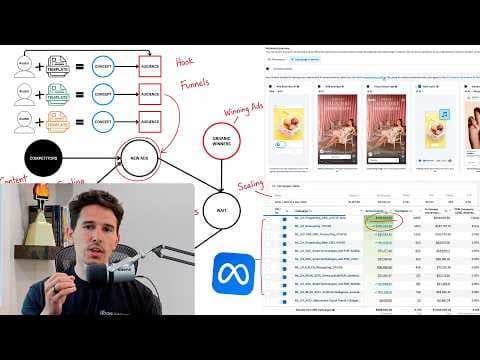
- A graduation system is necessary for moving top-performing ads from testing into a dedicated scaling campaign. The audited account had many active campaigns with broadly distributed spend, while the expected pattern was for one or two campaigns to represent 50–60% of total account spending.
- A dominant advertisement is evidence that an account has identified a winner. The highest-spending ad in the first account received only $1,800 during the previous 30 days, representing 8% of spend, while the auditor expected a leading ad to receive upward of 30%.
- Placement analysis is essential because returns can differ across Meta inventory. Instagram feed produced a 3.3 return on ad spend, while Instagram Stories and Reels produced 2.7 and 2.6, supporting a testing mechanism that directs more money toward stronger placements without forcing every dollar there.
- Audience segments reveal whether spending reaches new audiences, engaged people, existing customers, or unknown users. In the smaller account, most spending appeared as unknown because audience segments had been added only a week earlier, despite the feature having been available for over a year.
- Excessive campaign turnover prevents the development of a sustainable advertising structure. One account launched 24 campaigns in 30 days, leading to a recommended rebuild around separate prospecting CBO, scaling, retargeting, and, when enough existing customers are available, retention campaigns.
- Consistent bid strategies and attribution settings help Meta interpret the advertiser's conversion objective. Mixing cost-per-result goals, ROAS goals, highest-volume bidding, seven-day click, and one-day view settings creates conflicting performance signals and artificial walls between campaigns.
Install to Summarize YouTube Videos and Get Transcripts
Explore YouTube Video Summarizer or Get YouTube Transcript Extractor
Questions & Answers
Q: How should a Facebook ad account audit be prioritized?
A Facebook ad account audit should begin by identifying the five or six issues expected to have the greatest impact during the first 90 days. The review should examine campaign structure, budget control, scaling logic, ads, placements, audience segments, bidding, attribution, and funnel indicators. The goal is incremental improvement, because attempting to repair every possible issue simultaneously does not guarantee immediate gains.
Q: Why can ad set budget optimization limit Facebook ad scaling?
Ad set budget optimization can limit scaling when a person manually distributes budgets across many ad sets and prevents Meta from directing spend toward stronger opportunities. In the first audited account, every campaign used ad-set-level budgeting and lacked automation or scaling logic. A gradual transition to CBO was estimated to improve efficiency by 20–30%, primarily by reducing wasted advertising spend.
Q: How should winning Facebook ads move into scaling campaigns?
Winning Facebook ads should follow a graduation system that promotes proven creative from testing into a dedicated scaling campaign. Without that process, spend can remain fragmented across many active campaigns and ads. The auditor expected one or two campaigns to account for 50–60% of spending and the strongest individual ad to represent upward of 30%, signaling that a clear winner had been found.
Q: What does fragmented Facebook ad spend reveal about an account?
Fragmented spending can reveal that an account lacks a dominant scaling campaign and is not concentrating resources on its best performers. In the $25,000 account, numerous active campaigns received meaningful amounts of money, while the leading ad spent only $1,800, or 8% of the total. Pausing that top ad in multiple variations further demonstrated misalignment between manual decisions and algorithmic allocation.
Q: How can placement breakdowns improve Facebook ad ROAS?
Placement breakdowns show where money is being spent and how each Meta placement performs. In the audited account, Instagram feed generated a 3.3 return on ad spend, compared with 2.7 for Instagram Stories and 2.6 for Reels. A structured testing mechanism could direct more spending toward Instagram feed and Facebook feed, with an estimated 10–15% efficiency improvement and no loss of scale.
Q: Why should advertisers configure Meta audience segments?
Meta audience segments help advertisers distinguish spending across new audiences, engaged segments, existing customers, and unknown traffic. In one audited account, most spending appeared under unknown because the segments had been configured only a week before the audit. Adding them through advertiser settings creates clearer visibility into who receives the budget and supports more informed decisions about prospecting, engagement, and customer retention.
Q: When does a Facebook ad account need a full rebuild?
A full rebuild may be necessary when excessive campaign, ad set, advertisement, and audience turnover has eliminated any clear or sustainable structure. One audited account launched 24 campaigns in 30 days after spending $11,000. The recommended rebuild used four possible lanes: a prospecting CBO campaign, a scaling campaign, a retargeting campaign, and a retention campaign when the business has enough existing customers.
Q: Why should Facebook campaigns use consistent attribution and bidding?
Consistent attribution and bidding give Meta a clearer conversion objective across the account. One audited account mixed a cost-per-result goal, a ROAS goal, highest-volume bidding, seven-day click attribution, one-day view attribution, and multiple attribution configurations. The auditor said these differences created misleading performance data and walls within the account, recommending one attribution setting, typically seven-day click and one-day view, with optimization based on incremental results or seven-day clicks.
Summary & Key Takeaways
-
The audit process prioritizes five or six account problems that can produce the greatest impact during the first 90 days. Important checks include campaign structure, budget allocation, scaling logic, placement performance, audience segments, bid strategies, attribution settings, and leading indicators such as click-through rates, frequency, add-to-carts, and initiated checkouts.
-
One account spent $25,000 in 30 days at a 3 return on ad spend but lacked CBO automation and a graduation system for winning ads. Spend was fragmented across campaigns, its largest ad represented only 8% of total spend, and weaker placements received money that could have supported better-performing feeds.
-
Another account launched 24 campaigns after spending $11,000 in 30 days, making a full rebuild necessary. A third spent $24,000 at a 1.9 return on ad spend while mixing bid strategies and attribution settings. The recommended foundation separates prospecting, scaling, retargeting, and qualified retention activity into clear campaign lanes.
Read in Other Languages (beta)
Share This Summary 📚
Summarize YouTube Videos and Get Video Transcripts with 1-Click
Try YouTube Summary with ChatGPT & Claude or YouTube Transcript Generator
Explore More Summaries from Sam Piliero 📚




Summarize YouTube Videos and Get Video Transcripts with 1-Click
Try YouTube Summary with ChatGPT & Claude or YouTube Transcript Generator