How to predict value functions without a model
TL;DR
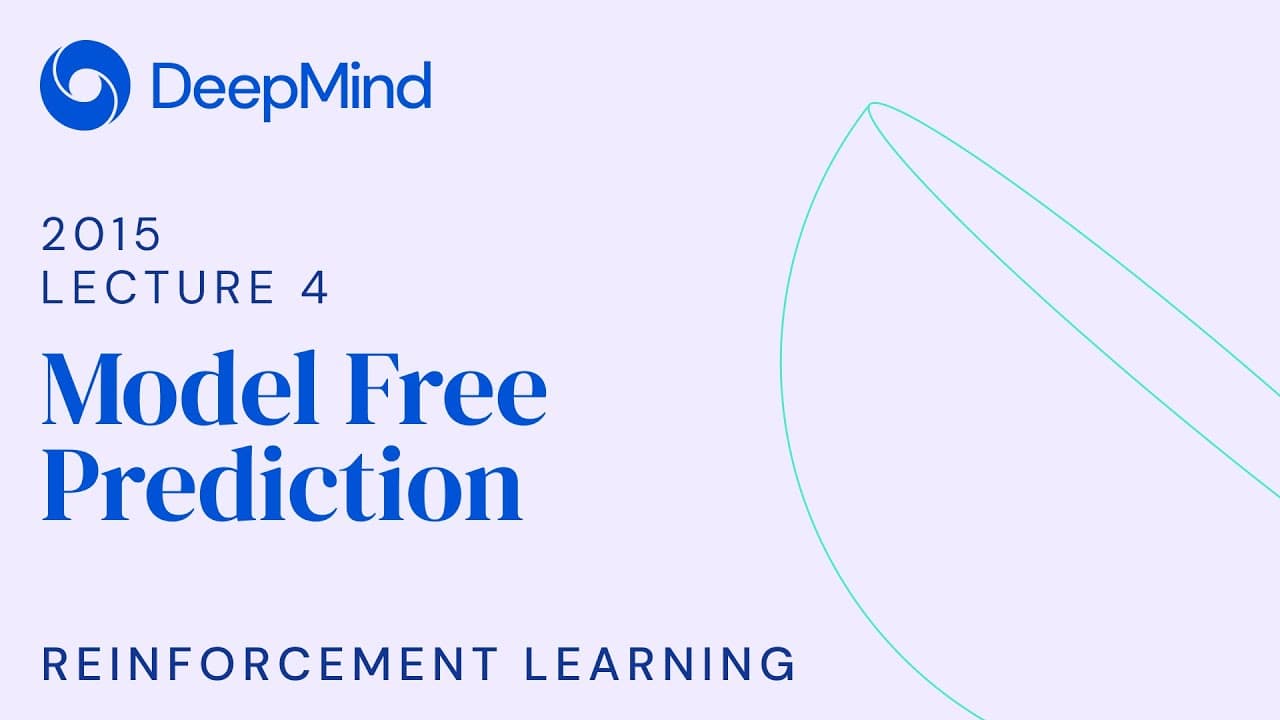
Monte Carlo and temporal difference methods enable value prediction without a known environment. The lecture focuses on model free prediction, evaluating a given policy from sample episodes, using first visit or other sampling schemes, and introduces TD learning and TD Lambda as extensions for efficiency and flexibility.
Transcript
let's get going so today uh we're going to start to talk about model free prediction um so what that means is taking something like a an environment that could be represented by a mark of decision process but no one gives us the mdp and we still want to solve it and so I think up to this point you should be wondering you know correctly well you kno... Read More
Key Insights
- Model free prediction does not require a known environment dynamics or reward function.
- Monte Carlo learning evaluates the value function by averaging returns from completed episodes.
- First visit Monte Carlo uses the first time a state is visited to accumulate returns.
- Policy evaluation aims to estimate the value of a given policy, not to optimize the policy.
- TD learning updates value estimates using one step ahead predictions.
- TD Lambda unifies different lookahead lengths into a single framework.
- The lecture distinguishes between planning with a known model and model free prediction.
- There is a progression from Monte Carlo methods to TD methods in model free prediction.
- More videos from this channel:
- More from this channel: Google DeepMind
Install to Summarize YouTube Videos and Get Transcripts
Explore YouTube Video Summarizer or Get YouTube Transcript Extractor
Questions & Answers
Q: What is model free prediction in reinforcement learning
Model free prediction refers to estimating the value function or improving a policy without assuming knowledge of the environment dynamics such as transition probabilities or rewards. It relies on interactions with the environment and observed returns, enabling evaluation and control directly from experiences. This approach is essential when the environment is unknown or too complex to model accurately.
Q: How does Monte Carlo learning estimate the value function
Monte Carlo learning estimates the value function by averaging sample returns from complete episodes. For each state encountered, it uses the observed total discounted reward from that point until the episode ends as a sample return, then averages across visits and episodes to approximate the expected return. It does not require knowledge of transitions or rewards beyond observed outcomes.
Q: What is first visit Monte Carlo policy evaluation
First visit Monte Carlo policy evaluation uses only the first time a state is visited within an episode to update its value estimate. This avoids bias from multiple visits in the same episode and provides a straightforward way to accumulate experience. Over many episodes, the average of these first visit returns converges to the true value under the policy.
Q: What is the difference between Monte Carlo and TD learning
The difference lies in how they estimate returns. Monte Carlo uses complete episode returns, requiring full termination before updating values. TD learning updates estimates one step at a time using the observed reward and the estimated value of the next state, enabling online updates and faster learning without waiting for episode end.
Q: What does TD Lambda achieve in model free prediction
TD Lambda blends n step returns to provide a continuum between full Monte Carlo and one step TD. By tuning Lambda, you can trade off bias and variance and control how far back along the trajectory the updates look, enabling more flexible and efficient value function estimation across tasks.
Q: Why is policy evaluation emphasized in this lecture
Policy evaluation is emphasized because it isolates the problem of estimating how good a given policy is, which is the core of prediction. Once the value function under a policy is known, those estimates can be used to improve or select better policies, advancing from prediction to control in subsequent lectures.
Q: When is Monte Carlo learning most appropriate
Monte Carlo learning is most appropriate for episodic tasks where complete episodes can be sampled. It provides a simple and robust way to estimate values without a model, but it may be less efficient when episodes are long or when variance is high, because it relies on full returns from many episode samples.
Q: How do model free methods relate to dynamic programming
Model free methods differ from dynamic programming in that they do not require a known model of the environment. DP relies on known transitions and rewards to perform back ups, while model free methods learn from actual interactions with the environment, constructing estimates of value functions or policies without a predefined MDP.
Summary & Key Takeaways
-
Monte Carlo learning estimates the value function directly from complete episodes by averaging sample returns, suitable for episodic tasks, and does not require knowledge of the environment dynamics.
-
Two main model free prediction approaches are introduced: Monte Carlo methods that use full-trajectory returns and one step TD learning methods that update using one step ahead estimates, offering efficiency.
-
TD Lambda generalizes between Monte Carlo and one step TD by combining multiple step returns, enabling a spectrum of methods that interpolate between full trajectory and one-step updates.
Read in Other Languages (beta)
Share This Summary 📚
Summarize YouTube Videos and Get Video Transcripts with 1-Click
Try YouTube Summary with ChatGPT & Claude or YouTube Transcript Generator
Explore More Summaries from Google DeepMind 📚



Summarize YouTube Videos and Get Video Transcripts with 1-Click
Try YouTube Summary with ChatGPT & Claude or YouTube Transcript Generator