How to Gain Muscle in a Year: Scientific Approach

TL;DR
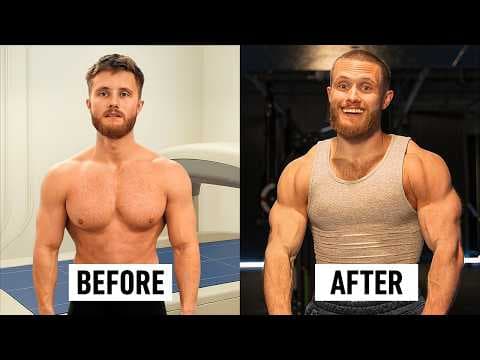
Training with a science-based plan and tracking every calorie, Jeff and his brother Brad embarked on a year-long experiment to measure muscle gain. Jeff, a seasoned lifter, and Brad, a beginner, both saw significant muscle growth, challenging the idea of a natural ceiling for muscle growth. Jeff gained 2.7 lbs of lean mass and Brad gained 10 lbs, highlighting the potential for continued progress with optimized training and nutrition.
Transcript
for the next year I'm going to train as perfectly as humanly possible that means I'm going to run the most science-based optimized plan and track every single set of every workout no skipped workouts no lazy sets no exceptions i'm also going to track every single calorie I eat every day for a year straight and in this video I'll show you my full re... Read More
Key Insights
- Muscle growth can be optimized through a science-based training plan and meticulous tracking of workouts and nutrition.
- A DEXA scan and ultrasound can effectively measure body composition changes over time.
- Beginners can gain significant muscle mass within the first year of training, as seen with Brad's 10 lbs lean mass gain.
- Experienced lifters like Jeff can still make gains after years of training, challenging the concept of a natural muscle growth ceiling.
- Training to failure on the last set of exercises may contribute to increased muscle hypertrophy.
- Consistency in training and diet, including tracking macros and calories, is crucial for achieving muscle growth goals.
- Psychological benefits, such as reduced social anxiety, can accompany physical changes from regular training.
- Adjusting caloric intake based on training phases (bulking, recomp, cutting) helps in managing body composition effectively.
Install to Summarize YouTube Videos and Get Transcripts
Explore YouTube Video Summarizer or Get YouTube Transcript Extractor
Questions & Answers
Q: How can beginners gain muscle effectively?
Beginners can gain muscle effectively by following a structured training program that focuses on progressive overload, training to failure, and a balanced diet that supports muscle growth. Consistency in workouts and nutrition, tracking progress, and adjusting caloric intake based on goals (bulking or cutting) are crucial. In the video, Brad gained 10 lbs of lean mass in a year by adhering to these principles.
Q: What is the natural ceiling for muscle growth?
The natural ceiling for muscle growth is a theoretical limit to the amount of muscle one can gain naturally without the use of performance-enhancing drugs. However, as shown in the video, with optimized training and nutrition, even experienced lifters like Jeff can still make gains after years of training, suggesting that the ceiling can be pushed further with the right approach.
Q: Why is tracking calories important for muscle gain?
Tracking calories is important for muscle gain because it ensures that you are consuming enough nutrients to support growth while managing body fat levels. It helps in maintaining a caloric surplus during bulking phases and a deficit during cutting phases. In the video, both Jeff and Brad meticulously tracked their calories to maintain consistency and achieve their muscle gain goals.
Q: What role does training to failure play in muscle growth?
Training to failure plays a role in muscle growth by maximizing muscle fiber recruitment and stimulating hypertrophy. It involves pushing the last set of exercises until no more reps can be performed. The video suggests that training to failure, especially on isolation exercises, can contribute to increased muscle growth, as both Jeff and Brad incorporated this approach in their regimen.
Q: How does body composition change with training?
Body composition changes with training as muscle mass increases and body fat decreases. Regular assessments using tools like DEXA scans and ultrasounds can track these changes. In the video, Jeff gained 2.7 lbs of lean mass and reduced body fat percentage, while Brad gained 10 lbs of lean mass and lost body fat, demonstrating the effectiveness of their training and nutrition strategies.
Q: What are the psychological benefits of regular training?
The psychological benefits of regular training include improved mental health, reduced anxiety, and increased confidence. In the video, Brad experienced a significant reduction in social anxiety, which he attributed to his consistent training routine. These benefits can enhance overall well-being and motivation to continue exercising.
Q: How can experienced lifters continue to make gains?
Experienced lifters can continue to make gains by optimizing their training and nutrition, adjusting their workout routines to include progressive overload, training to failure, and ensuring adequate recovery. Jeff's experiment showed that even after 15 years of training, he could still gain muscle by following a meticulously planned regimen and maintaining consistency in his approach.
Q: What is the importance of a structured training program?
A structured training program is important because it provides a clear roadmap for achieving fitness goals, ensures balanced muscle development, and helps prevent overtraining or injury. It includes specific exercises, sets, reps, and rest periods tailored to individual needs. In the video, Jeff and Brad followed a structured program that contributed to their muscle gains and overall progress.
Summary & Key Takeaways
-
Jeff and his brother Brad embarked on a year-long muscle gain experiment. Jeff, an experienced lifter, gained 2.7 lbs of lean mass, while Brad, a beginner, gained 10 lbs. The experiment involved optimized training, meticulous tracking of calories, and regular body composition assessments. The results challenged the concept of a natural muscle growth ceiling, showing potential for continued progress with the right approach.
-
The training plan included a mix of strength and hypertrophy workouts, with a focus on training to failure for maximum growth. Both brothers followed the same program to ensure scientific control. Despite challenges, like travel and injuries, they maintained consistent training and diet, which was crucial for their muscle gain.
-
The experiment highlighted the psychological benefits of training, such as reduced social anxiety, alongside physical changes. Jeff concluded that even after 15 years of training, gains are possible with optimized training and nutrition. The findings suggest that with dedication, both beginners and advanced lifters can achieve significant muscle growth.
Read in Other Languages (beta)
Share This Summary 📚
Summarize YouTube Videos and Get Video Transcripts with 1-Click
Try YouTube Summary with ChatGPT & Claude or YouTube Transcript Generator
Explore More Summaries from Jeff Nippard 📚


Summarize YouTube Videos and Get Video Transcripts with 1-Click
Try YouTube Summary with ChatGPT & Claude or YouTube Transcript Generator