Why Donate the Model Context Protocol to Linux Foundation?
TL;DR
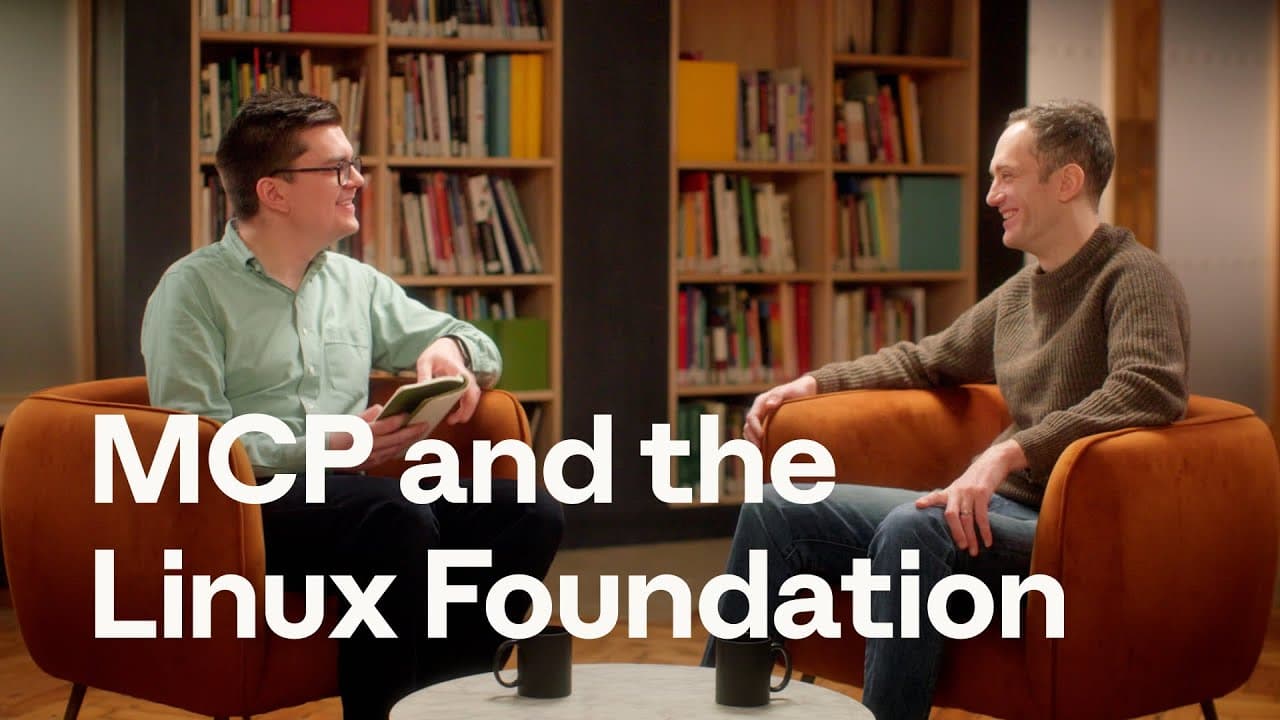
Anthropic developed the Model Context Protocol (MCP) as an open standard to facilitate AI integration with various tools and services. By donating MCP to the Linux Foundation, Anthropic ensures its continued open-source development and broad adoption, providing stability and trust for users and developers.
Transcript
MCP until you know now was owned by anthropic including trademarks and some of the code by donating it to an entity. What we effectively doing is we're you know giving the trademarks away. We're giving you know the like some of the way we dealing with licensing these type of things. A lot of the boring legal ease goes over to the Linux Foundation b... Read More
Key Insights
- MCP is an open-source standard developed by Anthropic to connect AI applications with other software and hardware.
- The protocol allows applications to connect to integrations, eliminating the need to write separate integrations for each model provider.
- Anthropic donated MCP to the Linux Foundation to ensure it remains open and trusted by all major players.
- The Linux Foundation will manage trademarks and legal aspects, preventing any single entity from altering MCP's open-source nature.
- MCP's open-source nature allows for community contributions, enhancing security and functionality through collective expertise.
- Critics highlight potential security risks and context bloat, but improvements are ongoing to address these issues.
- Future developments include enhanced scalability and richer user interfaces, promoting broader MCP applications.
- David Soria Parra values the community's collaborative efforts in advancing MCP and its open-source ecosystem.
Install to Summarize YouTube Videos and Get Transcripts
Explore YouTube Video Summarizer or Get YouTube Transcript Extractor
Questions & Answers
Q: What is the Model Context Protocol (MCP)?
The Model Context Protocol (MCP) is an open-source standard developed by Anthropic to enable AI applications to connect seamlessly with various software and hardware. It acts as a universal protocol, similar to USB-C, allowing for easy integration across different platforms and eliminating the need for multiple, redundant integrations.
Q: Why did Anthropic donate MCP to the Linux Foundation?
Anthropic donated MCP to the Linux Foundation to ensure its continued openness and to foster trust among users and developers. By transferring trademarks and legal responsibilities to a neutral entity, Anthropic aims to prevent any single company from monopolizing the protocol, thus promoting widespread adoption and innovation.
Q: How does MCP enhance AI application connectivity?
MCP enhances AI application connectivity by providing a standard protocol that allows different applications to connect to various integrations without needing to develop multiple custom solutions. This approach simplifies the integration process and ensures compatibility across different platforms, facilitating the use of AI in diverse real-world applications.
Q: What are the criticisms of MCP?
Criticisms of MCP include potential security risks, such as prompt injection and data exfiltration, and issues like context bloat, where excessive tool calls fill up the context window. However, these challenges are being addressed through community-driven improvements and enhanced protocol features to ensure safer and more efficient use.
Q: What role does the Linux Foundation play in MCP's development?
The Linux Foundation provides a neutral ground for managing MCP's legal and trademark aspects, ensuring its open-source nature is preserved. By hosting MCP, the foundation facilitates community collaboration and innovation, allowing for continuous improvement and broad adoption of the protocol across the industry.
Q: What future developments are planned for MCP?
Future developments for MCP include improving scalability and introducing richer user interfaces for more interactive applications. These enhancements aim to expand MCP's usability, allowing for more complex and long-running tasks, and enabling more intuitive interactions with AI models in various contexts.
Q: How does MCP compare to traditional integration methods?
MCP offers a standardized approach to integration, unlike traditional methods that often require bespoke solutions for each platform. By acting as a universal protocol, MCP reduces redundancy, simplifies the integration process, and ensures compatibility across different systems, making it a more efficient and scalable solution.
Q: What advice is there for developers interested in MCP?
Developers should focus on building innovative clients and servers using MCP, experimenting with its capabilities to create better products. Engaging with the community through platforms like Discord can provide valuable insights and opportunities to contribute to MCP's evolution, ensuring it meets the needs of diverse users and applications.
Summary & Key Takeaways
-
Anthropic's Model Context Protocol (MCP) is designed to connect AI applications with various software and hardware, acting as a universal standard similar to USB-C for devices. By making MCP open-source and entrusting it to the Linux Foundation, Anthropic ensures its stability and wide adoption.
-
The Linux Foundation's role is to maintain MCP's open-source status, holding trademarks and legal rights to prevent proprietary control. This move encourages community involvement, enhancing the protocol's security and functionality.
-
MCP faces challenges like security risks and context bloat, but ongoing community-driven improvements aim to address these. Future plans include better scalability and richer user interfaces, ensuring MCP's adaptability and usefulness in diverse applications.
Read in Other Languages (beta)
Share This Summary 📚
Summarize YouTube Videos and Get Video Transcripts with 1-Click
Try YouTube Summary with ChatGPT & Claude or YouTube Transcript Generator
Explore More Summaries from Anthropic 📚
Summarize YouTube Videos and Get Video Transcripts with 1-Click
Try YouTube Summary with ChatGPT & Claude or YouTube Transcript Generator